My great niece, Alexandra Kerr, her namesake–Great, great, great, great Grandfather, David Alexander Kerr (B. C1770, Banffshire, Scotland)– born this morning under the full moon and keeping with the Kerr tradition, “Late but in earnest.”
We send all our love to Sindy, Johann, Valeta, Grandparents, Aunts, Uncles and Cousins and celebrate this wonderful moment.
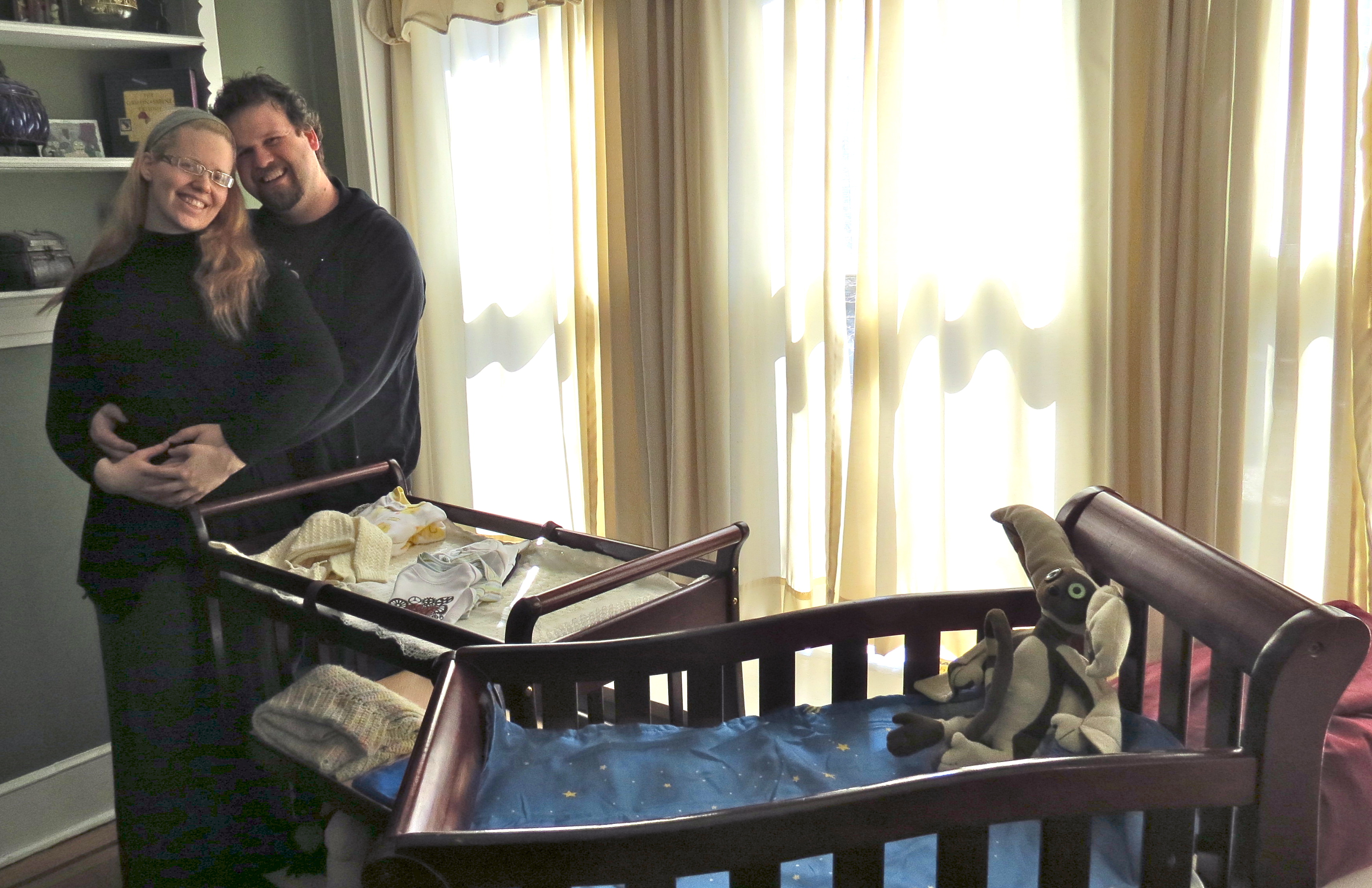
Our first grandchild is due early August so our thoughts turn to assisting our daughter, MaeC, and son-in-law, Jared, in setting up the space for the new arrival. As a yard and thrift sale aficionado, its time to see what treasures are waiting out there. Thrift store shopping requires frequent stops, but it’s possible to hop in and out quickly when focused on what you want. Because baby things are only used for a short time, most people are happy to give away what they can no longer use, so usually there’s a good selection.
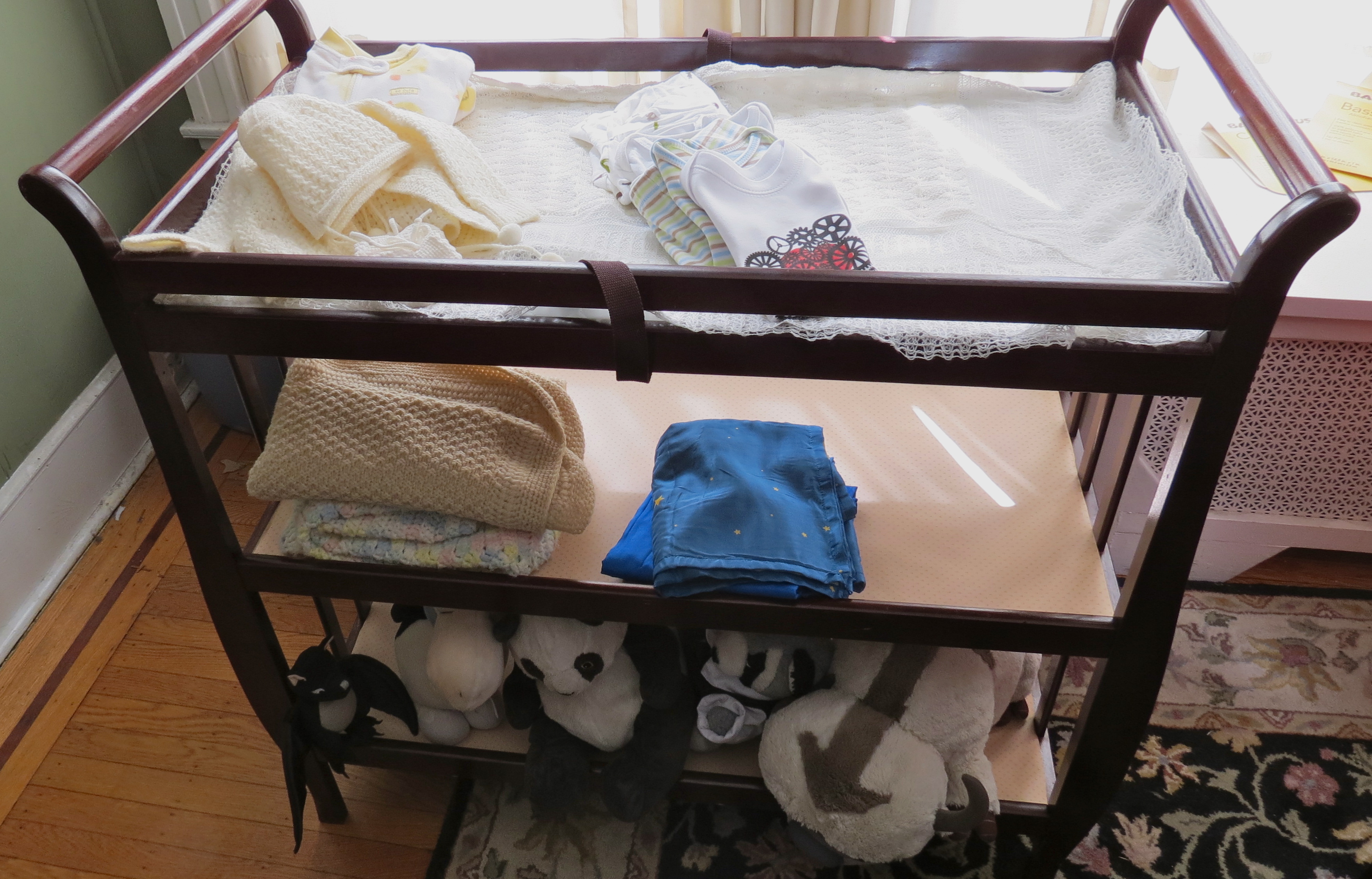
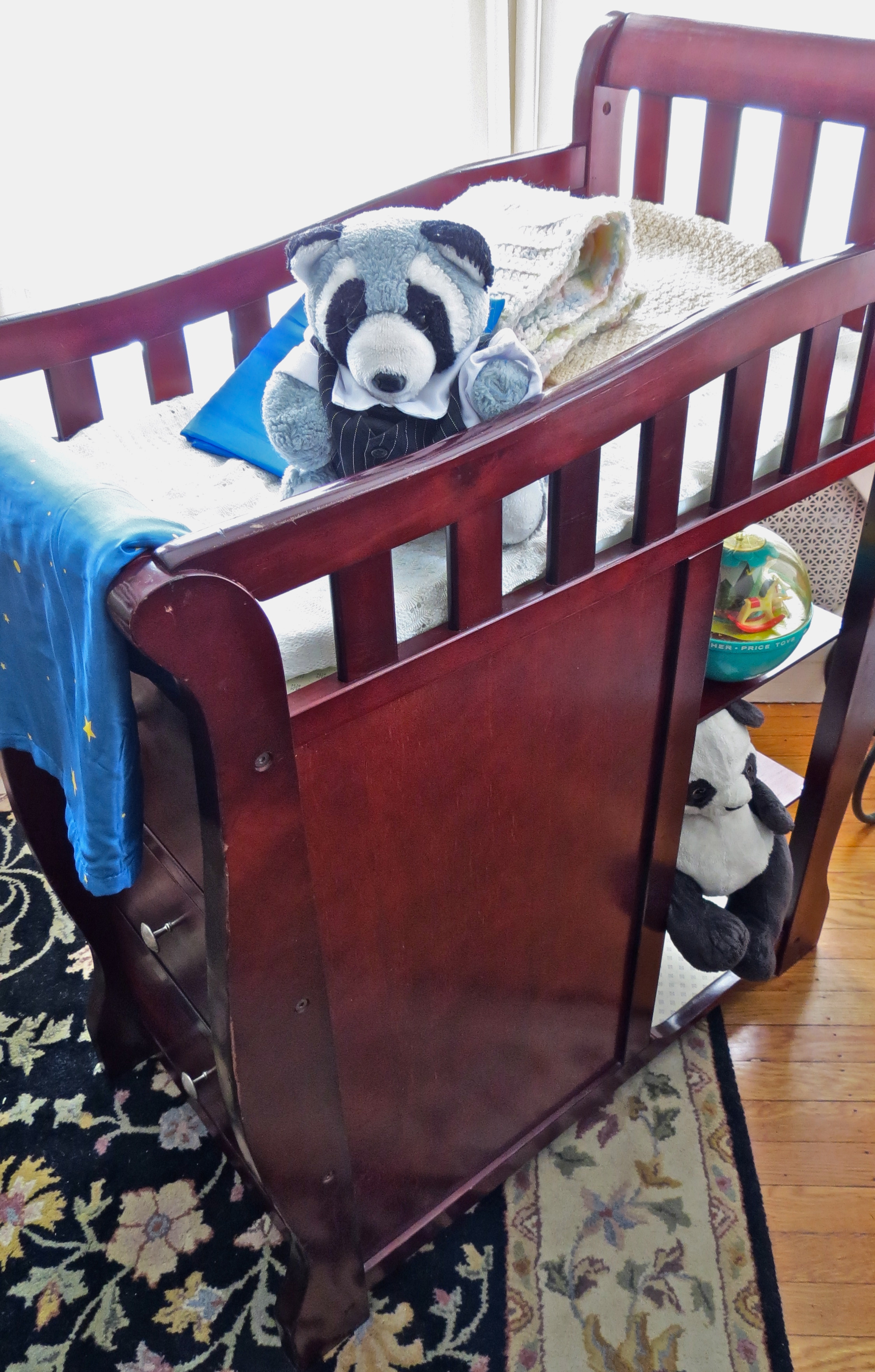
After MaeC and I checked out two thrift stores with no success, our luck changed with our third stop, for right in front of us stood two changing tables, one standard, top platform and two shelves, and a second dressing table with drawers and shelves. The two pieces matched and had a rich cherry finish. However, both were dinged up and needed a good polishing. Knobs had fallen off the drawers. Still, at ten dollars each, we couldn’t pass up the deal.
On our way home from the thrift store, we stopped by a hardware and picked up three knobs. Once at home, we started the restorations, beginning with cleaning the pieces with furniture polish, and using a furniture marker, fixing the places where the finish had worn off. The marker worked especially well with the dark wood. I’ve used these markers on furniture the cats attacked and even deep scratches disappear.
Next, we attached the knobs, which was an easy process of inserting the screw and turning the knob. For some reason one knobs was still loose, but after adding a washer on the inside of the drawer, that adjustment made the knob fit tightly.
The shelves, spotted and stained, gave the pieces a poor appearance. We had two choices: to paint the shelves or cover them. Since I had saved leftover wallpaper, we decided to cover the shelves.
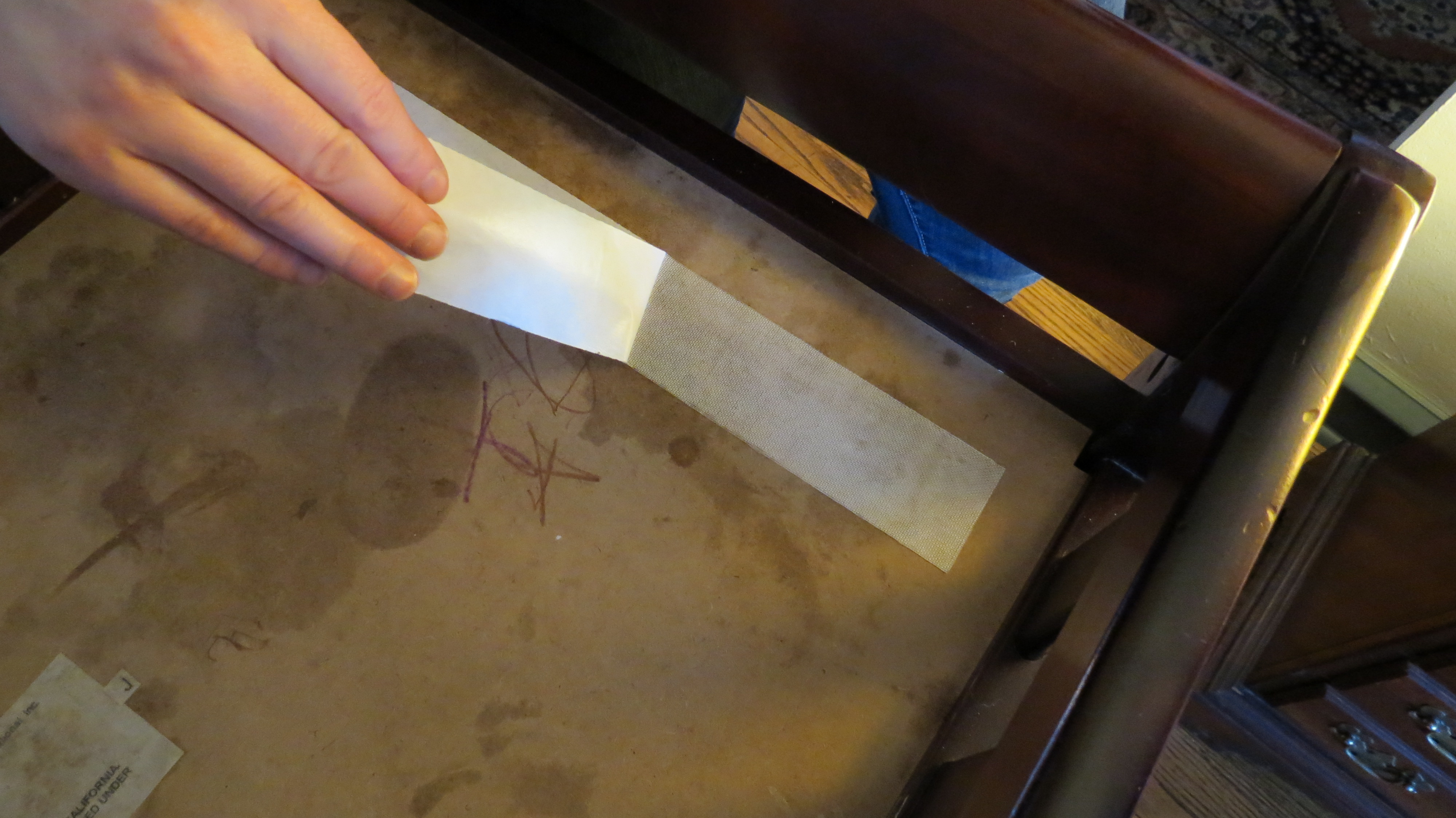
We went up to the attic to retrieve the rolls, selected two and then began measuring. Double-sided carpet tape worked great for affixing the paper to the shelves.
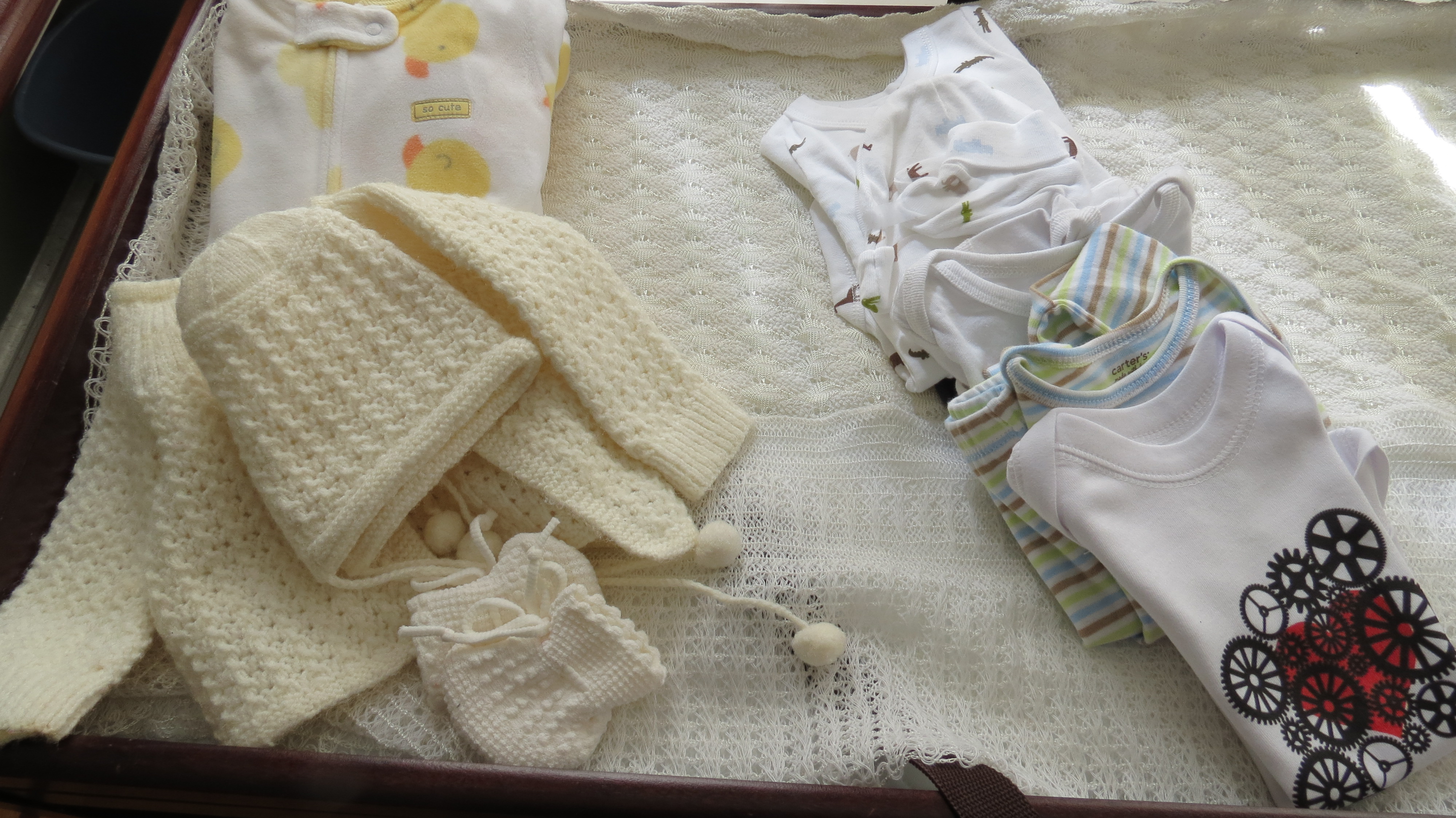
In keeping with our recycle up, I returned to the attic to find the clothes and blankets I had saved from the children’s baby days. After washing them up and air drying, the baby items were ready for storage in the changing table.
Jared’s mother, Gwen, sent along some new baby clothes. A little steampunk shirt rests alongside of the knit hat and sweater MaeC wore on her trip home from the hospital all those years ago. Gwen also sent two handmade blankets and stuffed animals from Jared’s childhood.
MaeC and I had a great time fixing up these pieces and spending time together working on this project. Adding the finishing touches, all we need now is the baby!
When I was six years old, my mother took the family to see the movie, Lili, released in 1953. My mother purchased the sheet music from the theme and would play the song on the piano, singing along. I remembered liking the song, too, and we’d talk about the movie.
The central plot of the story centers around Lili, a young woman left alone, and finding her place at a carnival. She falls for a magician, who rebuffs her. Thinking that all is lost, Lili contemplates suicide. Paul, the lame puppeteer watching her from afar, draws her into conversation with his puppets. Paul hires Lili as part of his act, and her innocent and sincere interaction with the puppets becomes an instant success. Although Paul falls in love with Lily, he is unable to express that love except through the puppets. After an argument, Lily leaves. As she wanders down a long road, the puppet images come alive in her imagination. Through dance, Lily realizes that Paul is the puppets, and she rushes back to the carnival.
Leslie Caron plays the part of Lily, who I remember as most convincing as the naïve girl finding her way in a harsh world. Her brimmed hat and sweater with the lace collar convey a sweet innocence. The photograph below of my mother taken in 1945 reflects style similarities of the time.
My Mother 1945
The expression of love through the puppets stayed with me long after my mother stopped playing the song. I came to believe that showing kindness, but from behind the scenes, made that moment magical. Elements of reality and fantasy co-mingle and mimic the puppet master and the puppets. Everett Ferguson wrote on the modern perspective of magic, which is a result of a universal sympathy.
The laws governing these connections may be unknown to most of us, may be hidden even from the magician; but it is in virtue or organic, natural, that magic works.
Where this all becomes interesting is understanding the effect of movies on children especially as an intersection to their parent’s reactions to the same film, which supports or negates the child’s experience. The borderlands between reality and fantasy are part of all movie-going experiences. While the movie Lilycaptured my imagination, I’m somewhat convinced that my mother’s influence played into my remembrances and taking in elements of the film personally.
I’d be interested to know if others connect to films through some aspect of their parent’s reactions. Let me know.
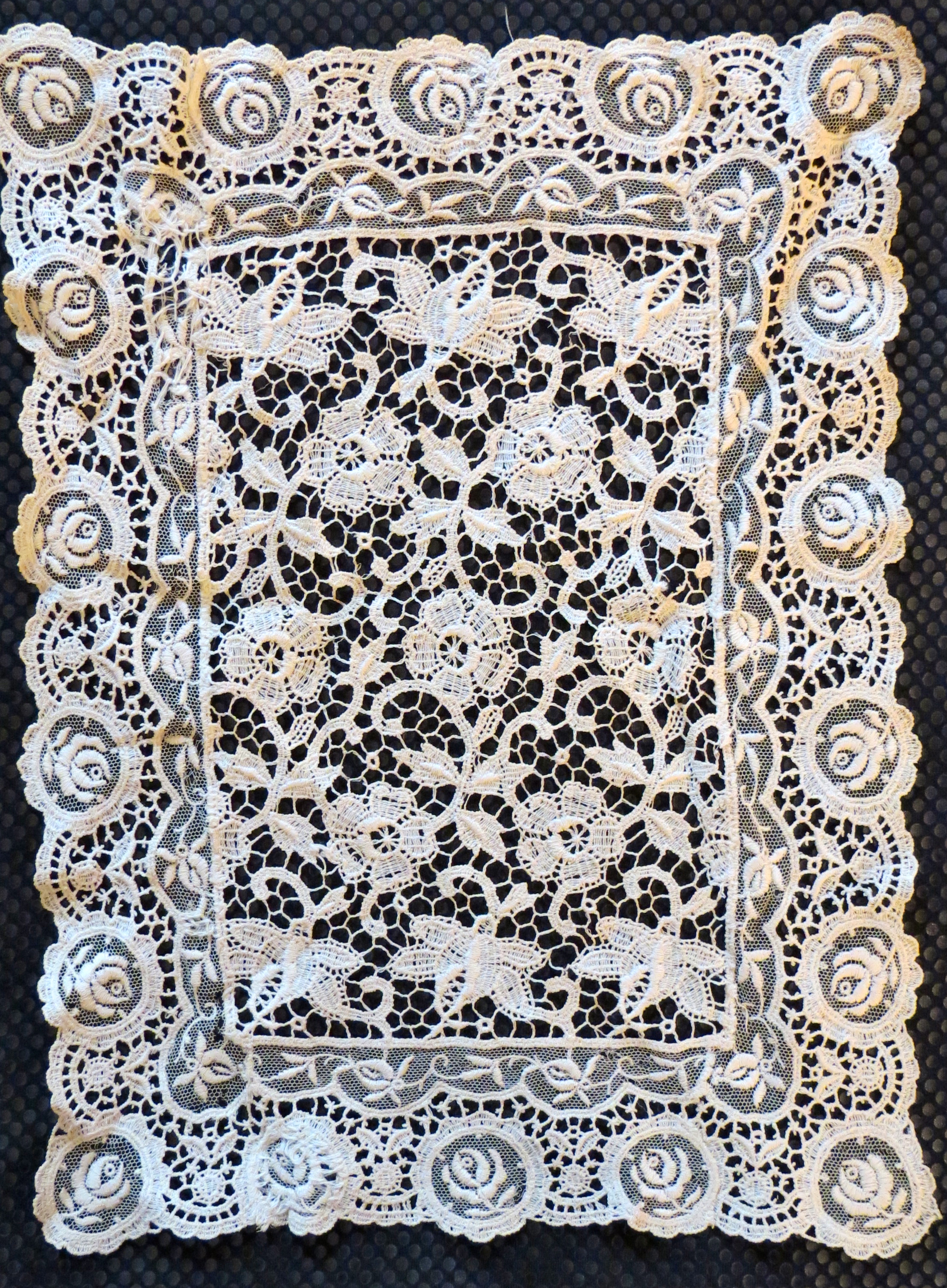
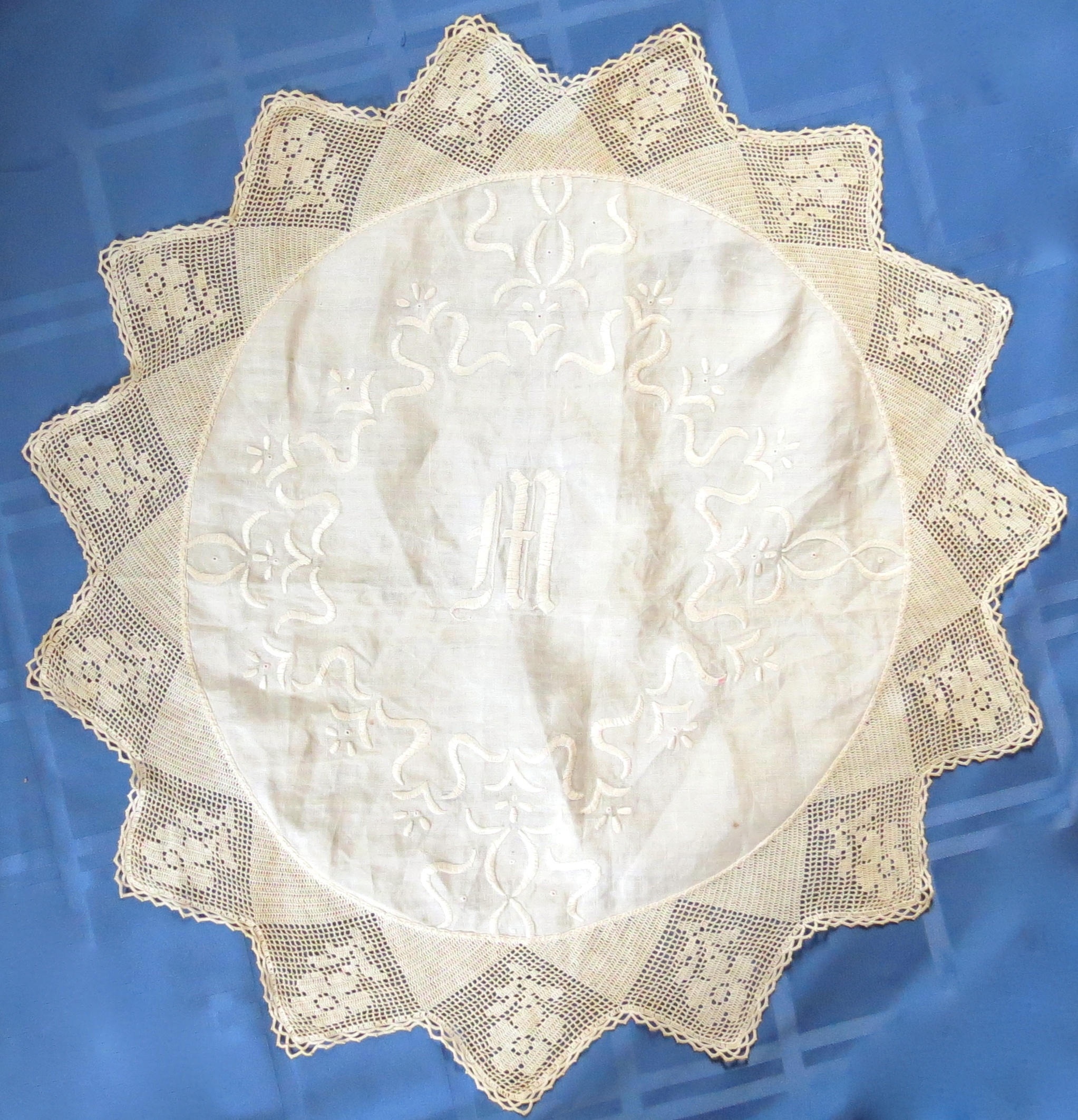
Years ago my Mother gave me my Grandmother’s needlework from the early 1900s. Linen tablecloths, napkins, handmade doilies, place mats, coasters and other assorted pieces remained in a disheveled pile in the attic for years. Occasionally, I would pull out a doily or bureau scarf to use around the house, but with so many pieces to choose, most were left untouched.
I could not find much information on the history of crocheting, needlepoint and embroidery as part of women’s lives around the turn of the 20th Century, although some sites did have information on quilting. Many sites sell patterns and vintage embroideries, but I found little information on women’s specific part in the history of these skills. On the website Crochet Insider, an article states,
In the United States, there is virtually no written history of crochet. Of the few books providing historical treatment of crochet, only one had a portion dedicated to American crochet history. Denise Levoie
To reexamine these pieces of art became my goal. Listed below are five issues that I faced and solutions to those problems.
1. Overwhelming quantity. I couldn’t figure what to do with so many items, and stains and disrepair characterized many of the pieces. I couldn’t just throw them into the washing machine so I thought it best to leave them until I could figure out the proper washing.
Solution: I sorted the pieces into categories, deciding which pieces could be given away, saved and restored. I planned to make a collage of the needlework for each female member of the family. With everything organized, each piece then became its own unique piece and its value more readily apparent.
Crochet: Pineapple Pattern
2. The question of utilitarian value. How does one find a use for a doily? I can see how they could be used as furniture protectors, but modern glass and plastic glass holders work better. For modern decor, a lace doily just doesn’t fit. Certainly, having a linen tablecloth with a crocheted edge is beautiful, but washing a vintage tablecloth frequently probably is not wise, running the risk of ruining the fabric.
Fan Quilt
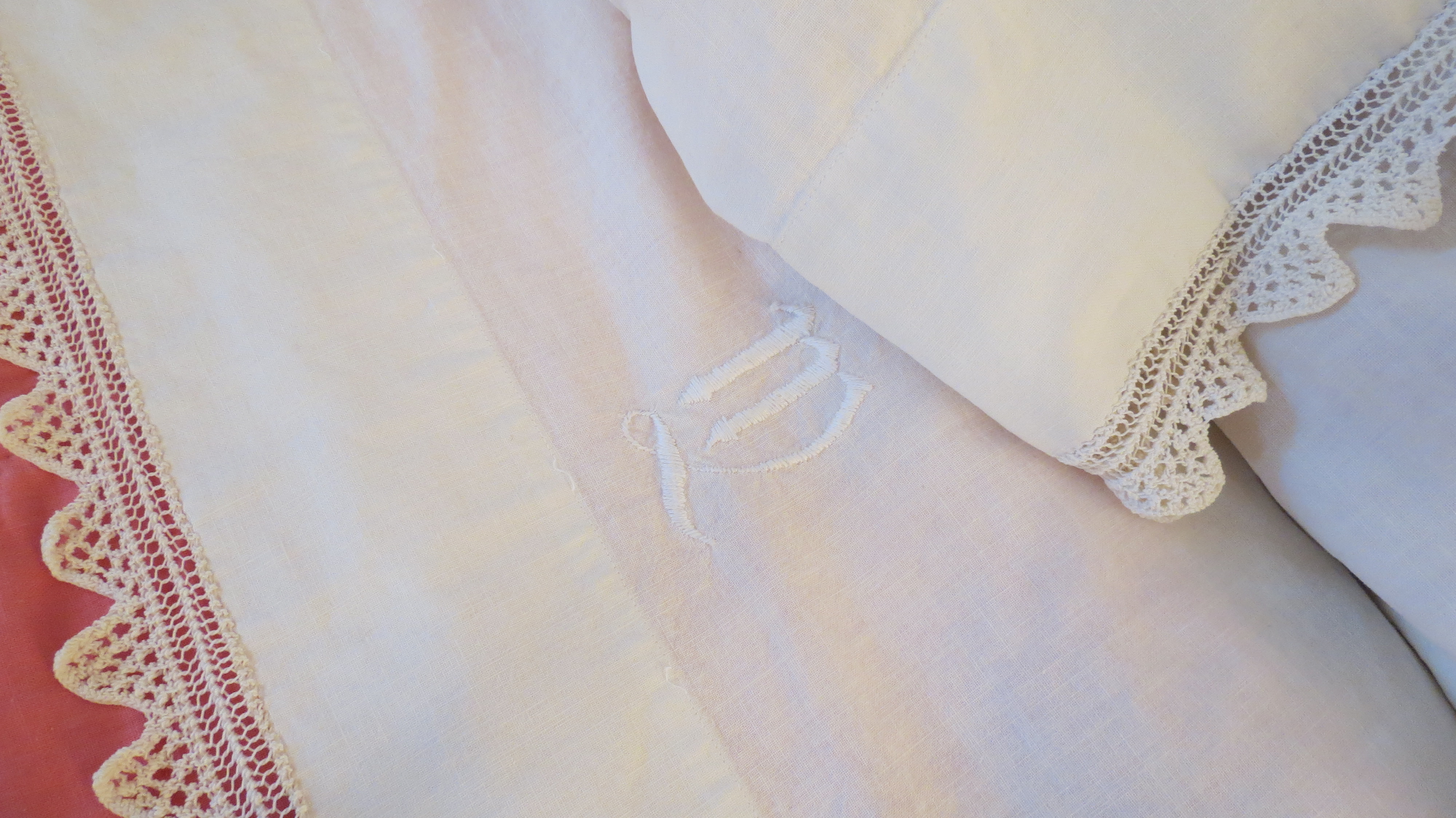
Detail: Crochet on sheets/pillowcase
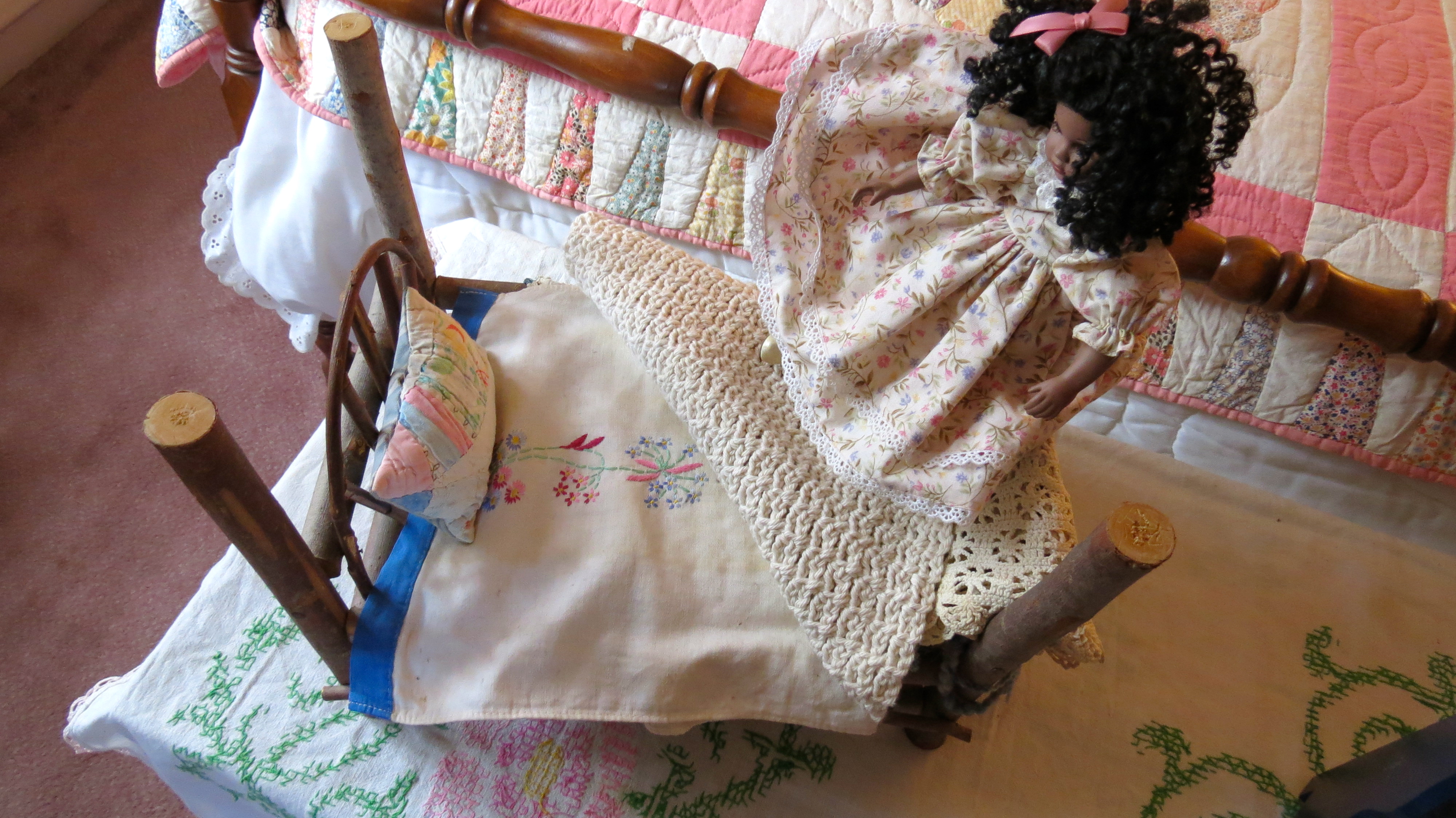
Solution:I decided to go “shabby chic” with our guest room. I bought furniture at thrift shops and resurrected some pieces from the attic. The doilies and quilts worked well in the room. I carefully washed the sheets and pillowcases and put them on the bed. I used some of the smaller pieces as blankets in a doll’s bed.
By the 1920s the color of fabrics changed as women began to prefer pastel and light color schemes. I would date the quilt above from that time period. Quilting was transforming from a utilitarian craft to an art form. Art has a greater positive connotation than craft, but is this the result of our culture’s elitist values? Should we reject the art classification, which in some ways diminishes utilitarian value? I could argue that these creations are decorative, and, therefore art, as the practical use has almost completely disappeared due to the delicate nature of the fabric and needlework.
3. Generational distance and missing the oral history.These pieces came from my father’s mother, who had passed away long before I was born. My mother’s mother had no such collection. She came from the tenements of Clyde Bank, Scotland, raising eight children on poverty wages. According to the Internet, women who had some free time were able to work on needlework projects. Although her husband was an auto worker, Mae Kerr did not work outside the home, allowing her time to crochet and quilt.
On a cursory inspection, the pile of linens seemed amorphous . . . sort of lacy stuff, I would call it. Was it lace–crochetted, knitted, or embroidered? Were the threads silk, linen or cotton?
Crochet on Apron
Solution: Research on the Internet provided information on the various needle crafts. I was able to identify the quilt patterns my Grandmother used. I also spoke with several women who could tell me about the different styles, sewing techniques and fabrics. After some investigation, I now have some familiarity the terminology, such as the various kinds of laces, tatting, needle point and white work, just to name a few.
Tatting
4. Lack of appreciation for women’s artistic contributions. As a student, I studied the great works of art, especially painting and sculpture, but fiber arts, especially as practiced by women, was seriously neglected in the artistic cannon of works. In the mid-1990s I enrolled in an art history course at Swarthmore College with Michael Cothren, and for the first time, read an academic article on the artistic merits of quilts. Museums display quilts in huge frames, which I found somewhat disconcerting as that removed the context of the bed and bedroom from the display. Does anything make a room look more cozy than a quilt on a bed? The Alliance of American Quilts established their mission “to document, preserve, and share our American quilt heritage by collecting the rich stories that historic and contemporary quilts, and their makers, tell about our nation’s diverse peoples and their communities.”
Solution: Learning more about fabric art assists in understanding this art form. A good article I can recommend is “The Distinction between Art and Craft” by Sally J. Markowitz. Websites I found helpful:
By sharing my Grandmother’s needlework on the web, I hope that I can contribute, in some small way, to an appreciation of these artistic creations. Women’s International Day stands for decent work for women. With the focus on that goal, we must ensure that women, whether working outside or inside the home, have time to pursue self-expression. Frantic work schedules that press on a women’s free time and low wages that demand that women hold two or three jobs works against the common good, depriving our culture of untapped invention and creativity.
Really. I’ve never experienced anything like this. The only sensation I get from food is texture, and I have become keenly aware of those variations. A crouton crunches down to what resembles saw dust. A cherry tomato squirts a flavorless liquid. Rice pudding has a creamy feel with lumps. Spinach, well, basically, it’s just about eating leaves.
Of course, I Googled the problem, but the causes didn’t match. Radiation to the mouth, no; tooth decay, no; acid reflux, no; aging . . . .well, maybe, but this lack of taste came on rather suddenly.
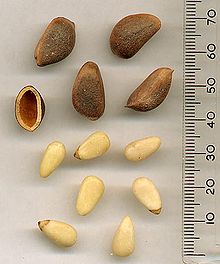
Several days went by; I Googled again with the word “aftertaste” as now I seemed to be experiencing a metallic taste. Again, none of the causes seems to fit. One site mentioned the effects of eating pine nuts–metallic after taste. But I hadn’t eaten any pine nuts. I checked with my husband who is the cook in the house. “We haven’t had any pine nuts in the last several days, right?”
“Oh, yes we did–last Thursday I poured the entire package into the spaghetti sauce!
I was combing through our home videos from the mid-1980s and came across this game that the children played at one of our birthday parties. Musical chairs started as the game concept but with a twist–while still taking away a chair, all children stay in the game as they “share” the remaining chairs when the music stops. Rather than being excluded one by one, all the children can enjoy the entire game and no losers! Did the kids like this new version? Video tells the story.
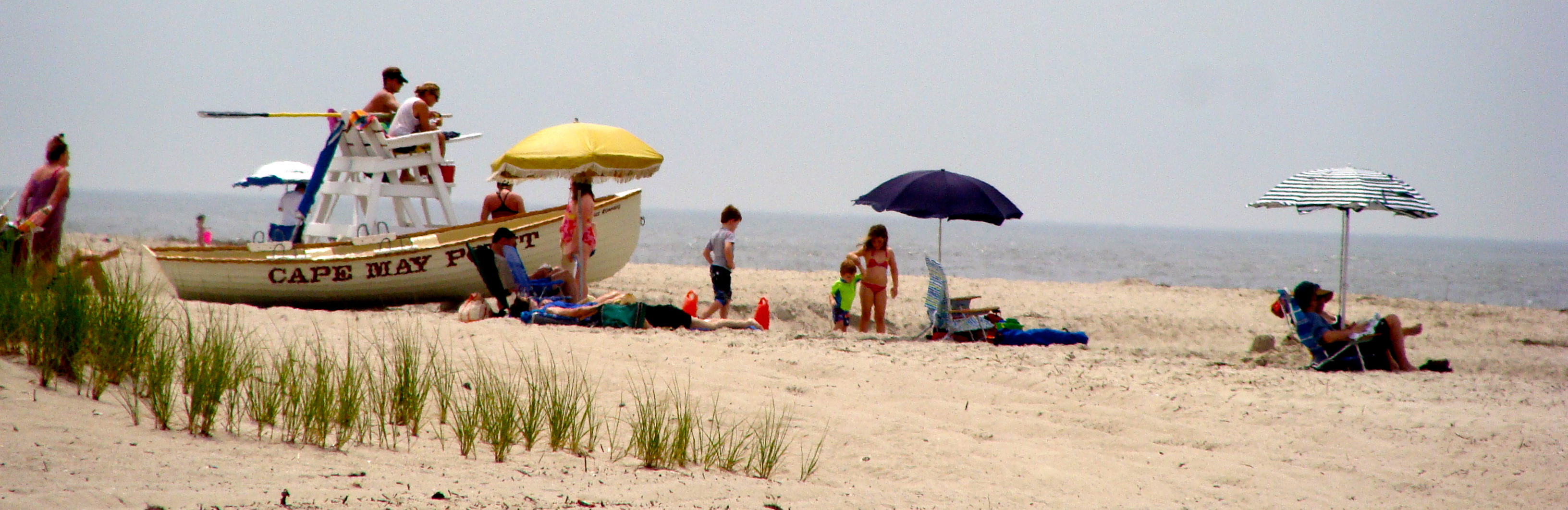
After twenty-five years, we have finally started to digitalized our home movies. Watching one of these videos of our children playing with their cousins on a vacation at Cape May Point, New Jersey, has left me reflecting on unconscious imprinting on our children.
Our children saw us with our cameras almost everyplace we went. As the video shows, we even took pictures of us taking pictures! I didn’t realize the impact all that photography might have had on the children until I viewed these home movies. In the last clip in the video above our daughter says, “I want to do what you’re doing, Daddy.” At six she knew that her parents liked their cameras. Is it just a coincidence she became a professional photographer?
What about her cousin, James who became cinematographer by profession? The videos on the beach show that his Daddy had a telephoto lens for his camera.
Now as adults all the children use photography in one way or another.
Parents model many things, but what seems to stay with kids are those activities which they see as bringing their parents the most joy.
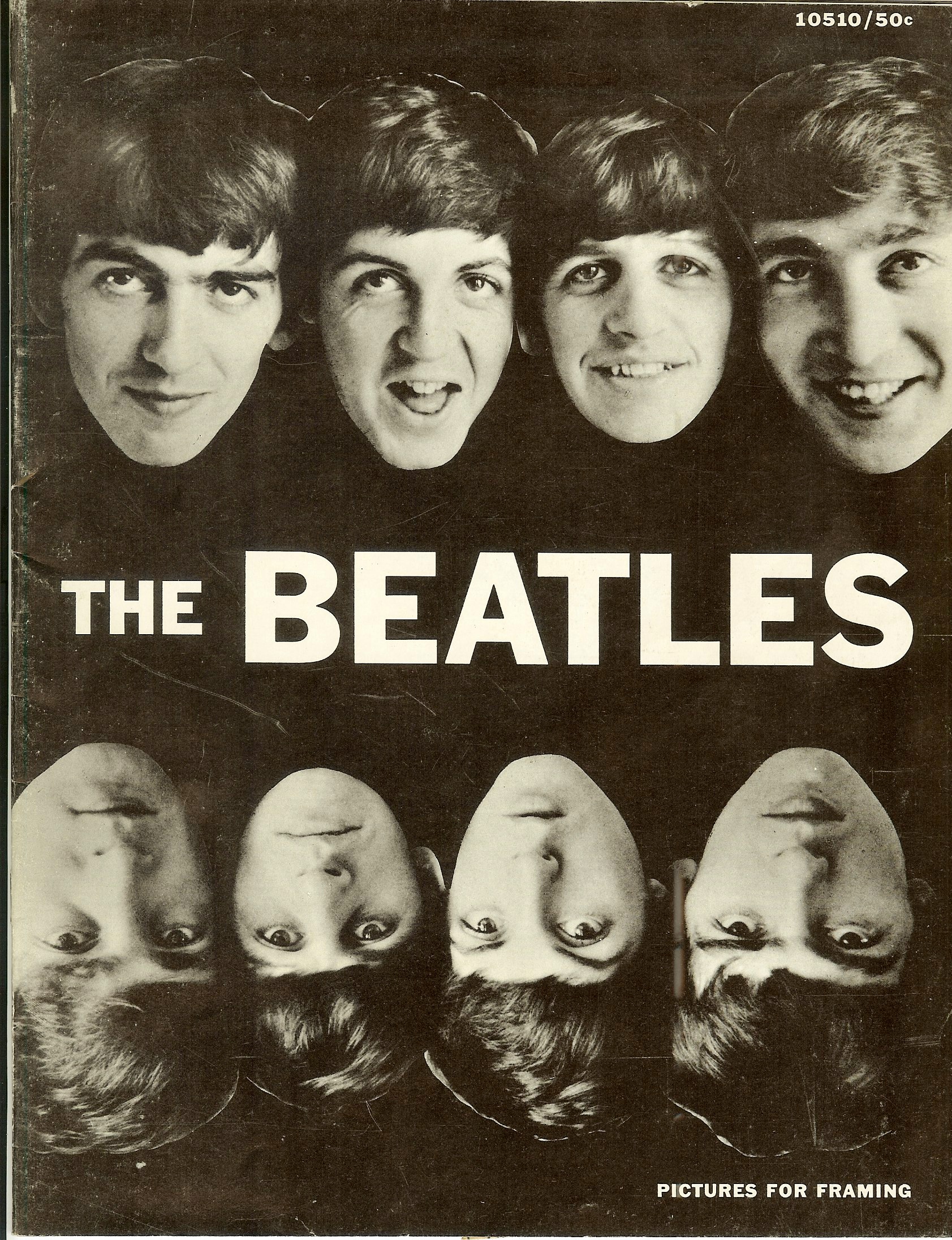
Awe-struck best describes my reaction on seeing the Beatles for the first time on “The Jack Parr Show” during a wintry evening in January 1964. Parr had intended the short video as a humorous anecdote about a British rock band and their astonishing popularity. The clip from that show exists here on YouTube. The music instantly set the standard for originality, fresh and energetic with a rhythmic pulse. Their expressive singing conveyed true sentiment. I suppose some critics might argue that the song in that clip, “She Loves You,” is cliché, but a close examination reveals otherwise. The lyrics, written in the third person, resemble a conversation about love. These young men from Liverpool defended love and sang about fairness, and that was very romantic. They offer wisdom and reconciliation, “Pride can hurt you too. Apologize to her.” Their performance package was perfect. Growing up in the era of crew cuts, the lads’ longer hair had instant appeal–a break from the uniform haircut that almost all males had at the time. Criticized and mocked by the Establishment, the Beatles‘ hair cut was considered as radical as was their “yeah, yeah, yeah.” To us, they just looked fabulous; and we admired this rebellious response to the status quo.
The Beatles transformed two teenagers from the suburbs in style as well as in mind. Before the Beatles:
and after:
I immediately connected with British culture and their representation of working class youth: Liverpudlian accents, collarless fitted suits and urban lifestyle. The Cavran Club tucked in a cobbled ally of Liverpool, provided that gritty, smokey backdrop that served as their performance home and became my imagined refuge from the suburban pabulum that surrounded us. Their place in the world was so foreign from my life. They lived on the edge of the wharfs and warehouses and played music in ally way cellars, while I remained safely planted in the middle of a suburban protective cocoon. I studied the geography of their city, intrigued by the River Mercy, the docks and ferries. The Beatles, humorous and irreverent, seemed fearless. They would find themselves in trouble because of their candid and unaffected remarks; but for their fans, they became that much more endearing. We admired their forthright approach to life. Aware of their way in the world, more than anything I wanted to be part of that scene.
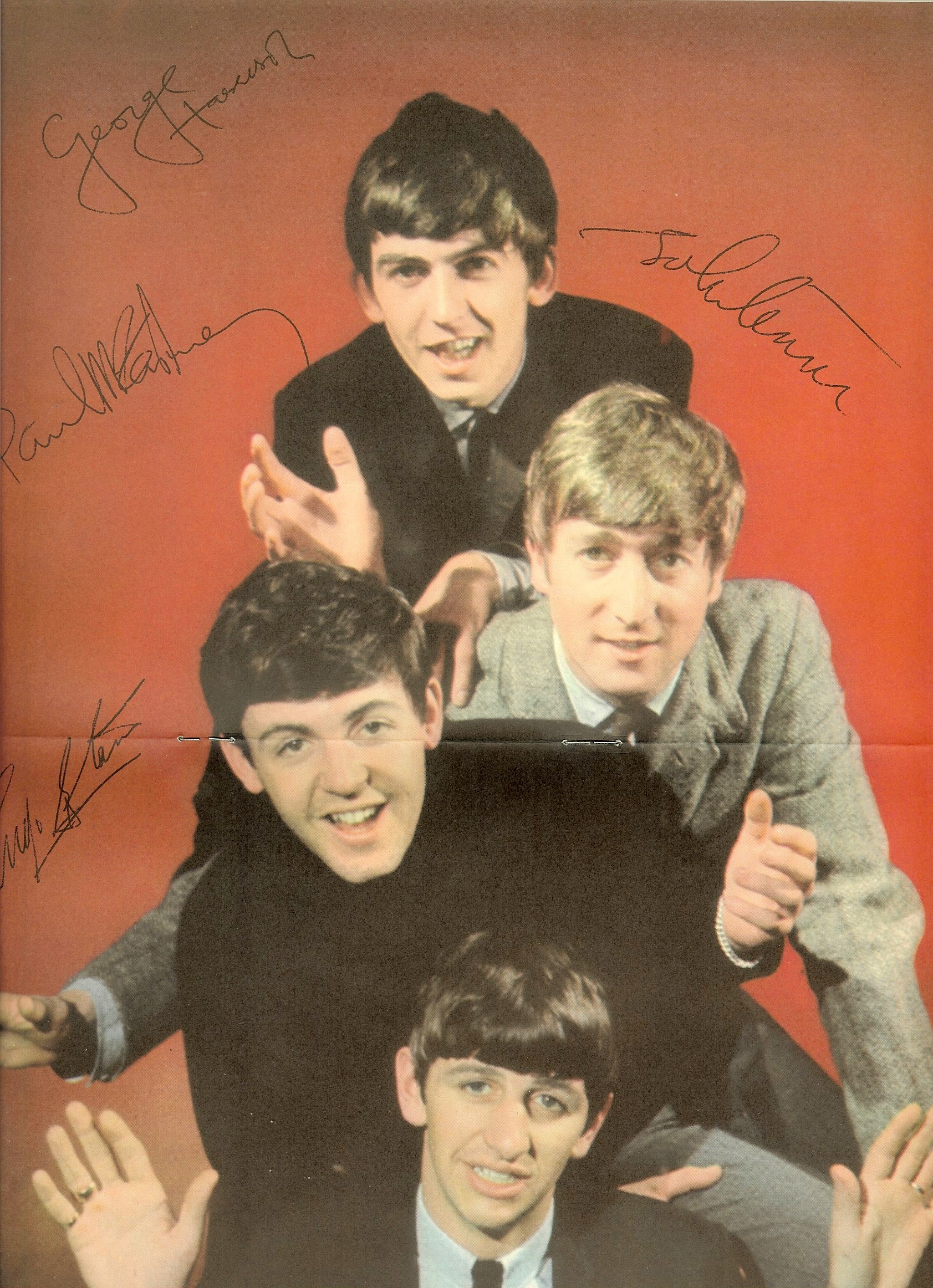
So we bought their albums, in addition to fan magazines, posters, trading cards, which offered a way of transporting ourselves into a time and place we could only experience vicariously.
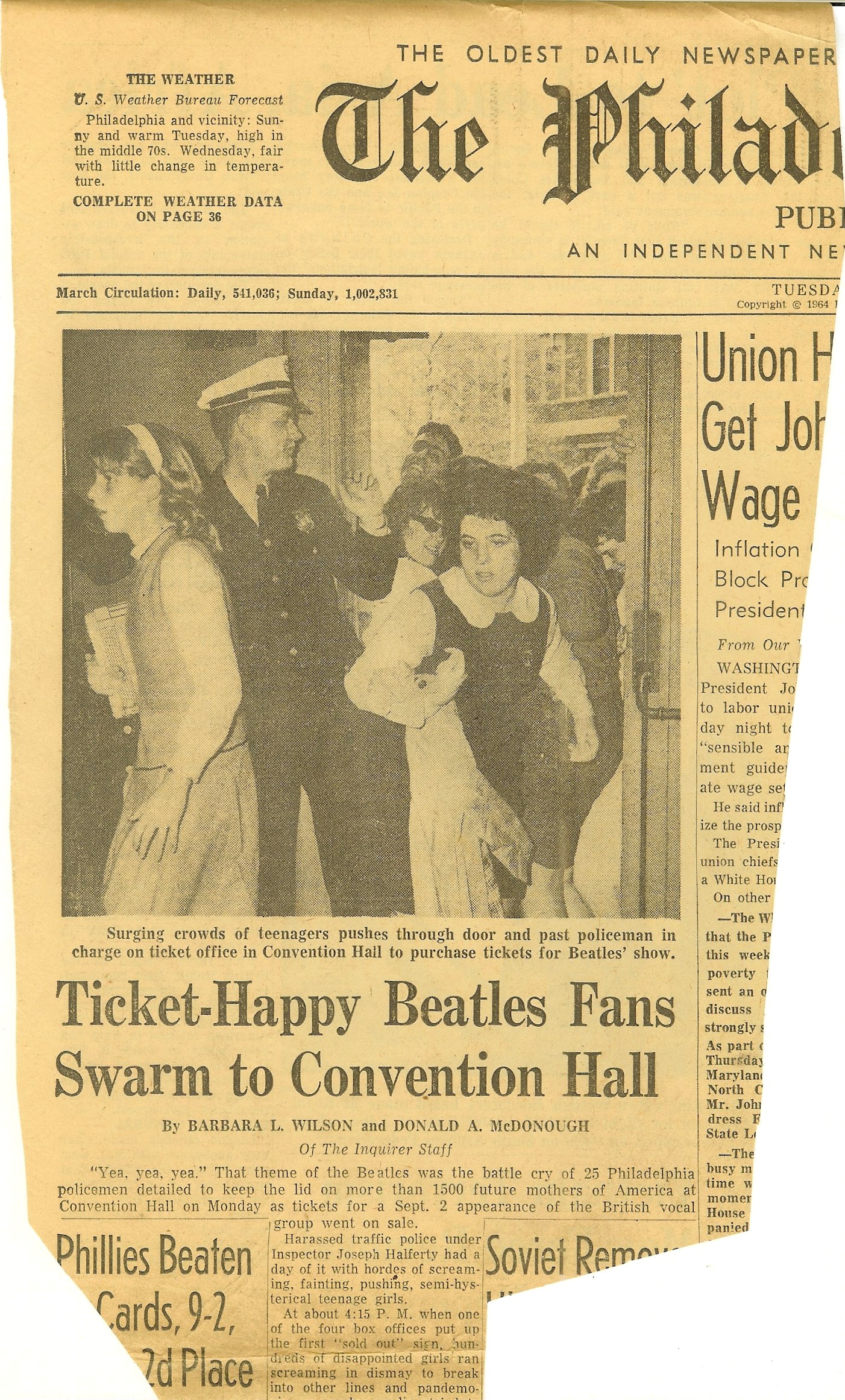
When the Beatles announced they would be performing in Philadelphia, we left school early and raced down to the Convention Center to buy tickets to their concert. We waited in line for hours, pushed and shoved as fans surged toward the doors. The police regulated the flow, but the crowds outside pushed against us as we waited our turn to pass through to the ticket booth. I finally squeezed through an opening, and just as I fell out of the crowd, a newspaper photographer snapped a picture, which turned up on the front page of the Philadelphia Bulletinthe next day! I’m the one to the left looking somewhat dazed after being crunched by the surging crowds. About 12,000 tickets were sold that afternoon in just 85 minutes.
We were thrilled to attend the concert, and although we had seats in the back of the Convention Center, it didn’t matter because once the Beatles appeared on the stage, fans surged forward streaming down the aisles and through the chairs. The wooden folding chairs provided standing platforms, some girls standing on the back rim of the seat. We never heard a note of the singing–the screaming was so loud. Cameras flashed steadily during the entire concert. None of that mattered; we were with the Beatles.
A Letter from Peter
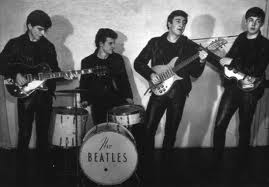
Peter Best, the drummer who preceded Ringo and played with the Beatles for two years, appeared on “I’ve Got a Secret,” a popular game show of the 1960s hosted by Garry Moore, on March 30, 1964. (YouTube clip here.) I was very much impressed with Peter as he had his own band but felt sorry that he had missed the opportunity to stay with the Beatles. I decided to write him a letter and began researching ways in which I might make contact. I phoned the “I’ve Got a Secret” show, and they suggested sending the letter to The Peter Best Four in care of Decca Records.
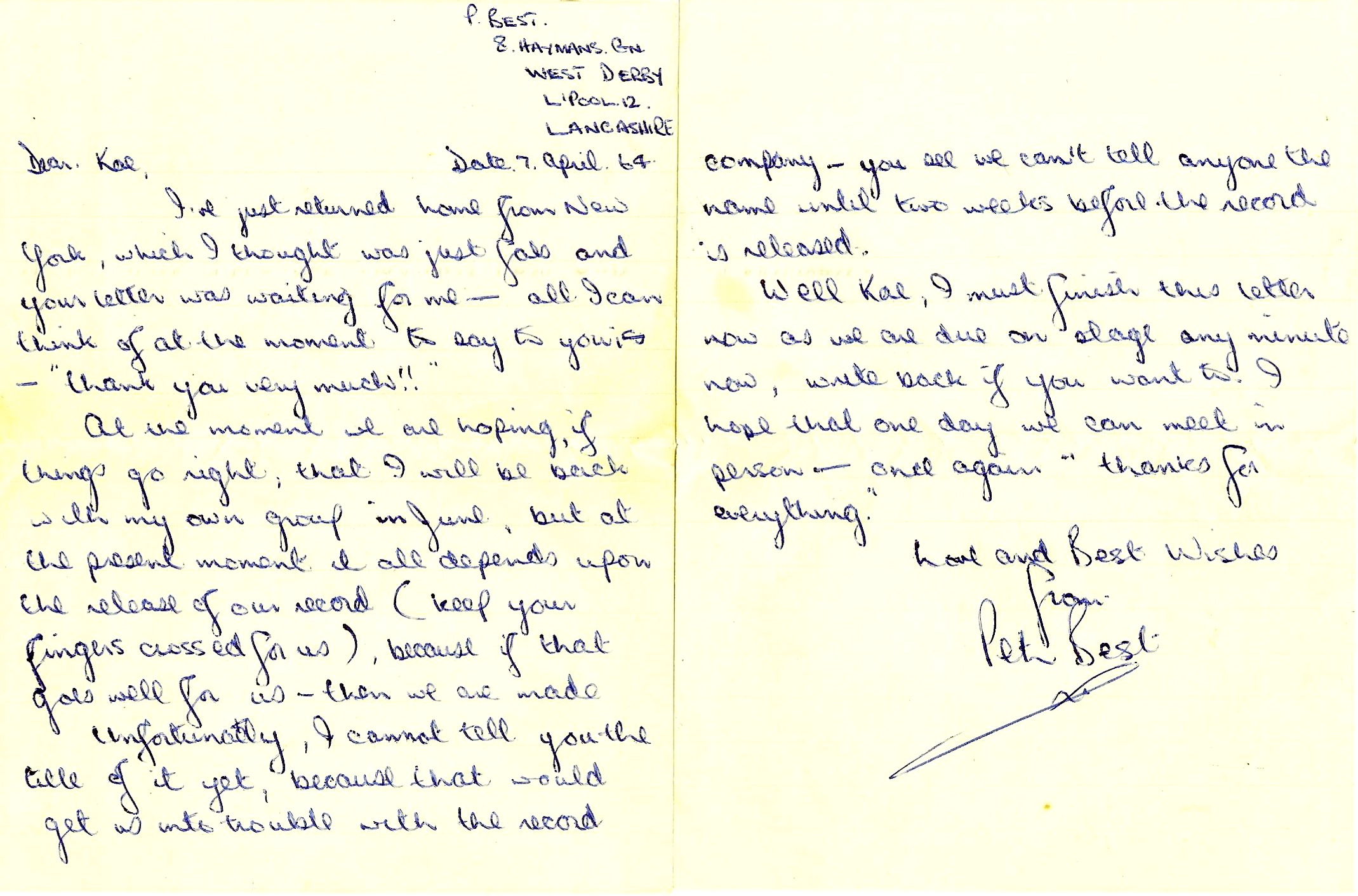
Two months went by when one day I was surprised to find my mother standing outside of my algebra classroom. I couldn’t imagine what had brought her there until she handed me the letter from the United Kingdom. Pete Best had written me back!
Post-Beatlemania Analysis
Our culture never had much respect for teenage girls for many reasons. We were “little women,” and society didn’t even respect mature women. In the early sixties, careers and opportunities for women were still limited to a few fields. My mother assigned my sister and me our occupations: teacher and nurse. Of course, screaming at rock stars didn’t help the status of teenagers in the eyes of the Establishment, but I now have an understanding of that enthusiasm that bubbled over: teenager girls were heralding what turned out to be one of the most influential bands in this history of music. The Beatles‘ music remains a powerful contribution to the musical canon, having sold over one billion albums throughout the world.
The Beatles profoundly influenced the culture, everything from movies and fashion to the introduction of eastern philosophy to the West. Some have speculated that pop culture changed the way Russian youth perceived the West, dissipating the propaganda of English/Americans as being the enemy. Individually, the Beatles contributed to progressive causes: George’s Concert of Bangladesh, John and Yoko’s peace campaign, Paul and Linda’s advocacy for animal rights.
Prophetic young women, teenage fans from those early years recognized that the Beatles brought hope, change and happiness through music, which is understandable and reasonable. Our unified voices, unfettered from society’s control, expressed an outpouring of jubilation and appreciation. Sophisticated behavior in the eyes of the patriarchal society, probably not, but heartfelt, truthful and joyful, most certainly. With a love like that you know you should be glad.
About twenty miles from the Chesapeake Bay Bridge Tunnel, we turned right from Route 13 to Route 184 to explore the bay side town of Cape Charles on Virginia’s Eastern Shore. For many years the town had been the terminal of the Little Creek Cape Charles Ferry, which provided car ferry service to Norfolk and Hampton. Now an expansive beach runs the length of the village. Many of the homes date back to the early 1900s, and the town center has a distinctly small town main street.
Upon leaving the town, we drove by the filling station pictured above. A sale sign poked out of the tall grass. Even in the state of disrepair, the little building conveyed a charming ambiance so we stopped to take a picture as it seemed that its future was somewhat precarious.
After some research, I learned that during the 1910s filling stations were fairly standardized, but beginning in the 1920s oil companies began pushing to make their product easily identifiable, leading to a variety of architectural styles for their stations. In 1926 the English cottage design became the trademark of the Pure Oil Company. These quaint cottage buildings were intended to appease neighbors, as unsightly gas stations were considered an undesirable addition to communities.
The Pure Oil Company painted their stations white and topped their steeply pitched roofs with characteristic blue enameled terra-cotta. Arched entrances, bay windows, ironwork and sometimes flower boxes gave these structures a Tutor look. Only the pumps out front identified the building as a service station. Carl A. Peterson, responsible for the design of these stations, became head of the Design and Production Department for Pure Oil in the mid-1920s. The company continued to use his design until just after the Second World War. Some of these stations have received historical designations, such as Freitag’s Pure Oil Service Station; but unfortunately, most have been torn down. In Wilmington, Delaware, a monument to Peterson’s work stands at Market and Seventeenth Streets, on the edge of the historic district.
Phillips 66 and Cities Service stations adopted variations of Peterson’ popular style. Standing by itself, one of these stations still remains on Route 30 in Devon here. I’ve seen two others in the Philadelphia area, one in West Philly on the corner of Whitby and 52nd Street and another, converted to selling Italian ice, located in Upper Darby on Garret Road.
The Pure Oil Company has another local connection. Securing its name in 1895, the company finished its crude-oil pipeline from the Pennsylvania oil fields to deepwater terminals across Pennsylvania. In 1901 before the pipeline was completed, the company built a refinery at Marcus Hook, PA, to process the company’s crude.
What triggered my nostalgia for this filling station is that my mother worked for a time in an office in a gas station that had similar architecture. Located near the corner of City Line and Lansdown Avenues, we would often drive by the station; and my parents would remind us of Mom’s time there. I always admired the structure with its rust-colored tiled roof and rounded door. The station has long since disappeared from the landscape, but when we drive pass that corner, the ghost of the building still stands in my mind.
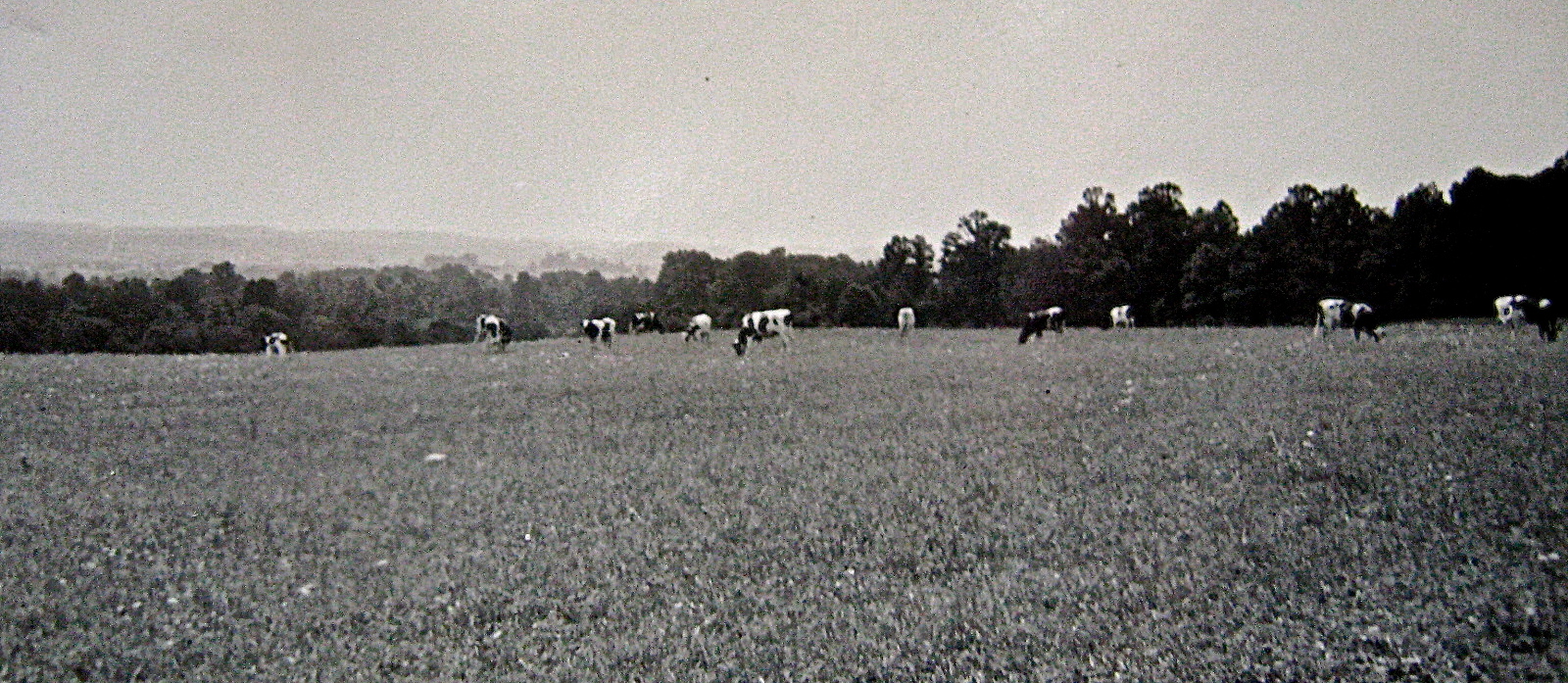
When Springfield was founded in 1686, most of the residents were farmers. In the 20th century, developers bought up most of this farmland, and our little neighborhood was carved out of the land for the growing post-World War II population.
Farming in Springfield c1930 from the Collection of Joan Gripshover
Fall 1950, A Neighborhood Emerges
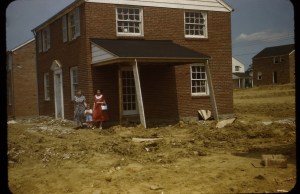
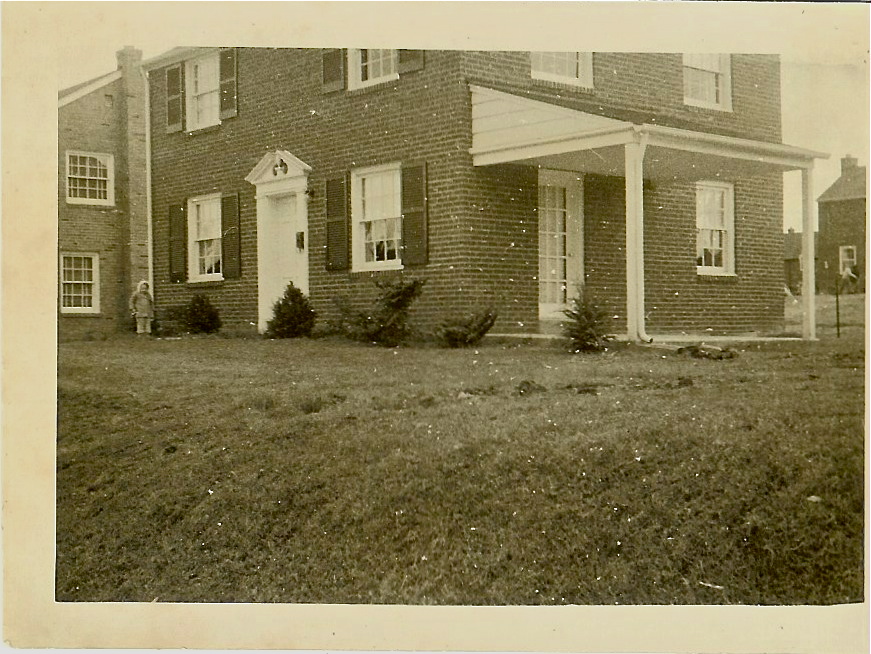
Memories of my childhood began to focus when my parents purchased a house on Briarhill Road, Springfield, Pennsylvania. Most of Springfield had been farmland, but the demands of the baby boom generation changed the landscape as families began to look for housing in suburbia. Woodview Farms, the name given to the three streets in the development (Briarhill, Wheatsheaf, and White Oak) formed a circle with one flat side, the hill at White Oak. The developer flattened the land, leaving only a few older trees here and there. Our home was the fifth one up on the left side, purchased for $11,500. My parents paid an extra $500 for the side porch. About 2 1/2 years old, I’m standing next to Mom, a few months before she delivered my sister in October. Mom, drawing from her Scottish legends, always believed they would have good luck with this home, as a cricket greeted them on the steps.
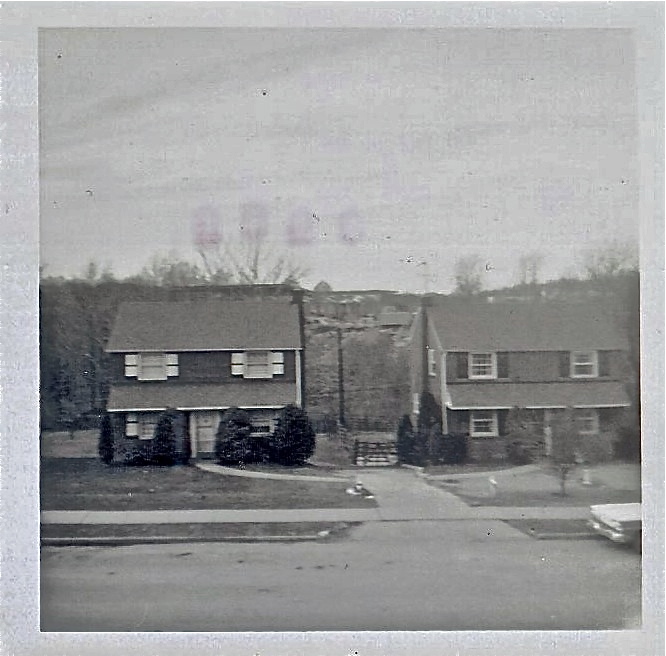
These houses were typical of the box colonial style that builders relied on for quick production and ease of construction. Local ordinances required that the builder vary the styles, at least slightly. Some houses were painted white, and some had patios or porches on the front or side. The houses on White Oak had garages built into the front. However, many construction-related problems surfaced fairly quickly for the new residents. As a result, the neighborhood established the Woodview Farms Civic Association to address their grievances collectively. Later, the Association served as a social organization, planning 4th of July parades and other celebrations within the community.
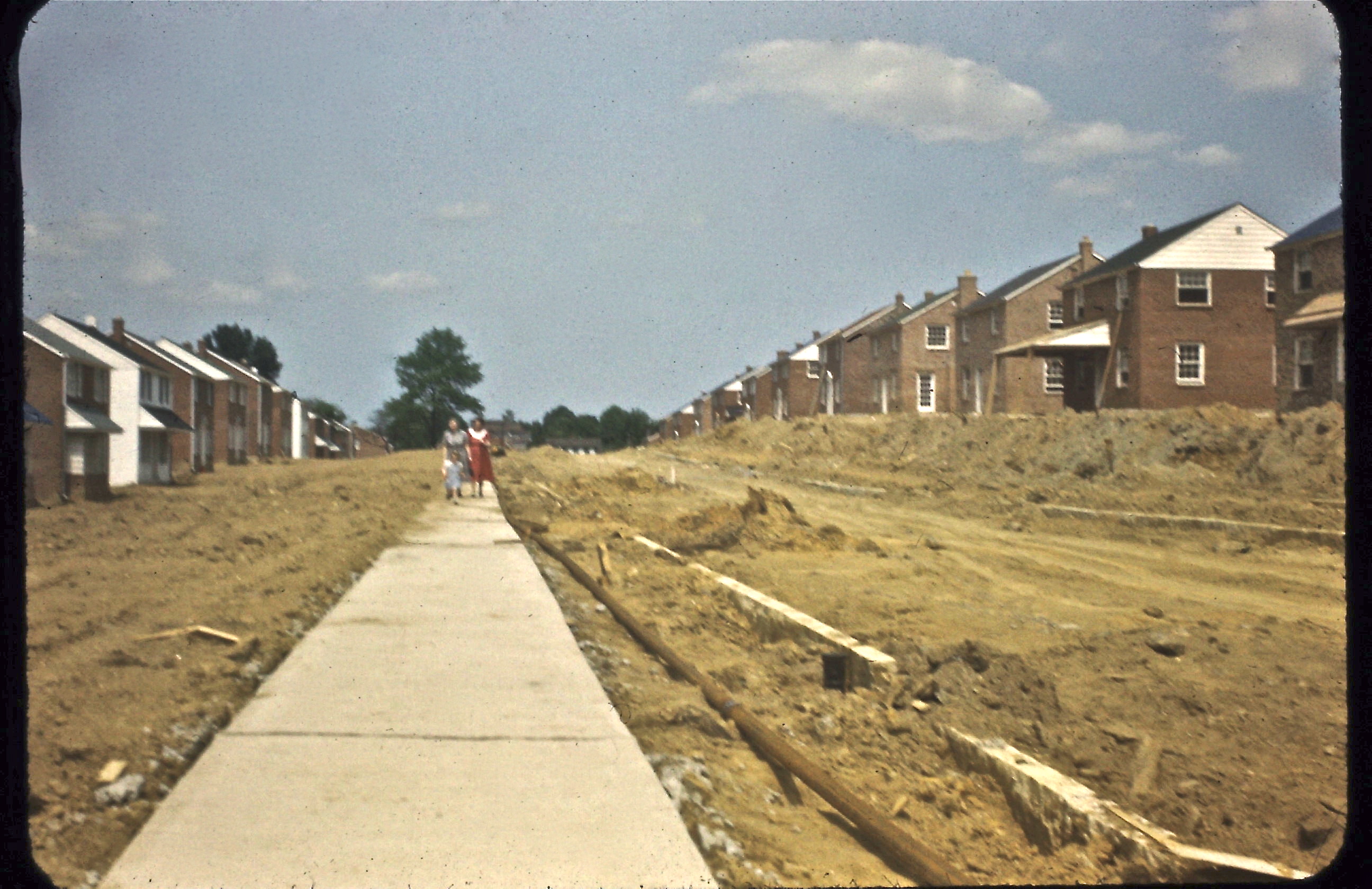
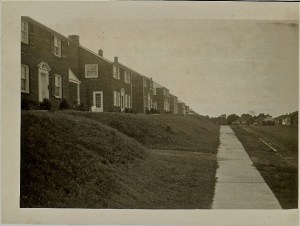
In the picture above, we are walking away from our house, about halfway between White Oak hill and the curve into Wheatsheaf. Woods lined the back of the homes on the left side almost to Woodland Avenue. By the time my sister was born on October 15, 1950, the grass had been planted, along with a few shrubs along the front, included in the sales agreement. Every house had two evergreens on either side of the front door. Note the lack of automobiles on the street. A working-class community in 1950, most families did not own a car.
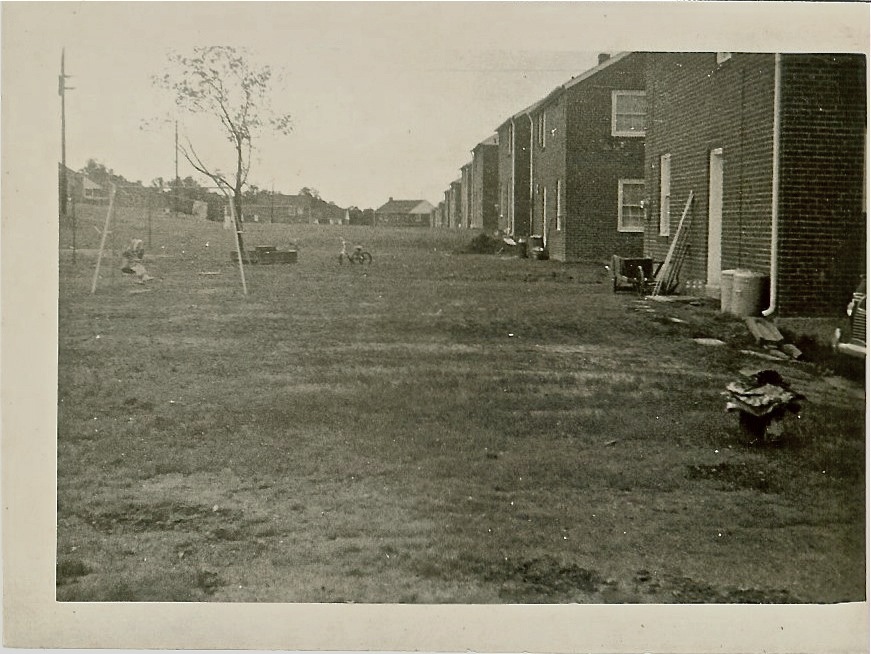
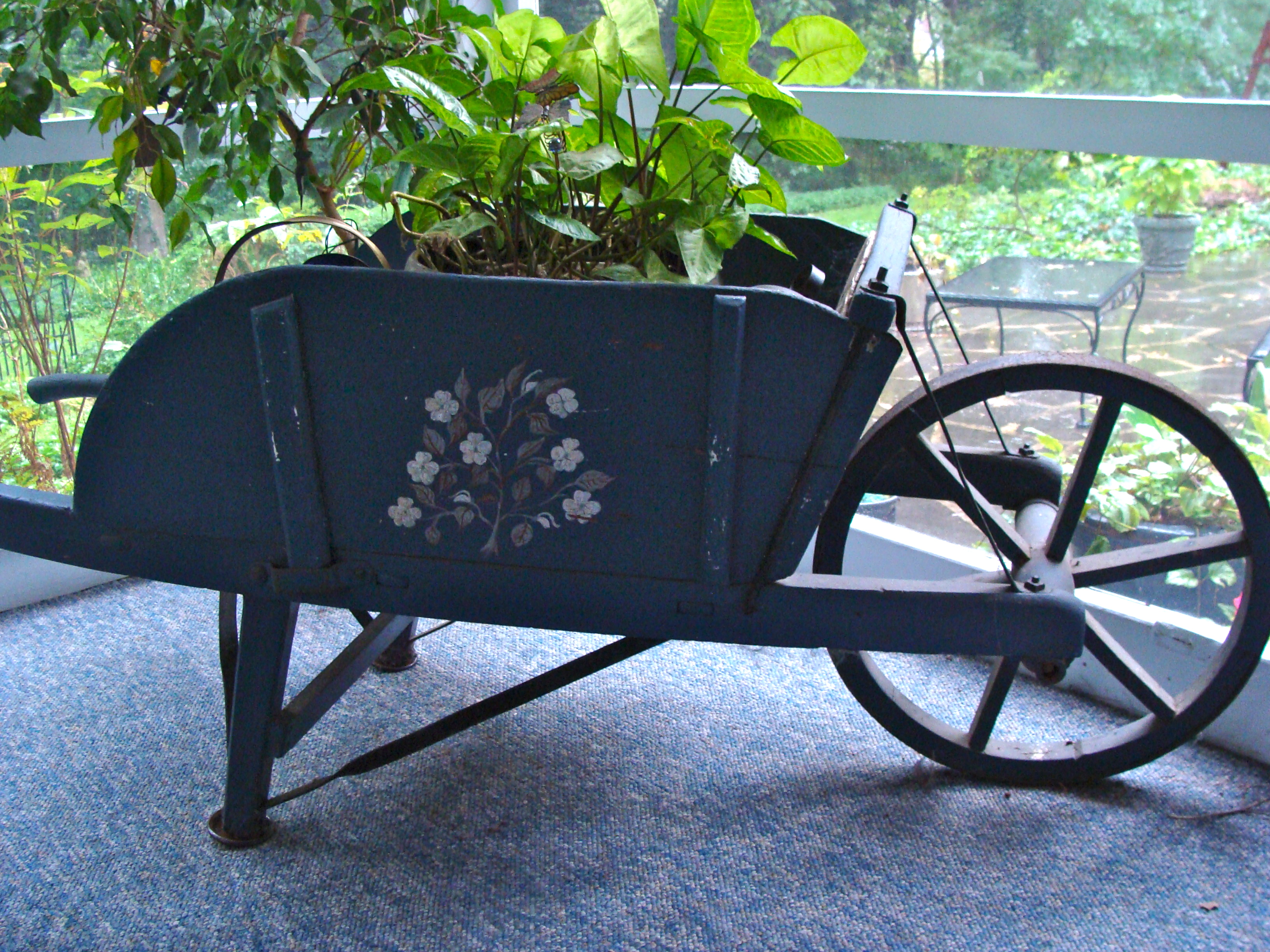
This photograph was taken in our backyard, from which we could view every house in the inner circle. I still have my Dad’s wheelbarrow, which is parked along the back of the house.
Wheelbarrow 2011
I believe I might have been the first kid on the block with a swing set. The 50s had arrived.
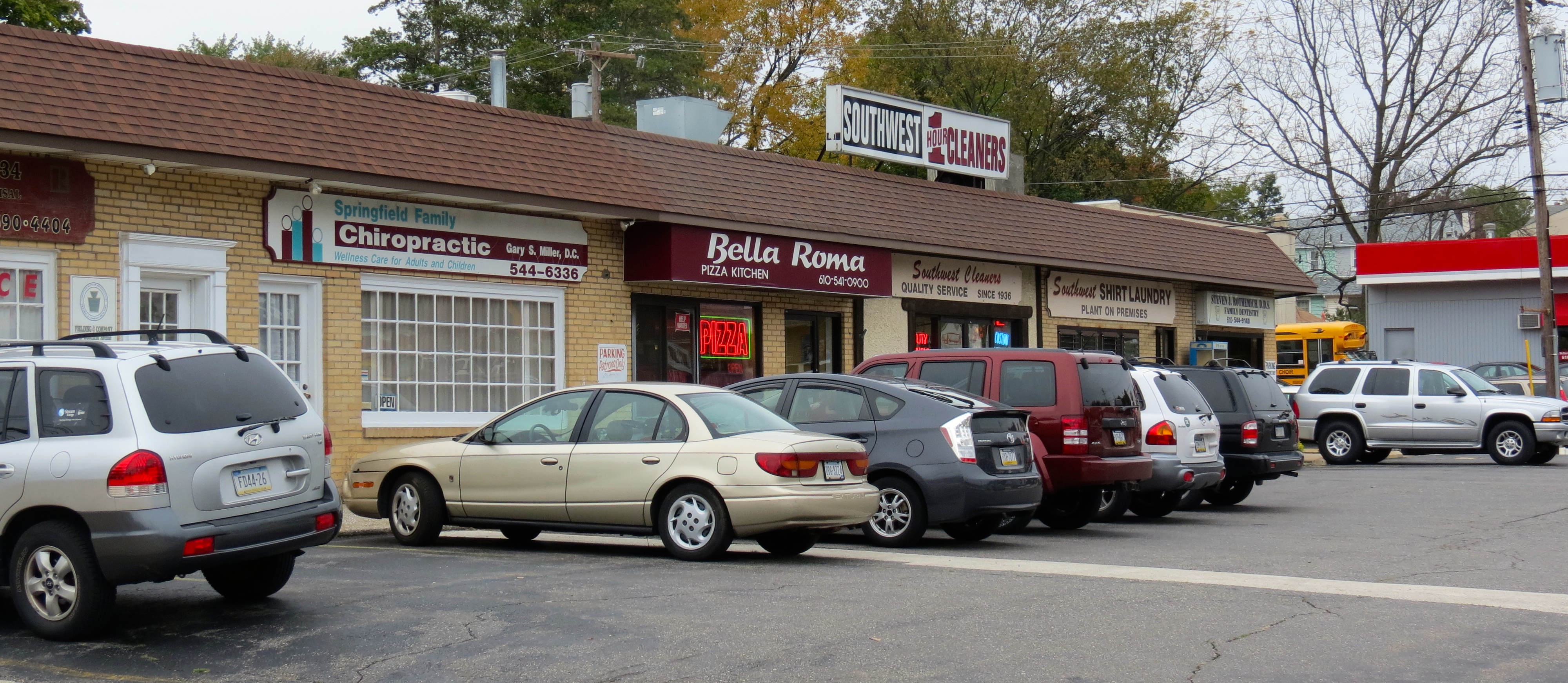
Commerce Corridor on Woodland Avenue
A sidewalk cut through our neighborhood to Woodland Avenue, Route 420, a major roadway to town east and to the airport. At the end of the sidewalk on the left stood the Woodland Inn, a rustic bar that had been in that location for years. Once, I fell off my bike in the parking lot, with the resultant bloody knee and elbow, and the kind bartender gave me a band-aid and a ginger ale. In the late 1950s, developers built a small strip of stores on the field on the left side of the sidewalk. Many businesses, including a toy store, hairdresser, orthodontist offices, and M&M cafe went in and out of those shops.
Trolley Stop Woodland Avenue 2014
The Red Arrow Line trolley stop was also on Woodland Avenue. Access to public transportation was important so Dad could commute to his workplace at the RCA plant in Camden, New Jersey.
Planted on the other side of Woodland Avenue was another older strip mall. Patler’s Pharmacy and soda shop occupied one corner and was a favorite place to hang out. Inside, a soda station supported a row of swivel seats with green vinyl covers, and we could get the best milkshakes, made the old-fashioned way with milk and ice cream stirred up in one of those mixing machines. As Kathy notes in the comments below, cherry and chocolate sodas were the best-tasting drinks ever. Mr. Patler would stand behind high wooden cabinets supporting bottles of medicine. The pharmacy was still in business in 1979. I went in one day with my son, John, and Mr. Patler was so taken by him, that he gave him a toy clown.
Photograph taken 2014, exterior, much the same, with different stores.
In the middle of the strip, a convenience store sold groceries and cold cuts. Mom often sent me there to buy lunch meats and rolls. However, I was under strict orders not to buy any candy.
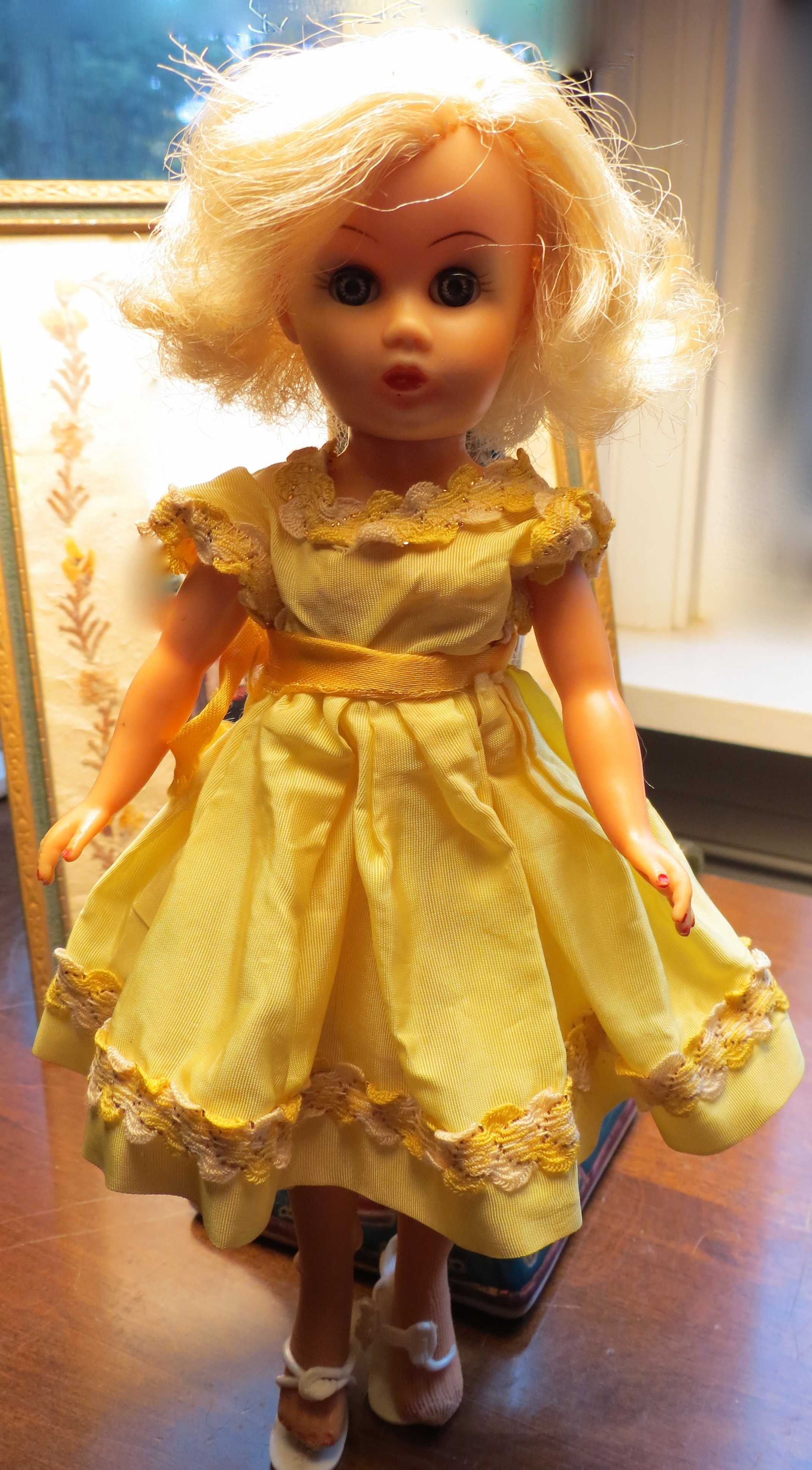
Next door, Carter’s Hardware Store displayed toys and home and garden tools in their window. As both Joan and Kathy remarked in the comments, Mrs. Carter was known for her gift-wrapping skills. We would find any excuse to browse around the store, as Mrs. Carter artfully displayed dolls and their fashions in wooden cases with glass windows. Playing with our dolls, especially the 6-inch Madam Alexander or Ginny dolls, was a favorite pastime. We then collected the high-heel fashion dolls, the precursor to the Barbie dolls that followed later. I specifically remember buying this yellow dress at Carter’s because I debated for so long as to whether to spend the money.
One Year Later, Summer 1951
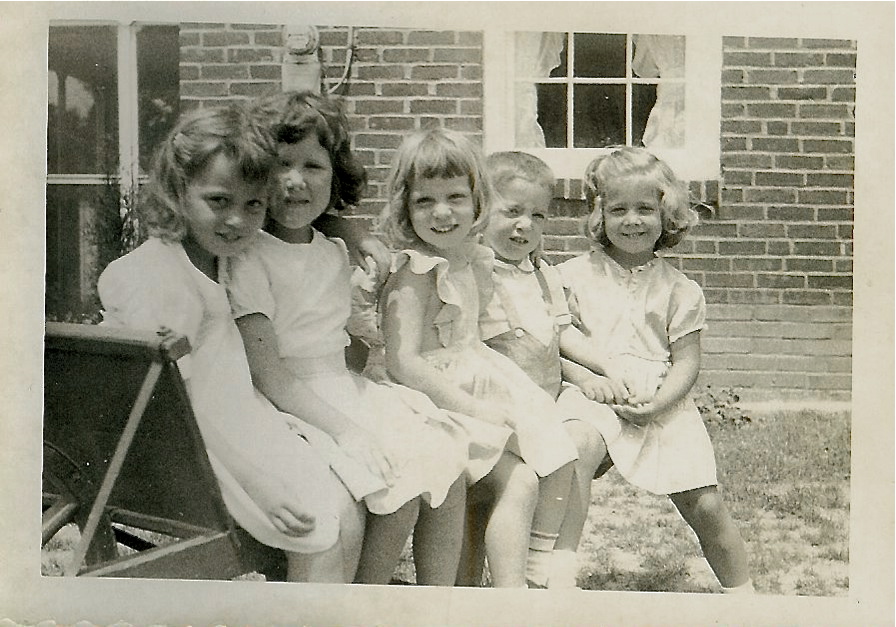
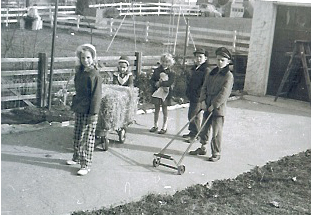
By the time the next year rolled around, neighborhood children had become playmates. I’m sitting center on the wheelbarrow, and Joan, my long-time childhood friend, is sitting on the left. Joan and I are still in contact today. Paul and Mary, the two children on the end, lived next door to us for a few years.
I wonder about girls playing outside while wearing dresses. Maybe it was a Sunday? In the post, 1950s Retrospective on Children’s Fashion: Petticoats and Mary Janes, I reminisce about what we wore back then. In the second photo just behind Paul, a hand lawn mower rests propped against the house. I remember that my Dad had one, too. What was nice about these mowers: was no noise.
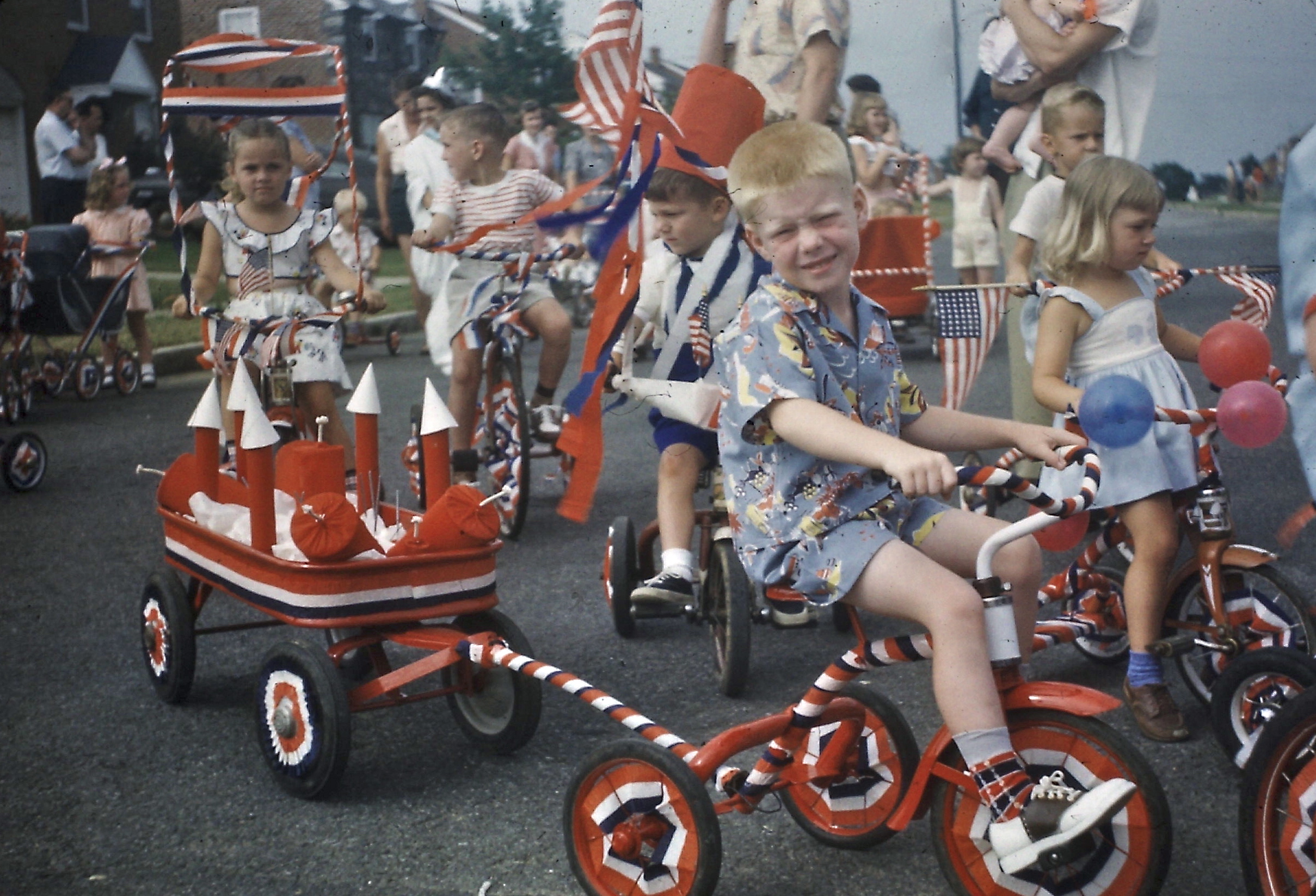
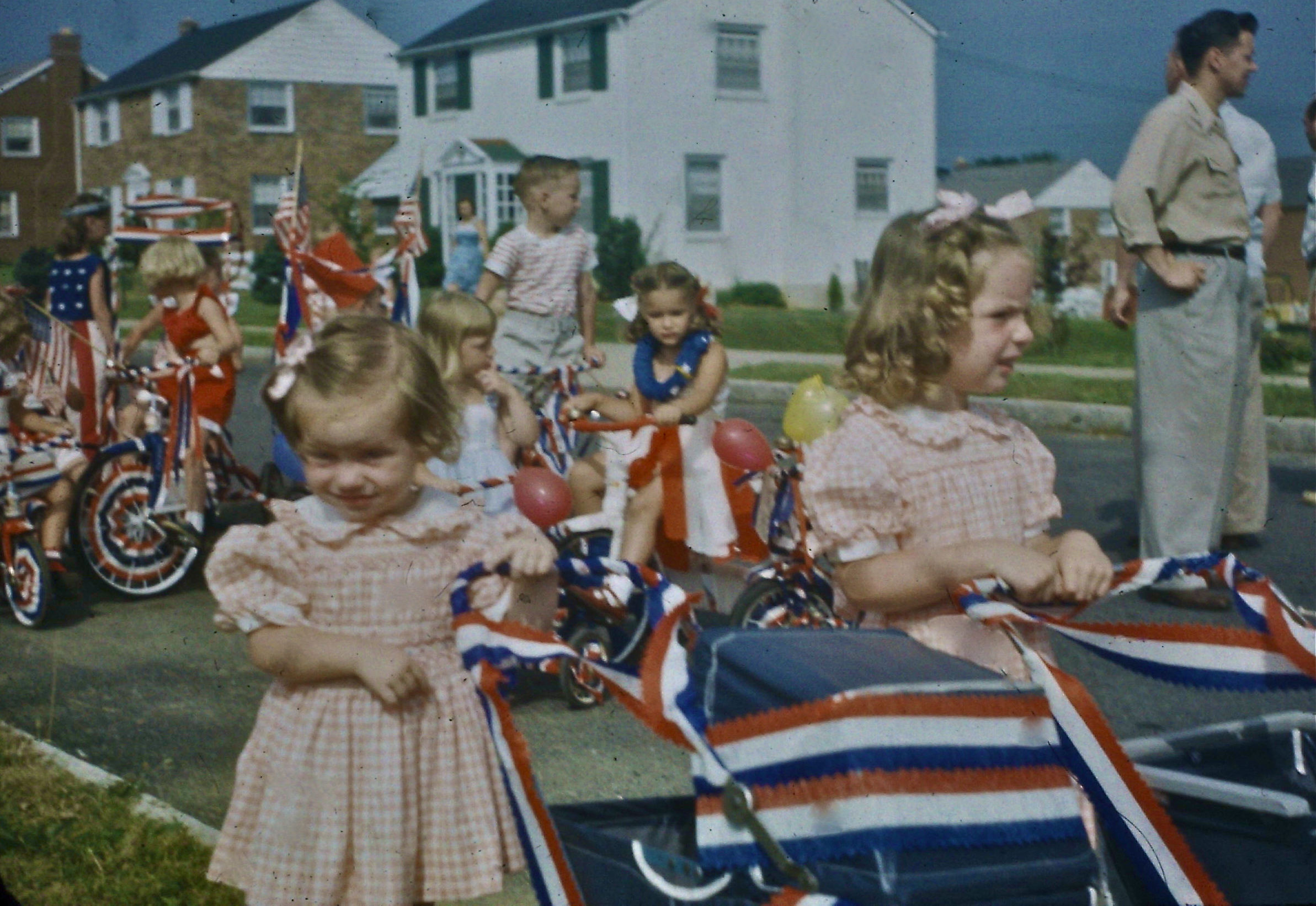
During the summer of 1951, the neighborhood organized its first 4th of July parade for the children, and the tradition continued for at least 50 years. My Dad took these pictures on Wheatsheaf.
1952, The Year of the Fences
Two years into the neighborhood formation, fences sprung up, including the dreaded chain link, the bane of aesthetic sensibilities. Is it true that the smaller the plot of land, the more likely people feel compelled to demarcate their territory with a fence? Our next-door neighbors had added a room off the back of their house. Dad had begun the process of building our garage as the stakes in the ground marked the footprint. In the color picture below, taken a few months later, piled cinder blocks and other construction materials show up in the yard. Our 194? Plymouth sits on the recently poured concrete driveway.
Plymouth had a running board.
The 4th of July parade that summer had the usual decorated bikes and doll buggies, but David, a neighbor from across the street, upped the ante by including a float. The Association was now awarding prizes.
1953 Halloween
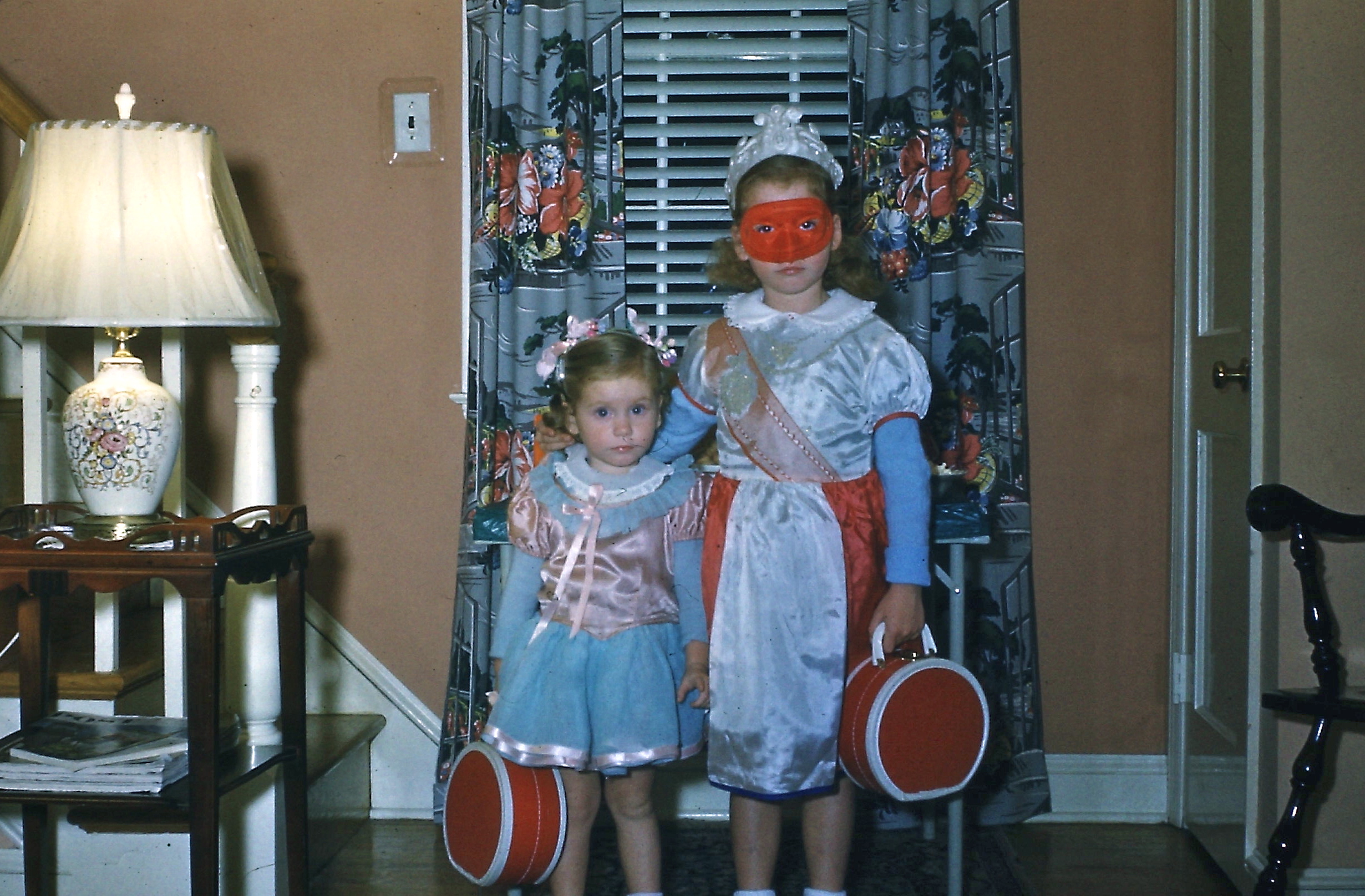
By 1953 Halloween was well-established as a neighborhood tradition. The twins, Carol and Janet from next door, arrive to collect their treat with a few others standing behind the door. Jean and I modeled our store-bought costumes, but I was not very happy because Mom insisted that I wear a sweater. Everyone knows that a princess does not wear a sweater under her gown under any circumstances! Thus began my compulsion about clothes that don’t match.
This next picture triggered a memory about wallpaper. Homeowners had a choice of having their walls painted or wallpapered. The choice of wallpaper was considerably cheaper because the builder did not have to “finish” the walls for painting. The wallpaper was always a choice Dad would regret as scraping it off was tedious and time-consuming. While on the subject of interiors, the television set appears central to the living room. I’ve written several blog posts on television westerns during that time: Lone Ranger and Tonto: A Nostalgic View and Modern Critique and Lone Ranger on Television: Reflections on My Childhood.
That same year Mom and Dad gave us two bunnies. The neighborhood now included cats, dogs, and other assorted animals. Mom had a goldfish bowl that sat on our kitchen window. One of our little rabbits lived for twelve years.
1955 Halloween Party
Because my sister’s birthday fell on October 15, we usually had a birthday costume party inviting our neighborhood friends over for a celebration.
4th of July Celebrations on the Block
The Civic Association usually arranged for a portable merry-go-round to be part of the neighborhood’s 4th of July celebration. Although the ride only lasted a few minutes and was certainly a miniaturized version of any other merry-go-round I had ever been on, nevertheless I looked forward to this ride every year.
Playing in the backyard. Note the fireplace in the top, left corner.
Most of the children in the neighborhood attended Central School on Saxer Avenue, and some went to the Catholic school at St. Francis. We walked to school, which was about three blocks away crossing at the light on Woodland Avenue. Built in the 1920s, each classroom opened with oak doors and hallways lined with woodwork trim. Each room had a huge walk-in closet for coats and boots. The cafeteria in the basement served hot lunches and milk in little glass bottles. The township demolished the school in 1978; a sports field occupies the space now. A Facebook page for Central Schools Alums is located here with pictures of the grand stone building. In those days the fire station’s second floor housed the public library across the street from Central School. This site has several pictures of the firehouse as it looked in the 1950s.
Miss. Symon’s First Grade Class, 1952-53
As a result of the housing boom, the district built a new elementary school, Sabold, on Thompson Avenue. Because of the street crossings, we now had to take a bus. The new school had new features such as a sink and bathroom in every classroom, and we each had our own cubby hole. A rack served as a coat depository.
Third Grade Classroom at Sabold
On Briarhill Road
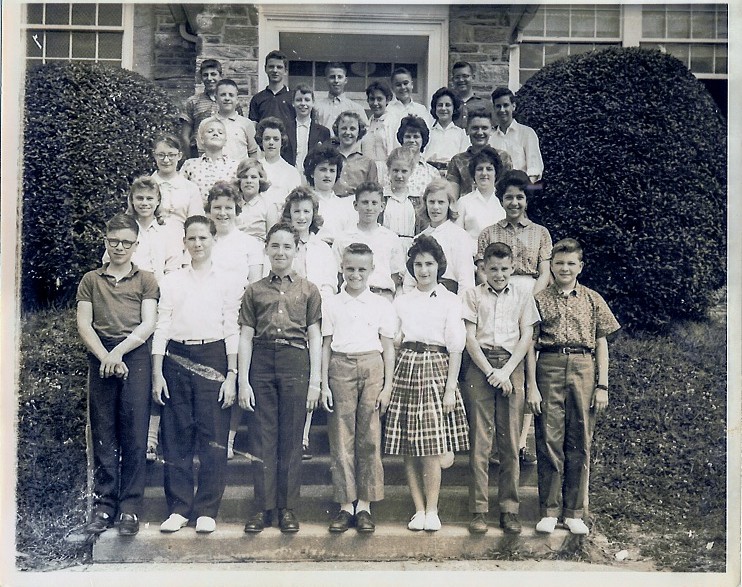
On the front steps of Sabold School
While attending Sabold, I became fascinated by two of the school’s neighboring properties. One was the Blue Church, the oldest standing church in Springfield and the adjacent graveyard; and the other was the mysterious research building behind the chain link fence, which defined the school’s boundaries. Students were absolutely forbidden to walk through the church property, but I couldn’t resist wandering through the gravestones looking at the names and dates. I also could not stay away from the small woods that followed along the chain link fence beyond the playground. I always loved any woodsy area, poking under rocks and studying the trees. That area served as a refuge from the schoolyard dramas. The mysterious L-shaped building, surrounded by trees, loomed on the other side of a high fence topped with barbed wire. Years later I found out it was indeed some kind of research facility. The building was eventually destroyed and the woods cleared for the shopping center where Gernardi’s now occupies that space. (More to come on the subject.) Ironically, I wound up working across from Papazian Hall at Swarthmore College, which was linked to the building behind Sabold. More information at this link.
Mrs. Boyer’s 6th Grade Class Sabold School/Springfield HS Class of 1965
Neighborhood Life
Not long ago my neighborhood friend, Joan, wrote . . .
I have such sweet memories growing up in Springfield. Every season had it’s specialty, from bringing May flowers to your special teacher, to the acorns that crunched underfoot walking to Saxer Avenue in the Fall. And remember those winters when we lost power but played merrily in the snow, sledding down Wheatsheaf and building forts. Or just simply lying on our front lawns in summertime watching the clouds pass by…where does one begin!
By the late 1950s, more cars began to fill up the driveways and streets. Still, most families did not own two cars as the majority of the moms on the block did not work outside the home. This was still the era where the breadman and milkman delivered to the back door. They drove snub-nosed square trucks with bifold doors. The bread man would carry a huge tray of bakery goods. We always begged Mom to buy the glazed donuts. Milk came in glass bottles, and we had a special little shelf at the back door where mom would leave the empties for pickup. He would also bring to the door eggs, cream, and butter.
During the summertime, the neighborhood received regular visits from the Good Humor truck, ringing its bell in the early evening. Kids would run out to catch the truck. Couldn’t wait for that Orange creamsicle. The DDT sprayer vehicle usually made an appearance in early summer. Mom cautioned us to stay away from the spray, but other neighborhood children would ride their bikes behind the truck and in one case, one boy passed out while following after the cloud of pesticide.
Each household was responsible for burning its own trash, so every home had a fireplace in the back corner of the yard for this purpose. Most of the trash was cardboard and paper. Once I remember Mom telling Dad that she almost caught her coat on fire trying to light the match on a windy day. Each house also had a receptacle built into the ground for garbage. The township established strict regulations on what could be thrown into the pail. Once a week or maybe twice, the long, green garbage truck would come through the neighborhood. African-American men would carry the pail on their shoulders and heave the contents into the open truck, which we tried to avoid because it smelled so bad.
Sledding on White Oak Hill 1955
Pools: Backyard and Community
Our first “swimming pool” was a metal sandbox, which held about three inches of water. The plastic, blow-up pools became popular, and the kid who could fill their pool with six inches of water or more commanded status. Through the years, these pools morphed into holding one and two feet of water. David’s parents bought such a pool, and we were in awe. In the 1960s a few neighbors installed in-ground cement pools. These were the days before air-conditioners, and summers could be long, dry, and hot.
Springfield had no shortage of community pools, and many of the children in our neighborhood learned to swim at the Palm Beach Swim Club, which actually dated back to 1928, built on the corner of Baltimore Pike and Woodland Avenue. In addition to the Springfield Swim Club, another pool was located off of Rolling Road. We belonged to Drexelbrook, which had a separate deep-end pool. Only the Springfield Club remains in operation today.
Construction of the Middle School
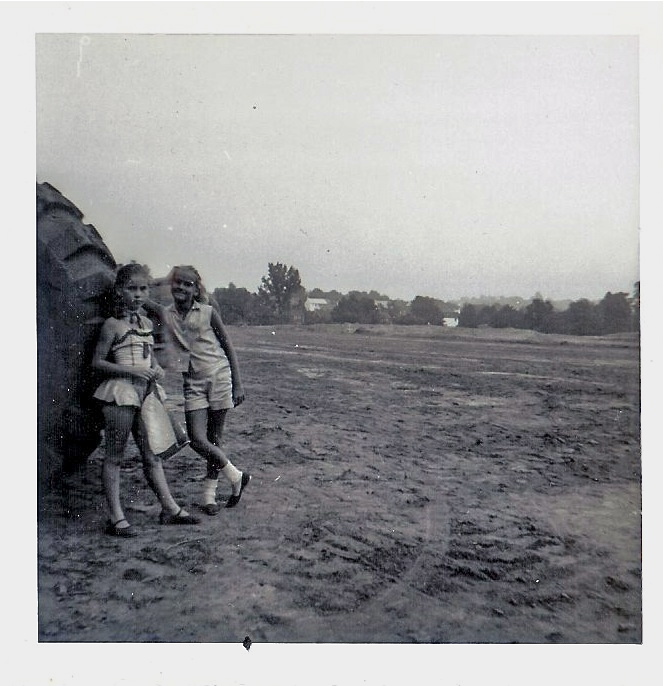
Around 1958, the school district began building the middle school on the plot of land next to our neighborhood. I believe an old tavern on was all that occupied the field. A wooded area lined the field. We were forbidden to venture into those woods, but occasionally we would climb down the neighbor’s embankment and over the trolley line to the path through the forest. If we made it as far as the creek, I considered the venture a success. For me, it wasn’t about being defiant but rather finding the woods so enchanting, drawn to the canopy of trees and the streams. As construction began, my father suggested that I take some pictures before the land transformed into a schoolyard. With my Brownie camera and friends in tow, we walked over to the field. The first picture, taken looking towards Woodland Avenue, shows the field just as the bulldozers began to flatten the land. The tavern still stands to the left, although difficult to see.
In this next picture my sister and our friend and next-door neighbor, Carol, stand by a tire of the land movers. The middle school was eventually named for Carol’s uncle, E. T. Richardson, who was the principal for many years.
Last photograph shows the view of the school construction from our second story window.
4th of July, 1958
Joan, Jean, and I welcomed Alaska as the 49th State during the neighborhood 4th of July parade. Joan was “Miss Arizona” and I was “Miss New Mexico,” the last two states previously admitted to the Union.
The Six Stars
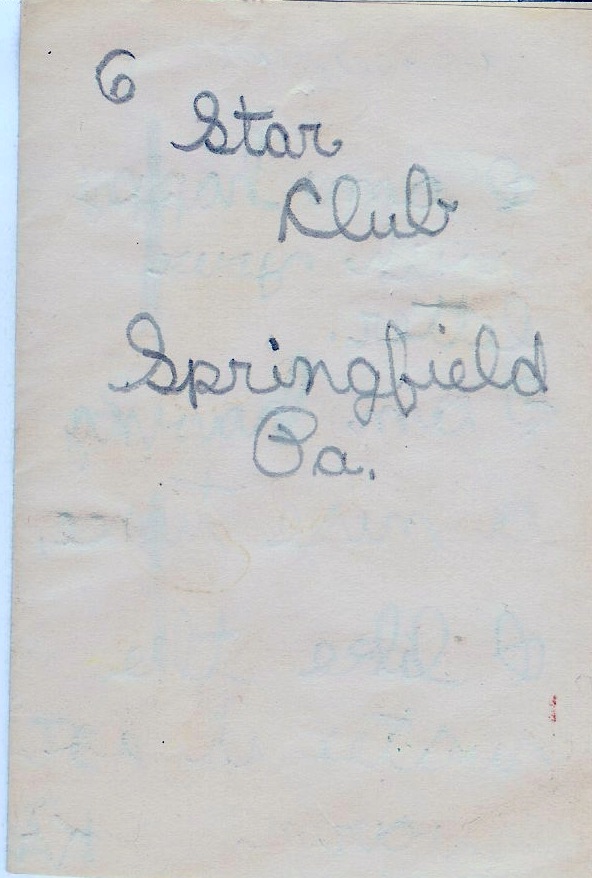
Not long ago, Joan sent me a reminder of our days back on the block . . . a little note I had written to her, and she had saved for 50 years!
Back then we formed our own kids’ club and named it “The Six Stars.” Some of our more ambitious projects involved putting on plays in our basement or garage. We prided ourselves in having real costumes, scenery, and music. Disney movies served as our inspiration, and the photograph below shows us taking our bows during the curtain call for Sleeping Beauty. We had to bribe David to play the part of the prince and remind him he was not to jive the crown by tilting it to the side. For some reason, I remember I forgot to remove the chandelier during the scenes in the forest. Parents contributed cakes and cookies, served at the end of the performance. My mother didn’t allow us to sell tickets as she felt it unseemly to charge friends and neighbors.
In addition to the plays, we had great fun recreating our own versions of the adult world. We assembled a train car, school, tunnel world, and jungle land. Building little houses out of anything we could find lying around the garage was our favorite project. We were frequently accused of constantly making messes, but these were our artistic creations!
Janet, Jean, Carol, David, me, Joan
During the summer, we sometimes would go off to camp, Jean with the twins to Girl Scout camp, Hidden Falls, and for me, Nik-O-Mahs in the mountains of central Pennsylvania.
Speaking of Stars, Dad gives Astronomy Lessons to Girl Scouts
Thanks to Dorothy’s note in the comments section about my father’s astronomy lessons for our Girl Scout Troop 665, for us to earn our star badge, I remembered that I had a newspaper article from the Philadelphia Bulletin, “Girls Get Own Planetarium.” Dad would set up the planetarium in our living room, and with a homemade pointer, he would name the star in the constellations. Marilyn, in the photograph, lived in our neighborhood, as well as Dorothy, Joan, and Tacy, mentioned in the text. I still have Dad’s telescope, which he assembled, and then built wooden the stand.
Going back a few years to when we were a Brownie Troop, we had our picture in the paper with a typesetter from the Chester Times. Other girls mentioned from our neighborhood: Linda, and Janice.
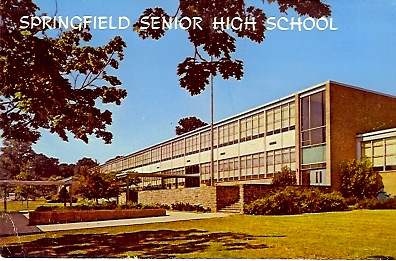
Springfield Junior/Senior High School
In 8th grade, I joined the marching band, and my schedule was changed to “music section” where classes were organized around orchestra and band classes. Picture taken at the side entrance of the junior high at that time.
Springfield Class of 65, Grade 8-7
Fall 1960 Jr. High Band: Saxer Avenue
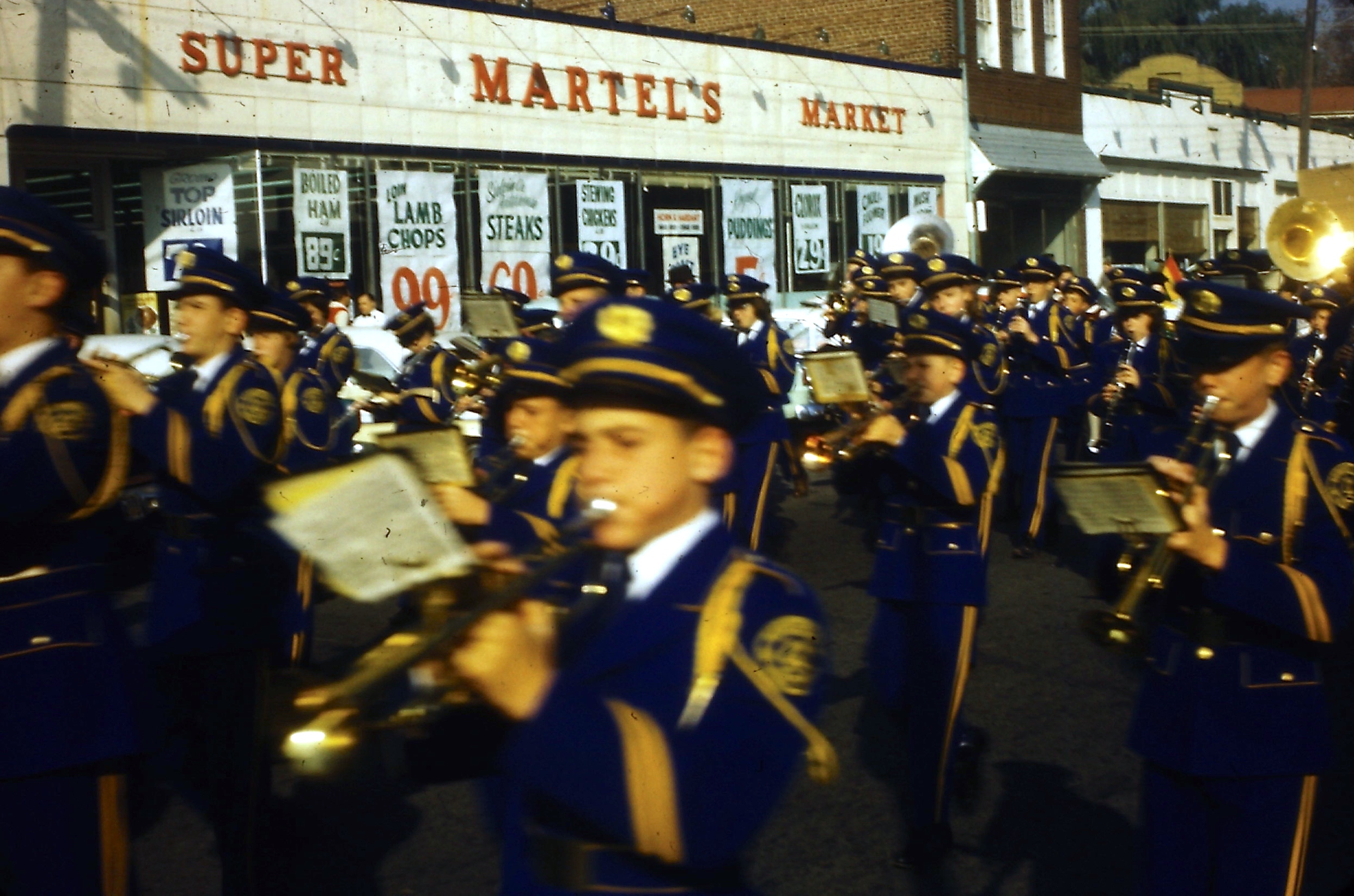
In front of Martel’s Supermarket
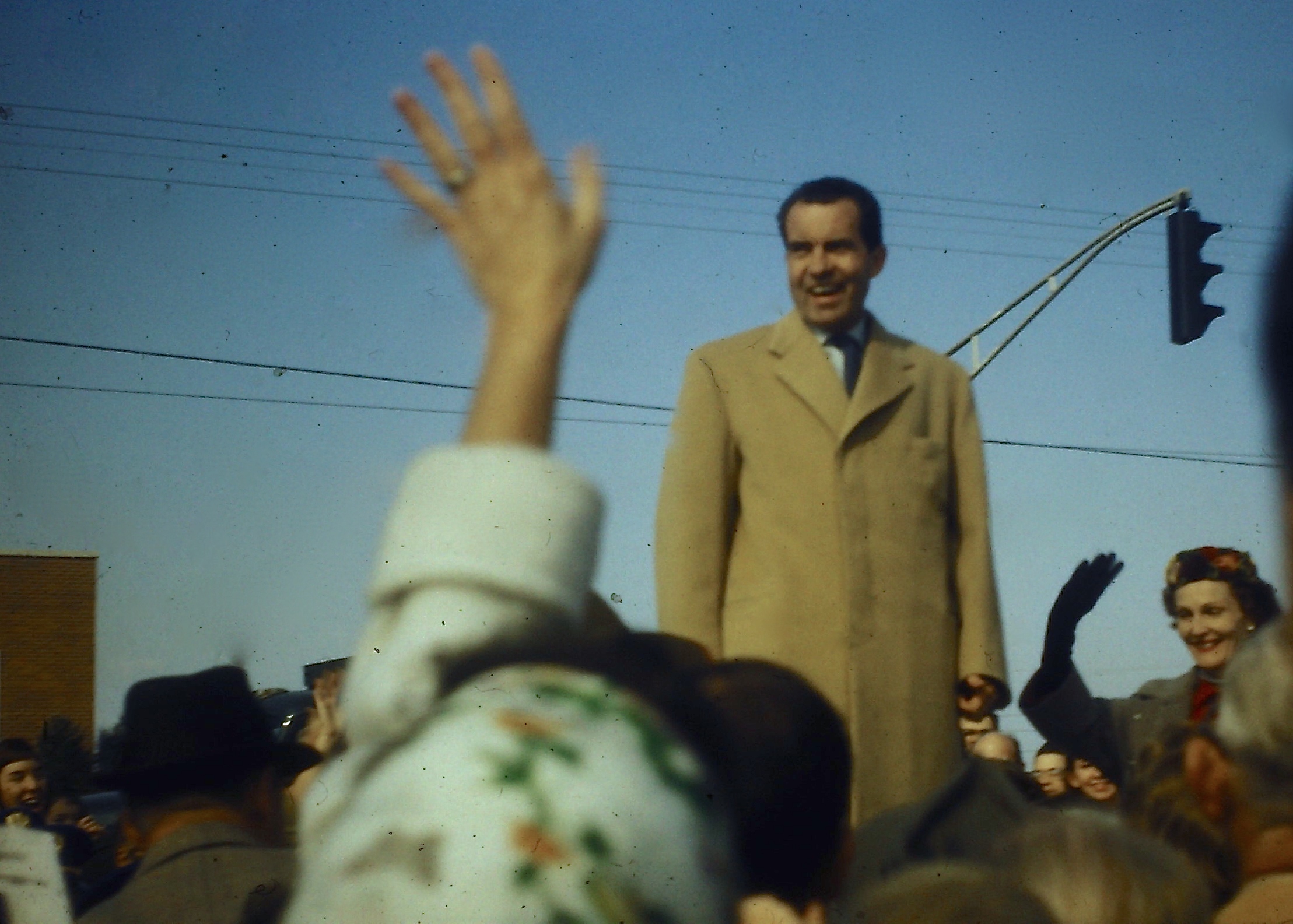
In the Fall of 1960, the Junior High Band was sent to Springfield Shopping Center, where then-candidate for president, Vice-President Richard Nixon, greeted the crowd. When John Kennedy came through Delaware Country, he did not stop in Springfield but rather spoke at the Lawrence Park Shopping Center in Broomall.
Richard Nixon Campaigning in Springfield
4th of July Parade 1963
To create this flag masterpiece, we stuffed white, blue (and pink, because we couldn’t get red) tissue paper into chicken wire.
Teen Dance Scene 1964
Our neighborhood girlfriends would gather at our house for a ride to the teen mixers at Holy Cross. In the mid-1960s, Holy Cross was the place to be on a Saturday night. Most of the teens who attended the dances came from the working class communities in the adjacent neighborhoods, and most were Catholic, of course. We attended public school, so it was a bit of a leap to attend a dance outside of our school where we wouldn’t know anyone. Some of our friend’s parents didn’t like the idea of their daughters going to a Catholic dance, but somehow we convinced them it would be ok. My sister remembers her shocked reaction when she saw smoking going on around the corner of the church. We were somewhat protected in our quiet neighborhood bubble.
The Church kept a strict dress code. Boys had to wear coats and ties and for girls, skirts or dresses. We would spend all day getting ready: washing our hair in the morning and using those humongous plastic rollers so that our hair would puff rather than curl. We would sit under a hair dryer bonnet for hours. More daring girls would wear heavy eye makeup and challenge the limits on how short their skirts could be. It was a fine line, and the authorities would send you home if you crossed it. Looking back, I believe the dress code established a certain decorum, even if we complained at the time.
We would join long lines outside the gym to pay our 75 cents to get in, passing by the three or four priests that lined up near the entrance. Everybody danced on the crowded floor; we didn’t have to worry about being a wallflower. When dancing, the boys would cut in front of us, nudging each other out of the way. We had bragging rights depending on the number of boys that would cut in. The temperature would rise through the night, but the boys still had to keep their jackets on.
Versions of the Bristol Stomp provided the basic dance steps, and dancers would hit the wooden floor with a collective stomp on the beat. That unison had to be a genre of tribal dancing, and while we danced with a partner, it was really a group dance–and that made it exciting!
The kids in Bristol are sharp as a pistol, When they do the Bristol Stomp. Whoa-oh. Really somethin’ when the joint is jumpin’, Ah-ah-ah, ah. When they do the Bristol Stomp. –Kal Mann & Dave Appell
After every dance number, we would escape back to our girl pods and share our analysis. “Wow, that was a cute guy you were dancing with.” “He asked for my number!” “Look, he’s wearing a Beatle jacket.” “Did you see that split?” Boys were considered “hot” if could do a split; and if a guy had a Beatle haircut, he racked up more status points. Oh, yes, about those Beatles . . . reminisces of the Fab Four at Yesterday: Beatle Memories & My Letter from Peter Best.
The DJ usually played Doo-Wop music for the slow dances: See the Pyramids Across the Nile, In the Still of the Night, Till Then, You Belong to Me. I remember melting every time the songs played.
1776 Neighborhood Bicentennial Celebration
On June 19, 1976, neighborhood residents held their own American Bicentennial celebration, 1776-1976. Neighbors distributed a booklet, which included the activities for the day, the current officers of the association, and a history of the organization.
Our family had the unusual situation that my parents moved out of their house in 1970, and my sister and I continued to live in the home. Jean eventually left, too, to start her nursing career in Boston. I married and raised two children in the house where I grew up. As an officer in the Civic Association for a few years, I assisted with the Christmas and Easter activities. I was active in local politics, especially in Bob Edgar’s 1974 campaign for Congress.
4th of July 1985
Santa’s Visit to the Neighborhood, 1986
The neighborhood tradition continued with visits from Santa via the Springfield fire truck and company.
Easter Egg Hunt
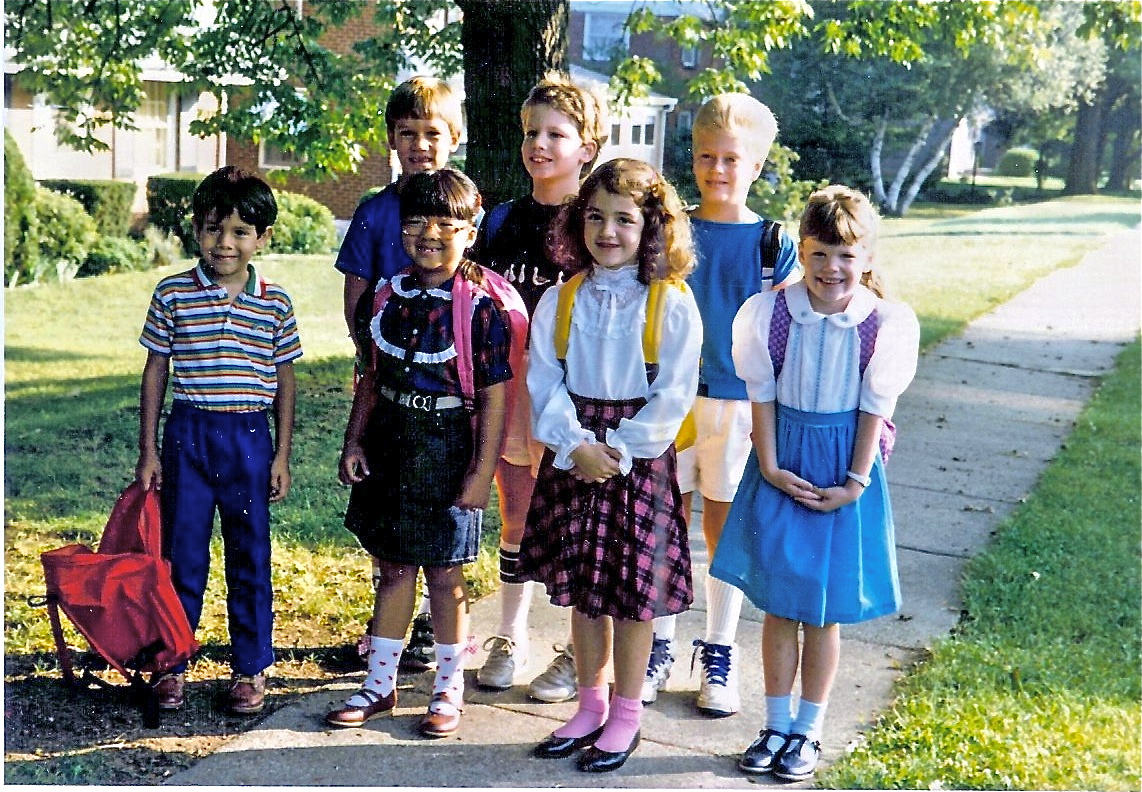
First Day of School, September 1988
Andy, Heather, BethAnn, MaeC, Jeff, John, Matt
Epilogue
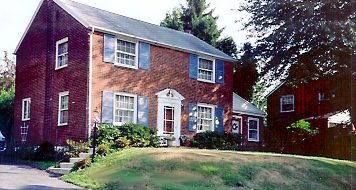
After forty years, I moved away from Briarhill Road. I thought that I might stay in the house until I could turn it over to my children, but several circumstances changed the course of life events, which prevented that outcome. As it turned out, Matt (pictured above) lives in Joan’s house, and his sister, Stacey, and husband, Mark, bought our house. A few of the original residents still live on the block.
I will leave the history of Woodview Farms neighborhood to others to record the third generation, as I say goodbye to my childhood home.





























 Psalmboxkey's Blog
