Humble Contributions to the Peoples' History

Archive for the ‘Politics’ Category

Philadelphia Performance Protest against Gun Violence

On March 29, Heeding God’s Call, held their Fifth Annual Good Friday Procession and Vigil to protest the continued gun violence in the city. Nearly 200 worshippers gathered late in the afternoon at St. Paul’s Baptist Church, where worship services began, and then “en masse” marched to Benjamin Franklin High School on North Broad Street for  the vigil.

Healing Presence Choir2

The Tabernacle United Choir and Arch Street Methodist Choir joined the Healing Presence Singers under the backdrop of the Common Threads Mural, which is representative of hope for the future. Holly Phares directed the choirs during the ecumenical service that included guest speakers from several faith-based organizations and  families who have lost children to gun violence. By joining together, the worshipers affirmed that it is possible for citizens to fight for legislation and social policies that would help bring peace to our streets and homes.
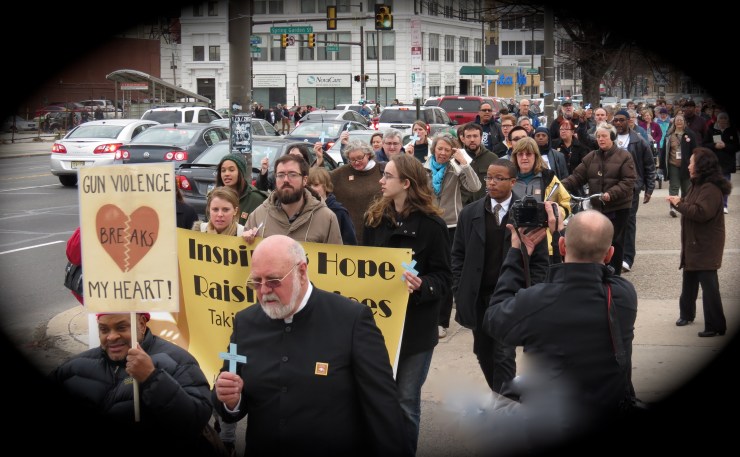
Marching

According to CNN, Philadelphia has one of the worst homicide rates in the country, with more than 80% of these crimes committed with a gun.

A young, black man, has a greater chance of being shot and killed in Philadelphia than he would have if  he were a soldier serving in the conflicts in Afghanistan or Iraq,

An average day in US has 30 gun-related murders with another 162 wounded  based on the most recent figures from the Centers for Disease Control and Prevention. In addition, 53 people kill themselves with a gun each day. Our homicide rate of 4.7 murders per 100,000 people is one of the highest of all developed countries. Unfortunately, statistics of these daily tragedies mean little in the public consciousness and only when mass shootings occur, do citizens begin to take notice. This outrage that follows these shootings is followed by frustration as law-makers, indebted to the gun lobby, block even the most sensible gun restrictions, such as high-capacity magazines. If the Tucson shooter had only ten bullets, Christina Taylor Green would be with her family today.

At the rally in Philadelphia, parents of children who were killed by guns spoke of their loss.

While this was a peaceful demonstration, just a day before mothers in Indiana had to stand in defiance in front of a line of armed men carrying AR-15 semi-automatic weapons. The moms, advocating for restrictions on purchases of high-capacity magazines and legislation requiring background checks on gun sales, were protesting in front of the Indiana statehouse. An armed opponent admitted that his rifle was loaded. Some might argue that the Indiana protest was also peaceful, but the potential for violence, either because of accident, mental instability or provocation, undermines the tenants of democracy to live free from the threat of gun violence.

Numbers to reach US Senators at this link.
Greek Antifascists bring their Message to Philadelphians

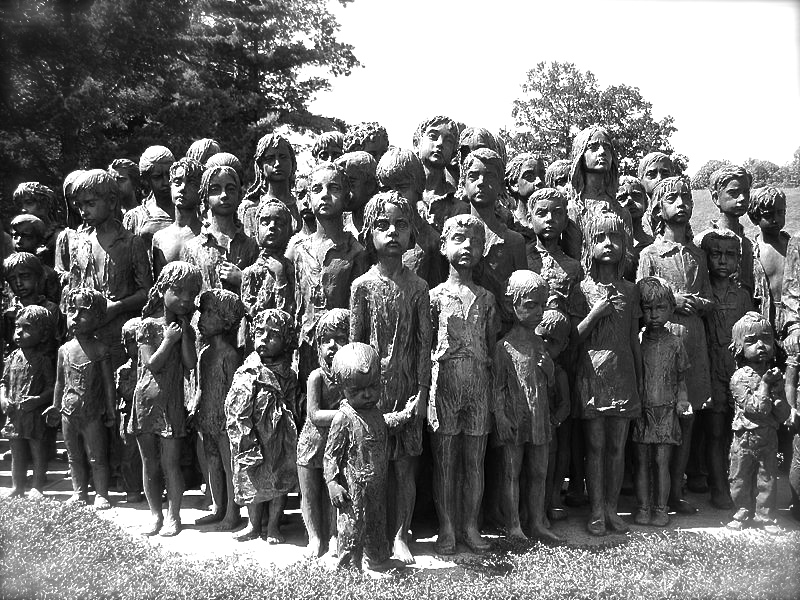
Was only 70 Years Ago . . .

Memorial_lidice_children_(2007)-commons

Wiki Commons

My son, John, and his housemate, Jim, hosted two Antifascist activists from Greece, who were giving a presentation at the Lava Space in Philadelphia on Monday, March 11. John and Jim attend many activist events, and they always invite me to come. I decided to attend this event mostly because of an email I received just a few days ago from a member of my photography class who traveled to the Czech Republic on a family heritage trip. In that email he wrote that he had visited the town of Vrbove and walked the along the streets that were so familiar to his grandmother. He also made a pilgrimage to the town on Lidice, on the outskirts of Prague, to view the memorial there. I hadn’t heard of this town or the Lidice Memorial site so I checked out the details on the web. In 1942 the Nazis marched into Lidice and killed every male over the age of twelve and deported the women and children to the camps. They burned and leveled the village. The Nazis brought on further horrors which I cannot even bear to write about. The Nazis carried out this atrocity as revenge for the assassination of General Heydrich by unknown assailants. This chance intersection with the Lidice Memorial underscored the heroic efforts of the Greek Antifascists.

The Dysfunction of  Scapegoating

When elements of fascism raise the specter of blatant racism, blaming targets of their hate for the economic failures while undermining democracy through brute force and suppression, citizens must take note. The Antifascists remind us that we must be aware of fascist propaganda, which scapegoats on immigrants and multiculturalism, taking advantage of economic crises to fuel the fires of discontent in times of austerity. Without vigilance to these seeds of discontent, the horrors of Lidice could revisit the human race again.

Greece: A Case Study of an Economic Meltdown

Austerity measures in Greece, with the goal of  paying off astronomical debt, have created nationwide protests. Greece is suffering with unemployment at 27%. The Golden Dawn, described by both the media and scholars as fascist and neo-Nazi, won 7% of the seats in parliament and colluded with police to initiate violence against progressive activists and immigrants.

According to a 2012 article in The Guardian,

Golden Dawn is opening branches in towns all over Greece and regularly coming third in national opinion polls. Its black-shirted vigilantes have been beating up immigrants for more than three years, unmolested by the police; lately they’ve taken to attacking Greeks they suspect of being gay or on the left. MPs participate proudly in the violence.

IMG_2336

Introductions by Chris

The Greek Antifascist City Tour 2013

Philadelphia was one stop on their scheduled visits to over 25 cities in the US to increase awareness and to raise funds for legal help. Greek activists, Thanasis Xirotsopanos and Vangelis Nanos, spoke to folks at the Lava Space about fascism and resistance in their country. Sofia Papagiannak gave her presentation via the computer as she had to return to Greece. Video footage provided documentation of the Antifascist resistance to the Golden Dawn.

IMG_2339

Models of protest activism  ~ Thanasis and Vangelis ~ against the most heinous of political movements

Gun Control: A Citizen Speaks Up, Part 3

Heartbreak

Photograph: J. R. Blackwell

On Friday evening, December 14, I went to bed with a migraine as I continued to be haunted by the thought of parents grieving for their children killed at the Sandy Hook School. Gazing at my Christmas tree, I thought about the holidays ahead, the gifts that will remained unopened. A tragedy of this magnitude affects all of us. For me, a debilitating headache; for those families, a debilitating heartache.

The only thing that cures my emotional overload is taking action. I’ve always been a gun-control advocate; now has to be the time to address the injustice of unregulated gun purchases.

One of my friends of Facebook asked: “Those kids, Why little babies?” My response: Because the sale of deadly firearms has been ok with us.

That response triggered a flurry of comments:

“Stop trying to advance your political agenda at the expense of this horrible tragedy. Instead of trying to politicize it.”

But victims of shooting crimes were speaking out that very night against gun violence, and an email from Roxanne Green, whose daughter was killed in the Arizona shooting stated, “I’ve heard a lot of promises from politicians since my daughter was murdered in Tucson, Arizona, including President Obama. But I am still waiting for them to act.” Steven Barton, wrote the same evening of his harrowing experience of being shot during the Batman movie, stating: There was no action taken to make sure that something so horrific never happened again. Washington avoided starting a meaningful dialogue on gun violence, and the costs of that were tragic.

I cannot presume in one post to solve this problem of gun violence. I propose a series of questions to consider:

  1. Over thirty Americans are murdered with guns every single day. Our broken laws remain ineffective, and our political leaders have been unable to stop gun violence. What can citizens do to mobilize for gun control?
  2. Has the “right to bear arms” morphed into an American obsession and addiction? Is an accurate interpretation of the Second Amendment entitle citizens to own guns and is this right absolute?
  3. What role has the NRA and other gun lobbyists played in thwarting the “will of the people” to regulate guns, as polls show the Americans support specific policies regulating guns. Why are lobby groups given this power?
  4. Does the American health care system support those afflicted with mental disorders? Is there widespread support to help those with mental disabilities and their families? In what places does our system fall short?
  5. What specific regulations could be passed immediately that most citizens would support?
  6. Would criminalizing verbal threats to life and identifying individuals who display dangerous and violent behaviors, preventing access to firearms be an effective strategy?
  7. We are a world community.  How do we address war and violence sanctioned by the state?
  8. How do we examine our culture to determine how the society encourages violent solutions and reactions?
  9. Why not pass laws that make it illegal not to have guns locked and secured and keys unavailable to anyone but the owner with huge fees and penalties for breaking these laws? Why not mandate that gun owners carry mandatory insurance?
  10. How does the freedom to own guns impose on the freedom from the dangers that guns bring to the public?
  11. How do we educate folks to seek answers to this complex problem.  One Facebook response, the tragedy “had nothing to do with fire arms.” Why are segments of the American population in denial about our gun culture?

We do know that if the current state of gun regulation remains the same, these shootings will continue to happen over and over and over again.

Gun Control: A Citizen Speaks Up, Part 1

motherandchild 2

Photograph by J. R. Blackwell 
Mother and Child, Laurel Hill Cemetery, Philadelphia

Your kingdom come . . . on earth as it is in heaven. Matthew 6:10 ESV

Those of us who abhor weapons of all kinds are forced to capitulate to reasoned approaches to gun control.  I want to yell out, “Just melt down every blasted weapon on this earth.”

I can’t imagine that there is any kind of killing in heaven. We might aspire to that.

Holiday Tree for Social Justice

Learn to do good; seek justice, correct oppression; bring justice to the fatherless, plead the widow’s cause. He has sent me to proclaim liberty to the captives and recovering of sight to the blind, to set at liberty those who are oppressed.   Isaiah 1:17

Inspired by my son John and his friend Jim’s activism for social justice causes, especially as advocates for workers’ rights, I decorated a holiday tree for them in the spirit of the season. Resurrecting a 30 year-old artificial tree, recycling/altering old ornaments and repurposing activist buttons . . . voila! an activist holiday tree!

IMG_1535

Details in slideshow.

Chicago Teachers: Progressive Unionism and Advocates for Education

On Saturday, November 17, representatives of the Chicago Teachers Union, Michael Brunson, Debby Pope, and Rolando Vasquez, spoke to an enthusiastic crowd  in Philadelphia about their strike in September 2012.

According to the mission statement of the union, which represents nearly 30,000 teachers and support staff, they by extension also represent students and families they serve. This is truly the goal of unionism: to consider the big picture in advocating for better working conditions and pay, progressive reforms in society and democracy the work place.

The union has addressed issues on charters, privatization and standardized tests. The union has also confronted the demonization of teachers and organized labor. In the past corporate-model school reformers dominated the discussion around issues of  accountability and standardized testing; Chicago teachers have focused on funding, poverty  and inequality.

Chicago teachers were successful because militant grassroots leadership from the Caucus of Rank and File Educators (CORE), guided the union membership in 2010 to build unprecedented community and parent support for educational reform.

Philadelphia schools have suffered drastic cuts under Gov. Tom Corbett and the confrontation continues over a radical restructuring and privatization plan advanced by the state-controlled School Reform Commission and backed by the powerful William Penn Foundation. In response, this past September hundreds gathered to found the Philadelphia Coalition for Advocating for Public Schools (PCAPS), a broad union-community coalition set to counter the Boston Consulting Group-drafted restructuring plan.  PCAPS asks for your advice by completing a public education survey to aid in developing a plan in which the citizens can contribute their ideas.

Video below features selected comments from the panel.

Social justice unionism, democracy in the workplace, shared leadership and responsibility are ideals shared by the Industrial Workers of the World. As the labor movement embraces these principles, mobilization will continue to grow and resist monied interests that obstruct educational reform.

Event Sponsors:  Labor Working Group (created during Occupy Philly) and the progressive Teacher Action Group (TAG).

Little Orphan Annie, the Poem Rewritten for the Political Climate Today

Mary Alice Smith, Riley’s inspiration for the poem. Wikipedia

In an earlier post, I described our family’s celebration of Halloween and how my Mother,  born in Scotland, followed the Celtic Halloween traditions. Our grade school classes also had Halloween celebrations–everyone would dress in costumes and parade around the school grounds, followed by parties in the classrooms. Homeroom mothers would serve cider along with orange and chocolate cupcakes.

One year my Mother came up with the idea that I should dress up as “Little Orphan Annie” – not the comic book character, but from the poem by James Whitcomb Riley. Riley based his poem on a real person, Alice Smith, who became orphaned when her father died in the Civil War. Allie, as she was known, lived with the Riley family, and she would tell stories to the younger children after finishing chores at the end of the day.

For my orphan Annie costume. I wore a dress with an apron and black stockings and carried a dust cloth and broom. I memorized the poem for a classroom presentation; Mom coached me on the proper inflection at the end of each stanza, “and the goblins will get ya if ya don’t watch out!”  Thinking about the poem, I recalled these lines . . .

and cherish them that loves ya, and dry the orphans tears
and help the poor and needy ones that cluster all about,
or the goblins will get ya if ya don’t watch out!!!

I became inspired to rewrite the poem for today’s current political climate, just before the 2012 election.

Over the past few months, I have received forwarded emails, not about a particular political issue or articulated argument advocating one position or another, but rather content focusing on rumors and lies with obvious prejudicial biases. In rewriting the poem, I included the lines above, written over a hundred years ago, as they apply today as well.

The Ghost of Little Orphan Annie on Election Eve

The ghost of orphan Annie has somethin’ strong to say,
Things you might’ve heard before but may have brushed away.
About payin’ those taxes, is that so very bad?
Or are ya worryin’ and fretin’ and makin’ yourself sad?
For all the roads an’ bridges, schools, an’ parks an’ like
Just let them go to dust?  Well, that would be a fright.
If you’ re complainin’ then finishin’ with a shout
The goblins will get ya if ya don’t watch out!

There’s ways to pull together as Americans will do
But a bake sale to cure a kid with cancer, mumps or flu?
Or how about a doctor for the child ill next door?
Or are ya a listenin’ to that politician’s unrelenting roar?
Now payin’ fair share, that’s not a scary scheme.
Those with more wealth could help, or so it would seem.
So let’s all pitch in together, please, don’t be a lout,
Or  the goblins will get ya if ya don’t watch out!!

Are ya balkin’ to give to causes that benefit us all?
Or is money is better spent on merchants at the mall?
With the social security Grandma can live her own
Rather than in your basement without a telephone.
And those that will follow you, fond an’ dear,
Take care of them, please, an’ dry the orphan’s tear
An’ help the poor an’ needy ones that cluster all about,
Or the goblins will get ya if ya don’t watch out!!!

So who are the goblins, do they hide in the night?
They’re just right in front of ya, in plain sight!
They tell ya that science is not on your side.
They tell ya not to worry, take your car for ride.
They point to your working pal as stealing your dough.
When its unregulated Wall Street that’s really the foe.
They make up a story so you’ll hate those abroad,
Those many poor souls, also victims of fraud.
Think: is it your anger what this is all about?
Then the goblins have got ya, ya didn’t watch out!!!!

The “Big Chair” and the Metaphore Bigger than its Presence

Perspectives on an Adirondack Chair

What’s the big deal about a chair? Actually, this chair is so big, about four times larger than a typical chair, and it’s a work of art that has taken on a life of its own. Jake Beckman, a student at Swarthmore College, conceived and built the original chair, which found a place among the other standard-sized Adirondack chairs that dot the stretch of lawn in front of the main hall on campus. Even The Colbert Report featured a segment about the famous chair.

Several years ago the original chair fell apart and was discreetly removed from the lawn. However, the campus community, becoming attached to the Big Chair, clamored to bring the chair back. Jake agreed to return to rebuild the structure, and the chair resumed its place with the others.

I guess I wasn’t the only one beginning to think metaphorically about the Big Chair. Some unnamed inventives would come by during the night, leaving the chairs in different arrangements, such as the Big Chair leading a line of the other chairs or the Big Chair in the middle of a circle. One morning, the Big Chair stood upright while a semicircle of normal chairs tipped down in front of the Big Chair.

Now I was thinking hard. The chairs assumed the metaphor for power dynamics .  .  . and not just at Swarthmore! I thought about “Big Chair” people, folks that tell us what to do or think: politicians, pundits, advertisers, bosses, CEOs, presidents, board of directors .  .  .  and I’m sure you can think of a lot more. Do we perceive these folks as big in influence, power, authority, and wealth and get drawn into a mindset that binds us to a deferential attitude? Many normal chairs sit on the lawn–there is strength in numbers when we act collectively. And normal-sized chairs serve a real function. We wouldn’t make 25 more Big Chairs.

On reflection, perhaps we do need the Big Chair–reminding us to keep the right perspective.

Drawing Inspiration from the I.W.W. and the Free Speech Fights 1908-1917

The working conditions at the turn of the century placed workers under incredible hardships as they faced both health and safety risks on the job. At that time, half of all worker deaths occurred in two industries—coal mining and railroading. Around 1900 between 25-35,000 deaths and one million injuries per year occurred on industrial jobs. In the Pacific states a lumberyard or camp worker earned on the average 14 cents an hour with working hours averaging 61 per week. Employees had to sign a contract to waive all rights to damages in case of injury or death. Migratory workers depended on hopping on freight cars to follow employment opportunities across. Railroads estimated that 500,000 hoboes at any given time were attempting to board the trains. Migrant workers made up a large percentage of the 24,000 trespassers who were killed and 25,00 injured on the railway lines just from 1901 to 1904.

Understanding that the root of this misery rested in the capitalist system, workers established a new kind of labor union.  The Industrial Workers of the World (IWW) believed in organizing all workers. Ahead of their time, the Wobblies refused to accept the society’s racial, ethnic and class prejudices and welcomed the most dispossessed into their ranks. They possessed a revolutionary spirit which provided the catalyst to create greater democracy through worker participation.

The I.W.W. organized the free speech initiatives to prove that direct action was the mechanism to stand up to the Establishment on labor rights. The system threw every weapon at the I.W.W., and the courts, police, newspapers, even encouraging mob rule. The politicians and industrialists formed alliances to protect their business interests and profits.

The public sometimes becomes confused with the rhetoric and propaganda of I.W.W. opponents who claimed that the organization despised the Constitution and rejected traditional American values and ideals. To understand this criticism it is important to differentiate between economic and political systems. Capitalism is an economic system, and the U.S. Constitution provides no support for any economic system. The I.W.W. rejected the elitist business interests of the capitalistic class in favor of workers. Elites labeled the I.W.W. unpatriotic because the membership refused to fight against their fellow workers in other countries. Translated: the I.W.W. is a bastion of democratic principles and follows an ethical philosophy of the highest calling: to join in solidarity with all workers and put an end to war.


Swarthmore Interactive Living Wage Discussion with Activist Cecilia Marquez ’11

April 5, 2012
Swarthmore College

The Struggle for a Living Wage and Workplace Justice at the University of Virginia

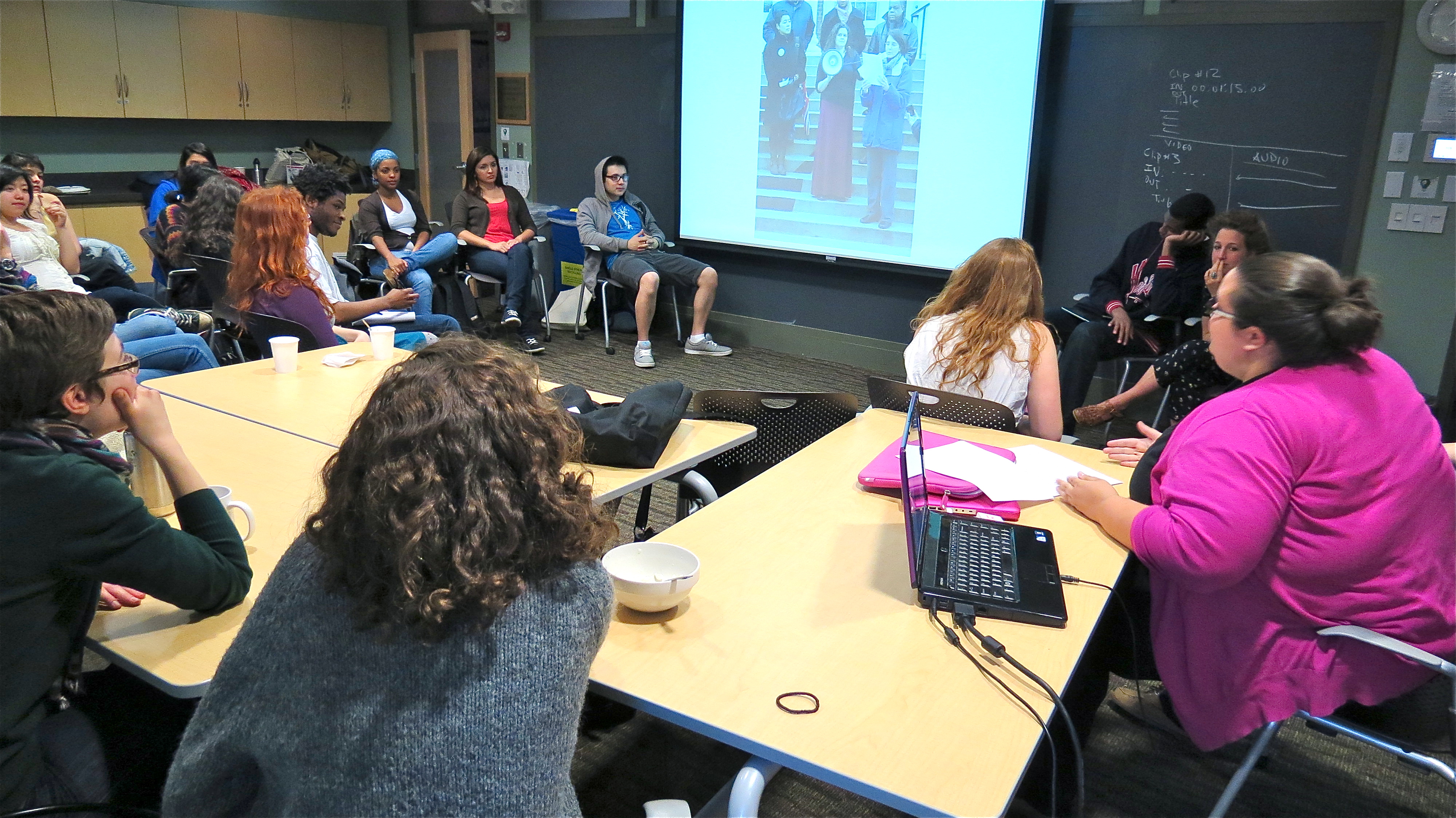
Cecilia Marquez ’11, PhD candidate in History at the University of Virginia and a key student leader in the struggle for a living wage for UVA employees, engaged students in an interactive discussion about the history and context of the campaign at UVA, strategies and tactics employed (including a historic hunger strike, which received widespread media attention), and the successes and shortcomings of the campaign thus far. She contextualized the struggle at UVA within a larger climate of living wage and union recognition campaigns happening at universities all over the country.

Cecilia covered specific topics in campus organizing, such as how to effectively organize with campus staff and foster student-staff solidarity, how to run an effective media campaign, how to make decisions about tactics in a campaign, and how to negotiate with college administrators.

For more information, check out the Living Wage at UVW webpage here. Swarthmore Labor Action Project (SLAP!), which monitors wages since the College implemented increases since the Swarthmore College living wage campaign in 2005, sponsored the event.

“Ain’t no power like the power of the people, ’cause the power of the people don’t stop. Say what?!?!” 

Thanks to Danielle Noble for written content.

Some pictures and video from the evening’s discussion.

Tag Cloud