Humble Contributions to the Peoples' History

Archive for the ‘Photography’ Category

Weekly Photo Challenge: Explorations in Minimalism

These minimalist photographs seem to tell a story of a philosophical extension beyond what we actually see. We wonder, what is over the horizon or after the last step on a staircase. The tattered phone booth reminds us that we can ignore the rustic housing and pick up a phone and dial anywhere in world. The macro lens extends our eye in to the world of the ladybug, as her tiny feet step into the crevices of her journey.

<a href=”http://dailypost.wordpress.com/dp_photo_challenge/minimalist/”>Minimalist</a&gt;

Photography Tip: Using Art to Create Scenes

In Art Imitating Life, I posted a photograph in which workers were unloading a truck and, by coincidence, that scene was depicted exactly in the mural right above their heads. It’s delightful to catch those moments, but photographers can set up similar interactions with art, creating an entire new pictorial presentation, while sometimes adding a bit of whimsy. Another blog post, Mea Culpa: Breaking the Rules at the Art Museum, has an example of creating a new vignette from an old painting.

Here’s a series of photographs that incorporates a new portrayal of a work of art. The photographer doesn’t just take a picture of art, but rather creates a new interpretation from the surrounds or by including their own additions to the scene.

subway station

The escalator provides the conduit for real-life subway patrons to become part of a scene of a train station mural.

Sign Duplicationjpg

Message on the wall replicates the sign the men are holding, reinforcing the theme.

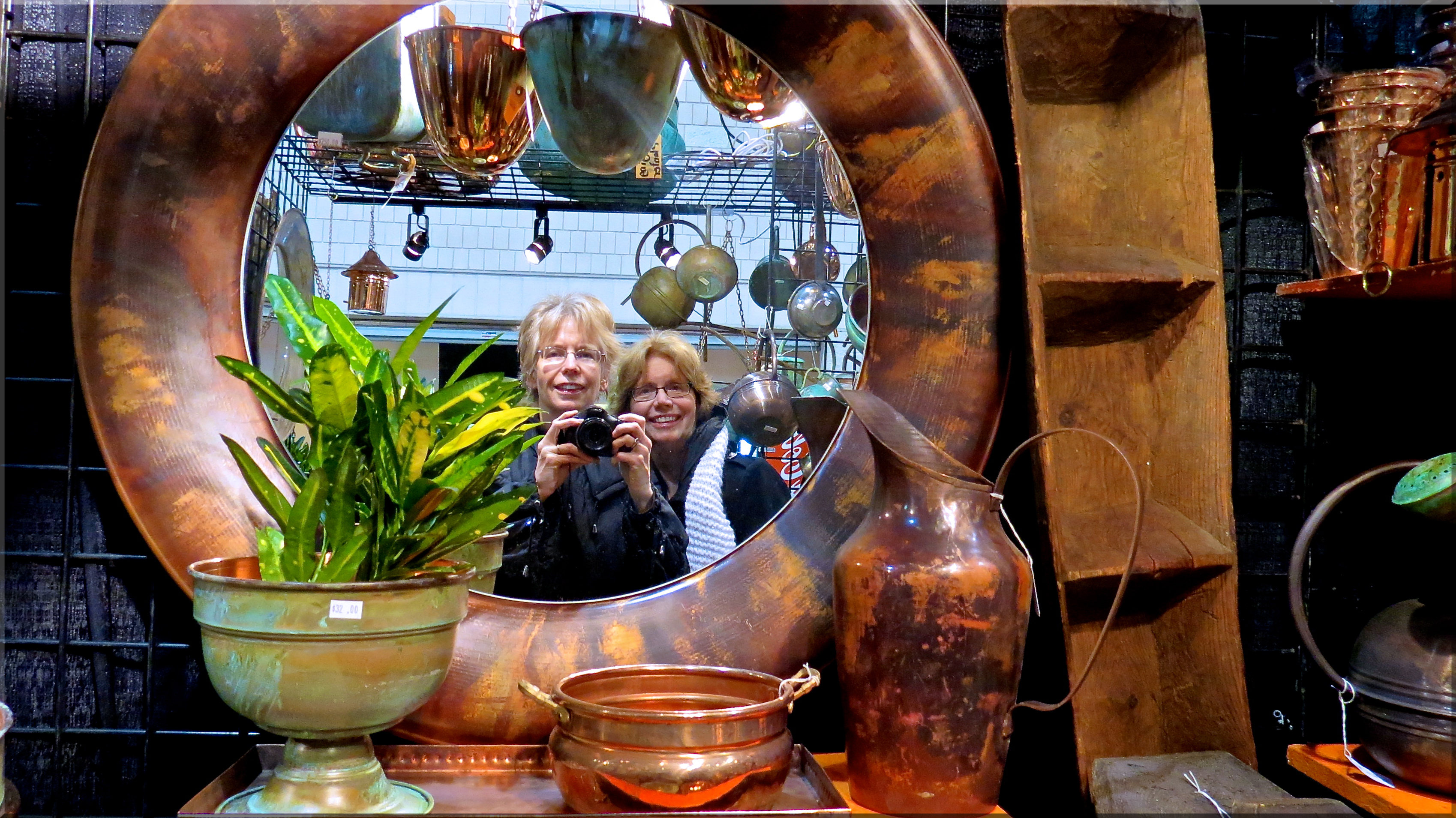
Reflecton

Using a mirror in a still life display to insert a selfie.

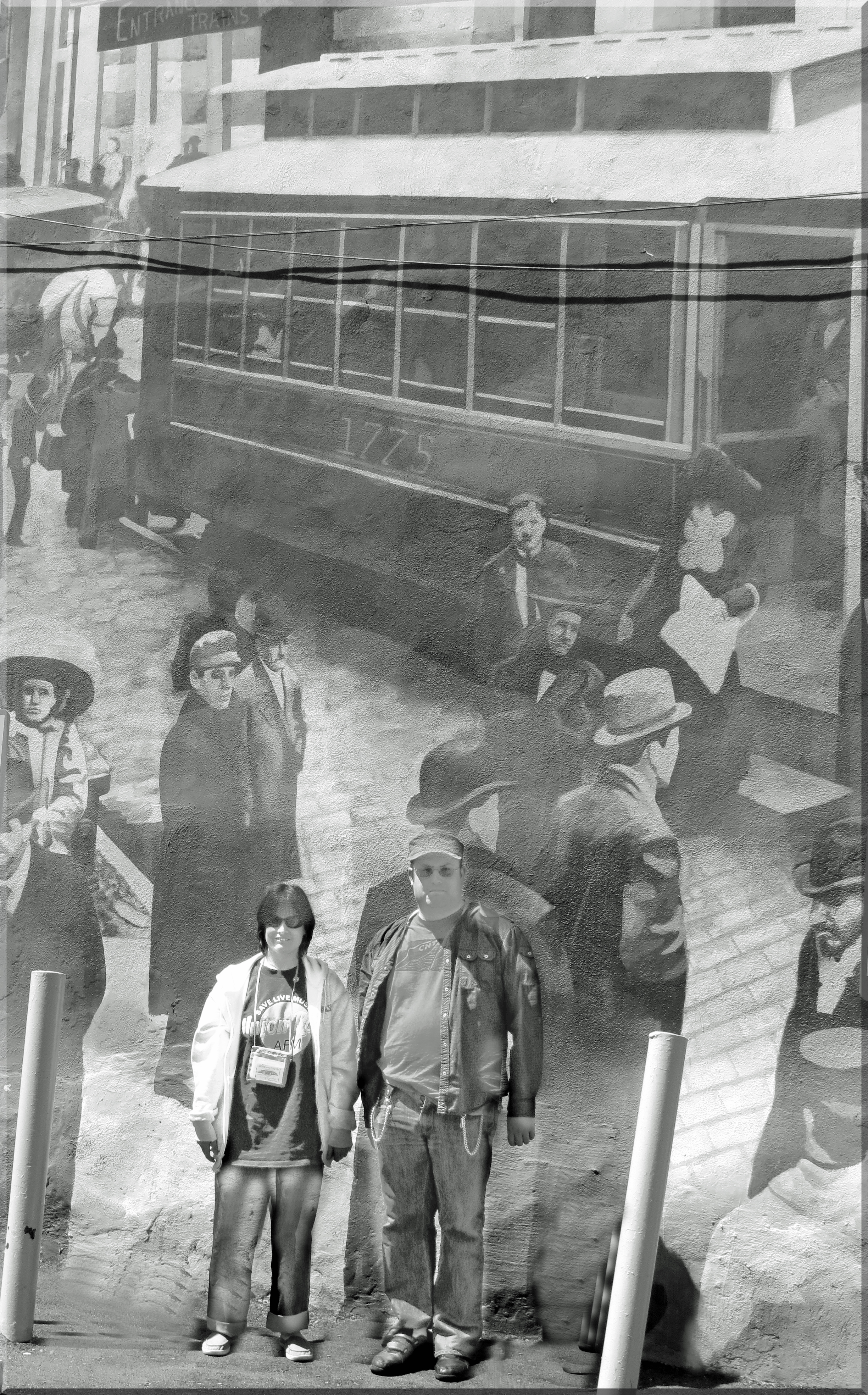
Black and White

A couple stands in front of a mural in West Philadelphia. Since the mural is painted in black and white, I changed the color in the photograph to match the background.

Asking

When traveling through France we were often lost, and to tell that story, I am asking directions to unresponsive statuary.

Have you incorporated an interesting art piece into any of your photographs to create a new vision? Leave a link in the comments!


Autumn Afternoon at Longwood Gardens

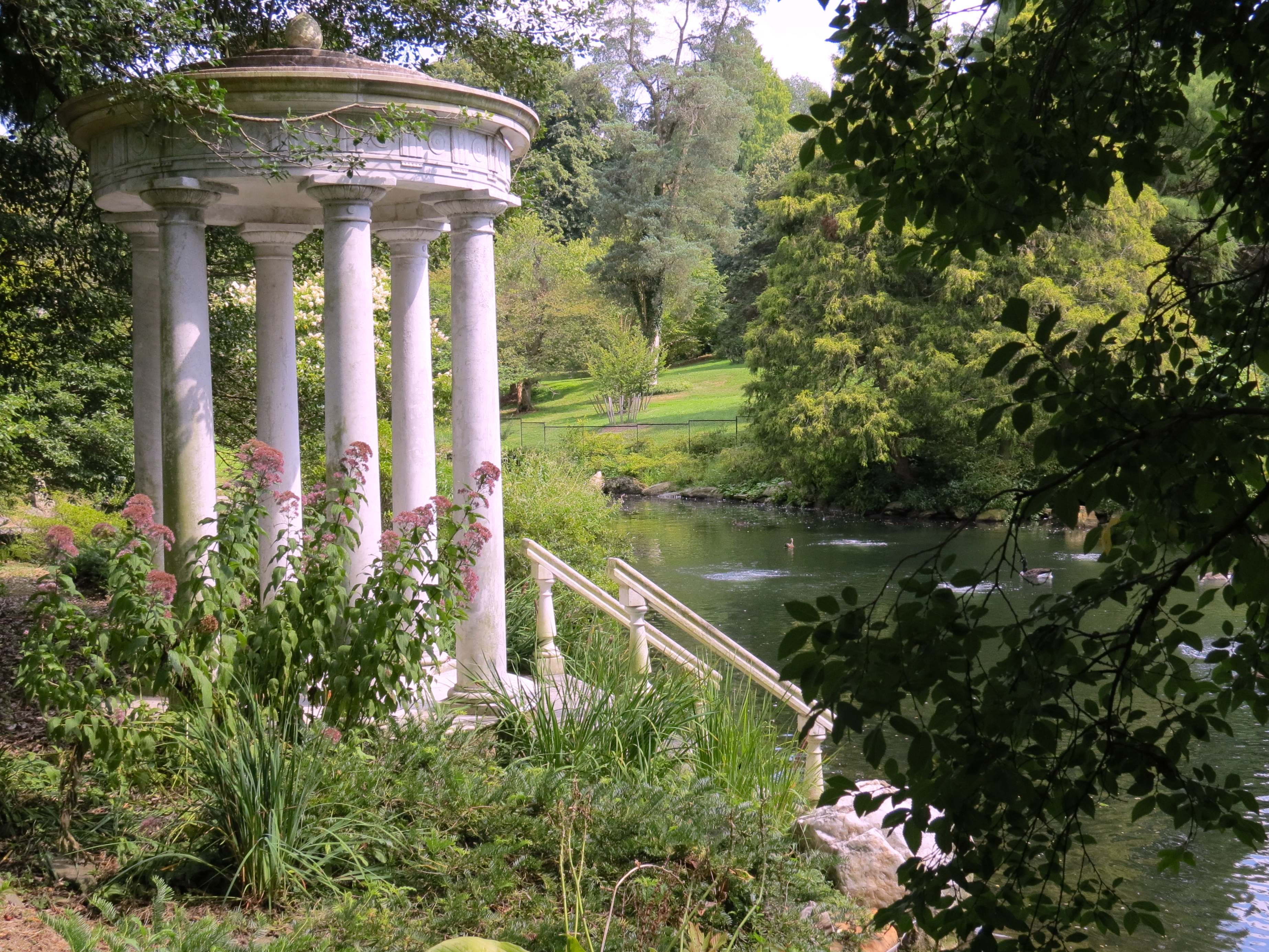
longwood-gardens-gazebo closeLongwood Gardens, one of the most beautiful botanical gardens in the United States, is a popular destination for visitors in the spring and winter holidays. One of my favorite memories is the skating performances, set in a snow-covered backdrop with colored lights reflecting on the ice.

I couldn’t imagine how the autumn season could complete with the holiday display, but every path through the garden offered beautiful vistas and colorful flowers. On this clear October afternoon, I walked by two lakes, through the meadows, into the woods, over to the train display and inside the conservatory. Even though the parking lot was filled with cars, over 1,000 acres allows visitors to explore the many sites without crowds.

Several months ago I visited Morris Arboretum in Chestnut Hill, Philadelphia, where G-scale model trains and trolley cars ran along a quarter-mile of track through a magical garden setting. Longwood Gardens has built a similar display incorporating colorful plants and water features into their train layout.

Given the number of bulbs and gardeners working on the plantings, that display should be spectacular come spring time.

Longwood Gardens bulbs

Summer Camp, Fifty Years Ago, and Almost Not Making it Back Home

Rite of Passage: the Summer Camp Experience 1957

For many children in the U.S., the summer camp experience has become a right of passage: separating from parents, friends and a familiar neighborhood to live in “the great outdoors” and learn life strategies of how to get along with adults and other children. According to the American Camp Association, nearly 11 million kids attend one of the 7,000 overnight camps each summer, with stays ranging from a week to two months. I had classmates whose parents sent them to camp for the entire summer. Research suggests that camp can build confidence, social skills, and independence. Probably for most kids, the experience is a mixed bag, like life.

Girl Scout camp Hidden Falls provided that experience for my sister, Jean, and her two friends. Jean wrote my parents the quintessential camp letter, “Please, please come get me! I hate it! . . . almost mimicking to a tea Allan Sherman’s hit single record years later, “Hello Muddah, Hello Fadduh,” a comic song in which a camper bemoans his experiences to the tune of Ponchielli‘s Dance of the Hours.

Take me home, oh Mudda Fadda
Take me home, I hate Granada
Don’t leave me out in the forest where
I might get eaten by a bear

Camp Nik-o-Mahs, in the Mountains of Central Pennsylvania 

I remember being intrigued by the Camp Nik-o-Mahs brochure. The camp was once a scout camp founded in the 1920 and named for the nearby town of Shamokin, spelled backwards, that is. The Hall family, who lived in my hometown of Springfield, operated the camp. The list of activities sounded exciting: archery, swimming in a creek, campfires, canoeing, all in a woodsy atmosphere. The cabins resembled little clapboard houses with porches. The camp sponsored overnight hikes and a trip through a water cave. In 1958 the brochure read that campers can “frolic to their heart’s content” in the creek. [1] An adventurous 11-year old, I loved all of that so I begged my parents to let me go. They were not so enthusiastic. My folks were protective and not convinced that the experience would be as joyful as I was imaging. The begging paid off, however, and they submitted the application what I think was about $35 for a week. What could happen in a week, after all?
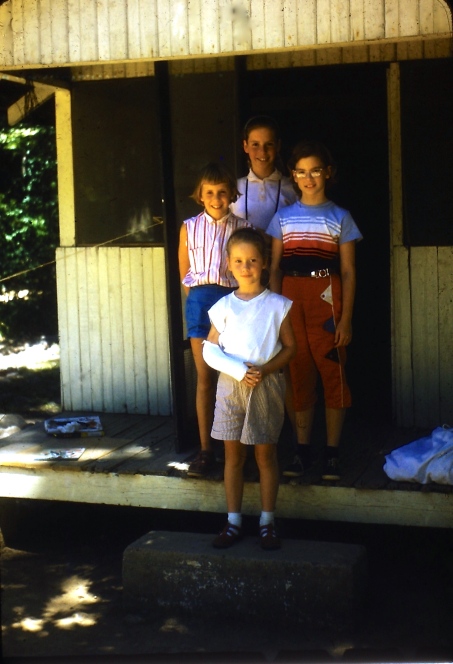
First Day of Camp (me in the back)

First Day of Camp (me in the back)

Introduction to Latrine Duty

After a four-hour drive, but which seemed endless–due to my excitement, we arrived at the camp. Each cabin had three sets of bunk beds, with four to six sharing girls the quarters. About nineteen cabins lined along a dirt path, the girls’ cabins grouped together, then the boys’ cabins further down. I think there was a rule about not being allowed on the boys’ side.

After saying good-bye to parents, counselors explained the rules and regulations and gave us a tour of the camp. They pointed out the shower room. You could take a bath, but you had to do something with water, like build a fire, to make it hot. I didn’t take any baths.

I was nervous about getting along with the counselor and other girls in the cabin. I recall that I thought the counselor was a bit bossy, but I soon became friends with the other campers and enjoyed their company.

The next morning we dutifully cleaned our cabin, as instructed, and awaited inspection. Beds had to be neat, clothes put away, and the floor clean. Counselors marched in with clipboards and pencils and snooped around the corners of the cabin and found two “dust bunnies” under my bed. For the offense, they assigned our cabin the dreaded latrine duty. Later I would tell my mom about what happened, and she was quite indignant that she was paying good money only to have her daughter clean toilets. The job wasn’t that bad, actually, it was more the idea of cleaning toilets. Our cabin passed all subsequent inspections.

Campfire Philosophy

At the first evening campfire, the camp director introduced us to the hierarchy of swimming privileges. The top place was reserved for the members of the Walrus Club, who carried a card with their special designation and were permitted to swim in the deep water. I made up my mind that night that I would take the swimming test the next day, as I wanted to enhance my status with a Walrus Club membership.

Campfires were held almost every evening, and we would sing the typical camp songs.  Looking back on these songs, I’ve realized that the theme of mortality ran through the lyrics of many of these songs.

Titanic
There was a ship Titanic that sailed the ocean blue,
And they thought they had a ship that the water wouldn’t go through,
It was sad when the great ship went down.
Husbands and wives, little children lost their lives (in a high voice)
It was sad when the great ship went down.

Can’t Get to Heaven
Can’t get to heaven on roller skates, you’ll roll right past those pearly gates.
I ain’t going to grieve my lord no more, no more.

Found a Peanut
Found a peanut, ate a peanut, got a stomach ache, called the doctor, died anyway, went to heaven, said go the other way.

Maybe these songs were trying to tell us we wouldn’t always be carefree kids and that we’d better wise up to the ways of the world.

Not sure if singing these other lines from the Titanic song also put a psychological bent into my head for class consciousness, which I’ve been confronting of late?

They were nearing to the shore, when the water began to pour.
And the rich refused to associate with the poor,
So they sent them down below
Where they’d be the first to go.
It was sad when the great ship went down.

Food, Glorious Food

Reveille played over the intercom to wake us in the morning, and we lined up at the mess hall for breakfast. We sat on benches in front of long tables, food served in large bowls. At home, we didn’t usually have bread with our dinner, but here everyone scoffed up the bread. Mom told me that after I returned from camp, I ate everything. The camp experience had expanded my palate!

The camp operated a little store, and parents left an allowance for incidentals. I became totally addicted to string, red liquorice, which I considered the yummiest of candies and spent just about all my allowance on the red stuff.

Jumping into Penn's Creek

Jumping into Penn’s Creek

Notoriety on My Second Day: “Can’t get to Heaven”
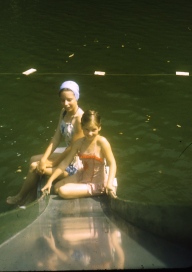
PICT0002

At the bottom of the slide

Standing on the pier over Penn’s Creek, I asked the adult counselor if I could take the swimming test for the Walrus Club. She said ok, and pointed to a wooden raft in the creek. Part of the problem may have been that I am nearsighted, and I wasn’t wearing my glasses and couldn’t see where she was pointing. Two rafts floated on the creek, one just beyond the sliding board and another way down the creek in the deep water. “Well,” I thought, “that raft beyond the slide couldn’t be the destination, it was far too close for any test for the Walrus Club.” I jumped into the water and swam toward the far raft. I was a good swimmer, I knew I could do the swim. On my return trip, I passed by the sliding board, and at that very moment, an inexperienced camper took off down the slide and panicked, grabbing me for support, pulling me under the water. I was tired by that point and could not cast him off. I told myself, “If I could just get one breath . . ..” Then realizing that was hopeless, I thought, “This is it.”

I blacked out. I came to as the lifeguard carried me to the shore. I was crying, but not sure why as I couldn’t remember deciding to start to cry. The waterfront came to a standstill as I sat sobbing on the sand. From that moment on, I was known as “the girl who almost drowned.”

By the next day, I had completely recovered from the ordeal. I wasn’t fussed over, not even sent to the infirmary. What occupied my thoughts now: did I pass the Walrus Club test? I was ready to retake the test. When I asked the swim counselor, she told me, yes, I had passed, and remarked, “It was a good thing I had been watching you.”

Summer Romance 

One serendipitous happening from the almost drowning incident: I met my first love. A seasoned camper at Nik-o-Mahs, “Plottsie,” as everyone called him, approached me on the path to the waterfront, “Are you the girl who almost drowned?,” he asked. Thus, began the romance. Plottise was a thin boy with glasses and usually wore a plaid shirt. We hung out and sat together, and of course, we were teased by the other campers for our attachment.

A special event on the night before we left marked the end of our stay. The counselors handed us candles on little cardboard floats, and we gently placed them on the creek, watching them glide downstream until they fell over the waterfall. The flickering lights in the dark forest reflected on the water, and Plottsie and I held hands as we walked along the path that followed the creek. All was perfect.

Then Plottsie popped a question, “Can I kiss you?” Thrown into confusion, I asked myself, “Was I old enough to kiss?” “Was I allowed to kiss?” “What did this mean?” I replied, “I don’t think right now,” and with that remark, coolness came over the night. The next day, I went looking for Plottsie as I wanted to take his photograph before I returned home. He stood at a distance as I snapped the photo and hurried off. When I returned home, I mistakenly opened the camera, exposing the picture to light. Plottsie had disappeared in a cloud of whiteness.

The Following Year

The next summer I returned to Camp Nik-o-Mahs. The red liquorice had lost its appeal, and the trips and hikes were no longer new experiences. The candle ritual on the last evening was still beautiful, but I stood alone looking through the silhouettes of the trees thinking I probably wouldn’t be back.

De Ja Vou, Returning to the Camp, 50 Years Gone By

For whatever reason, I decided that I wanted to return to Camp Nik-0-Mahs, which had been closed for years. I wasn’t sure what I’d find there, but a road had been named for the camp. I thought that I might be able to recognize the place along the creek, even if the buildings were no longer standing.

Returning to the camp meant a road trip through the Allegheny Mountains, part of the Appalachian Range that runs through the eastern United States. Traveling in mid-October the leaves were at their colorful best with reds, yellows and oranges between dark green trees not yet turned. The sun would occasionally peek out from behind heavy cloud cover, casting a glow on the landscape, highlighting nature’s pallet of colors. The road twisted around the mountains as we drove upward, only to come back down on the other side. Farmlands spread out in the valleys with fields of dried cornstalks and sunflowers against meadows of green clover. Barns, some unpainted and rustic, others vivid red, dotted the landscape. Little villages of clapboard houses clustered along crossroads.
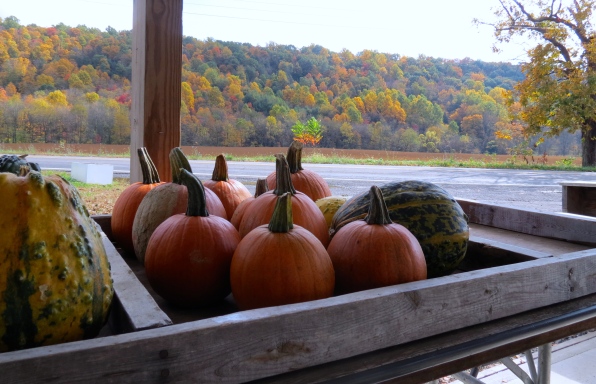
IMG_8465

Penn’s Cave

An outing to Penn’s Cave was one of the trips we made during our stay at camp, so on this trip, I planned a stop there. Penn’s Cave had been a popular tourist stop back when I was at camp and is still is today, as it is one of the few caves accessible only by boat. Since my camp days, the cave had been added to the National Register of Historic Places.
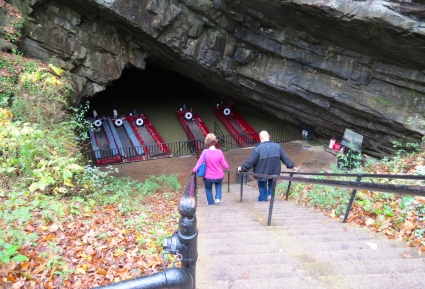
Entrance Penn's Cave

The area looked much the same, with the Penn’s Cave House, the three-story frame house built in 1885, standing near the entrance. Steep stairs still led down to the cave and the familiar flat-bottomed boats that took us through the watery cavern were the method of transport. After gliding through the cave, we came out on the other side to a large pond and then returned through the cave again. The tour was almost exactly as I had remembered it.

Finding The Camp

We followed Route 235 through the towns of Laurelton and Glen Iron, making a turn at Creek Road, near the end of which we found Nikomahs Drive paralleling Penn’s Creek. We drove until the road disappeared into the forest, so we got out of the car to look around for any sign of the camp. The house at the end of the road looked very much the era that I had remembered, painted cream with green trim. A sign confirmed the name of the house, Windy Inn, which the Mifflin Times reported was built sometime before 1920. [2] We found several stone structures, now abandoned and left to the elements. One lone building stood intact with a slab inscribed with the date, 1926. A stone sign above the door read: “Erected in Honor of our Mothers.” I guessed that the building may have been the old mess hall. I couldn’t find any trace of the cabins.

I walked to the edge of Penn’s Creek, which looked quite impressive as the current moved swiftly from the heavy rains on the previous day. I guess those many years ago I could have been lost in those waters, but the fates prescribed that my destiny would be to stand here on the bank of the creek decades later.

[1] “Camp . .  Nik-o-Mahs, In the Mountains of Central Pennsylvania,” Millmont Times, Vol 14, Issue 2, June 1, 2013, p. 1-12.

[2] Ibid.

<a href=”http://dailypost.wordpress.com/dp_prompt/finite-creatures/”>Finite Creatures</a>

Epilogue

Since writing this post, I’ve learned more about the history of the camp, from the comments here and on About Me.  Many thanks to everyone who shared their histories. Tom Hall, whose parents ran the camp, wrote me about some of the other camp traditions. The citing of the ghost of Penn’s Creek was always a favorite. Can never go wrong with ghost story. Besides the Walrus Club, campers could join the Old Timers Club. Another camp event was the funeral service for Jake Hopper (the outhouse that got too full). Tom relates about the “big time campfires where the fire would come out of the sky to light the main fire.”  I recall that we hiked somewhere out of the camp, maybe in was to to Tall Timbers. One of counselors took a wrong turn, and we wandered around a backroad until we were rescued.  Campers visited Rolling Green Amusement Park, which went out of operation in 1971. The camp closed its doors in 1966.

Bicycling the Schuylkill Banks Boardwalk, Philadelphia

This past June my sister and I biked along the trail that runs parallel to the Schuylkill River, and we returned on a warm October afternoon to head in the opposite direction and try out the new addition to the path, the Schuylkill Banks Boardwalk. Officials opened the new leg of the path just several weeks ago.

IMG_8407

We bicycled past the view of Boathouse Row and around the back of the Philadelphia Art Museum and alongside of Waterworks before coming to the over-the-water extension. A viewing area above the walkway at Locust Street gave us a vantage point to take photographs up and down the river.  On a Tuesday afternoon, there wasn’t much pedestrian traffic so the four-block ride to the end at the South Street Bridge in West Philadelphia took about ten minutes. Along the trail the boardwalk widens with benches so we could pause and view the cityscapes.

This slideshow requires JavaScript.

The walkway serves as a practical walking path from 30th Street Station to the Art Museum. Normally, I would take the subway from 30th Street and get off at 22nd Street, and then walk to the Art Museum. Now the walkway conveniently connects those locations while enjoying the beauty of the Schuylkill River.

Pirates Celebrated at Marcus Hook Festival

September 21, 2014

The legend that Blackbeard, the notorious pirate of the 18th Century, once walked the streets of Marcus Hook, a town nestled on the Delaware River just below Philadelphia, provided the justification for a lively festival and an opportunity for the Marcus Hook Preservation Society to raise booty for the restoration of the Plank House, where rumor has it, that Blackbeard and his crew spliced the mainbrace!

Marucs Hook isn’t the only town to celebrate their pirate heritage. At the Beaufort Annual Pirate Invasion: It Takes a Village to Pillage, the town recreates actual pirate invasion in 1747. Blackbeard also made several appearances in Beaufort until the governor of Virginia tracked him down. The seaport festival in Philadelphia is the backdrop for a pirate battle on the Delaware River, as tall ships blast their cannons in mock high seas battles.

The pirates at Markus Hook opened their encampment to visitors, their period tents offering vignettes of camp life, with open fires providing the aroma of burning wood. Firearm displays, cooking demonstrations and craft tables gave the landlubber much to gaze at and appreciate. Pirate garb is particularly fanciful, with feathered hats, long waistcoats, billowy blouses and gold jewelry. Most events didn’t cost a single dabloom, if you can just resist spending your last farthing on pirate wares at the vendor booths.

The entertainment on stage included enthusiastic performances of pirate music and sea shanties, from groups such as the Brigands. Pirates brandished their swords during the lively swashbuckling contests.

Canon firing complements of Archangel, TheVigilant Crew and the Crew of the Mermayde.

Returning to Rising Sun, Civil War Reenactment

Trailer  . . .


October 4, 2014

About a mile south of the Mason-Dixon Line, the historical boundary between Maryland and Pennsylvania, the town of Rising Sun rests in the quiet farmland of Cecil County. According to the town’s Facebook page:

The Missouri Compromise of 1820 created the political conditions which made the Mason-Dixon Line important to the history of slavery. It was during the Congressional debates leading up to the compromise that the term “Mason-Dixon line” was first used to designate the entire boundary between free states and slave states.

No Civil War battles were fought in Cecil County, but Frederick Douglass, on his escape from slavery, passed through Perryville, about ten miles south of Rising Sun, and then continuing by train to Delaware.

The Rising Sun Historic Preservation Commission sponsored the Annual Rising Sun Civil War Re-enactment, in partnership with Company A 37th Regiment, North Carolina Volunteer Troops. Over 500 local school children visited the encampment to view the demonstrations. The historical reenactors set up vignettes inside and outside their tents with artifacts and antiques from the time period. Danea Selby portrayed Catherine Virginia O’Connell, sharing her family history and homeopathic treatments.

Dr. Theodore Tate’s display included surgical instruments and medical supplies from the time period.

The Preservation Commission treated the reenactors to a full-course dinner on Saturday night. Both reenactors and guests danced at the Civil War Ball, held on the moonlit night. Music by Kaydence, featured traditional folk music with instrumentation that included guitar, concertina, flute, fiddle, mandola, banjo, and penny whistle. Tom and Lesley Mack, who called the dances, represented the Shenandoah Valley Civil War Era Dancers. A quote from their Facebook page says it best,

a dance was a chance for everyone to be cheerful in order to forget the raging war even for a few hours. It was a place to meet neighbors, friends, or newcomers and enjoy the music and dance of the time.


Near the end of the evening, reenactors fired the cannon one last time.

Experiment still frame 0477

Participants

Confederate
9th Virginia Cavalry, Company B
37th Regiment, North Carolina Volunteer Troops, Company A
1st Regiment, North Carolina Artillery, Battery C
1st Regiment, Maryland Infantry, Company 1
5th Regiment, Virginia Volunteer Infantry
2nd Corps Field Hospital
Lt Col Robert Archer Camp, Sons of Confederate Veterans

Union
2nd Delaware Volunteer Infantry, Company G
42nd Regiment, Pennsylvania Volunteer Infantry, Company B
Federal Generals Corps & Staff
Sedgwick VI Corps, U.S. Army


Civil War Skirmish at Red Clay Creek

Wilmington RR2

On a warm morning in September, I returned to Red Clay Creek in Delaware to photograph the woodland scenes and Wilmington & Western steam train that provided the backdrop for the skirmish. Photographer for Philadelphia Weekly, J. R. Blackwell, and I met up with General John Houck and the other reenactors portraying both the Union and Confederate forces. J. R.’s photographs feature stunning portraits of the soldiers and camp folk.

The Night They Drove Old Dixie Down. This link has an interesting history of the song. On a comment board, someone wrote this insightful post:

My great-great grandfather fought for the Union (wounded 3 times) as he was an abolitionist, and yet this song moves me so much, it almost makes me feel sorry for Southerners. And I mean no irony in that last sentence. As my Uncle Bill, a combat infantryman in WWII said, “Rich old men start wars and send poor young men off to die in them.” Pretty much the case for almost every war.

This next video came out of an experiment where I interviewed reenactors to set up a storyline for the video, as I wanted to try a different approach by expanding on the music videos I had made last year at Red Clay Creek and Rising Sun. When asking folks why they became involved with reenacting, many Confederate and Union soldiers felt strong connections to their ancestors who fought in the Civil War. I understand that relationship as I have an affinity with those who came before me and have written about their lives on this blog. The end of the Civil War meant that those who had lost their connections to family and culture through slavery could now begin to establish their heritage.

Historical Reenactors

Morris Arboretum and the Summer Garden Railroad

Swan Pond

Swan Pond

For over a year, I’d been planning an outing to the Morris Arboretum, and finally after a late start, drove down PA 476 to the northwest corner of Philadelphia to the Chestnut Hill neighborhood of the 92-acre garden. Ignoring the heat at around 90 degrees, the high humidity and thunder clouds threatening in the distance, I considered these positive circumstances–no crowds!

The gardens were set high on a hilltop, providing lovely views of the surrounding forest landscape. The gardens, modeled after the English park style, featured wide paths that wound past a swan pond, rustic cabin, stone buildings and sculpture exhibit. Sounds of water trickling along the creek offered a soothing and cooling atmosphere in the summer heat.

Much of the park is shaded, and I kept to those paths that offered relief from the direct sun. I strolled along the 450-foot raised walkway, built from recycled metal and wood, and which soars to 50 feet at the highest point through the treetops. Rope netting hung like hammocks where visitors could just lay back and gaze at canopy overhead. A gigantic bird nest made from tree branches provided benches to sit and ponder the three large blue “eggs” resting in the center.

The Garden Railway

My fascination with trains is what really brought me to this garden. G-scale trains and trolley cars run along a quarter-mile of track through a magical garden setting. The entire display, including all the buildings, are constructed from natural materials, everything from bark to seeds. Rivers and waterfalls flow through the miniature town, which includes replicas of famous Philadelphia landmarks such as Independence Hall and the Betsy Ross House. Each building was a masterpiece, with intricate detailing in the doors and windows. The whimsical chicken train glided along to accompanying music, what else but the chicken song, and the Oscar Mayer Wienermobile even carried a bottle of mustard. I lingered for quite a while in the railroad garden, as the miniature recreation offered so much to enjoy.

A thunder-storm rumbled through the hills, driving me back to my car. With many other gardens to visit–the rock wall, rose and water gardens and Japanese Overlook–I know I will return, perhaps during the holidays, when evergreens, holly boughs and twinkle lights decorate the train scape.

Did I find a Native American Artifact?

Just a rock? Or Native American Artifact?

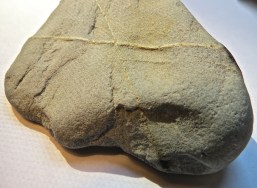
IMG_7591While beachcombing on an island off the coast of Maine, I came across a rock, just one of thousands piled along the shoreline. What struck me about this rock was the straight planes and angles, as if a human had cut the rock rather than being shaped by natural forces. The rock fit nicely in the palm of my hand. Black deposits appeared on three sides, the fourth side, none at all. Shaped like a wedge, etchings marked the narrow edge. New Englanders told me that some folks collect these rocks, as they are considered lucky because two straight white lines cross each.
When I returned home, I scanned the Internet looking for any evidence that the shape might reveal its history. I studied images of Native American tools, but I could not find anything like it. I checked with the folks at rockpiles.blogspot,com, where Peter suggested that the rock might be a hoe,

You can see the “edge” as a worked sequence on the upper edge, and you can see how the hoe was was attached to a handle – the dark staining is from organic material like leather that was used to tie the hoe to the handle.

Corn Festival and Artifact Appraisal

I still wanted to learn more about the rock and came across the Roasting Ears of Corn Festival, Eastern Pennsylvania’s oldest Native American Festival, held at the Museum of Indian Culture in Allentown. One of their many events included a chance for an appraisal of an Indian artifact.

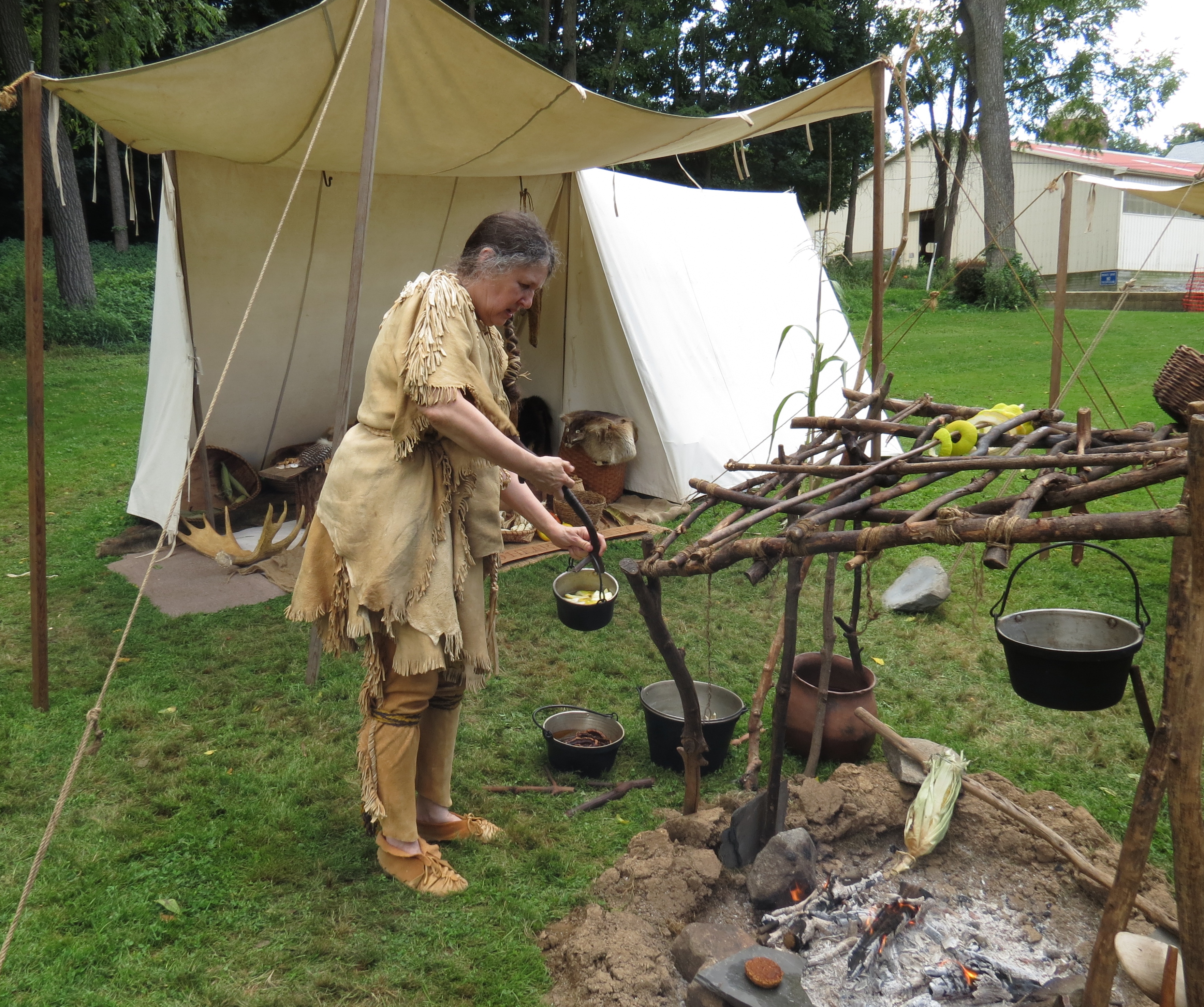
As I pulled into the parking lot, I could hear the drums in the distance and joined folks streaming into the staging area. Children were taking turns at the tomahawk and spear throw, and dancers filled the central arena. Before looking for the appraisal tent, I headed first for the line for the roasted corn. Buffalo burgers and Indian tacos were also on the menu. The blueberry frybread sounded good, so I ordered that, too, and found a seat at the picnic tables in front of the dancing circle. Later, I read about frybread in a Smithsonian article on the subject:

Navajo frybread originated 144 years ago, when the United States forced Indians living in Arizona to make the 300-mile journey known as the “Long Walk” and relocate to New Mexico, onto land that couldn’t easily support their traditional staples of vegetables and beans. To prevent the indigenous populations from starving, the government gave them canned goods as well as white flour, processed sugar and lard—the makings of frybread.

It seems that frybread has become a favorite at pow-wows and fairs, varying in the way it is prepared in each area of the country. Native American dancing, although energetic, is meditative with the rhythmic drumming accompanying the movements, and I fell under the spell in the soft summer air as I savored the blueberry frybread. Glad I didn’t know at the time could be as much as 700 calories!

IMG_7734

American Indian Cooking Demonstration

I have some familiarity with Indian history, having taken a course in Native American autobiography. In a post, My Favorite Book: Condemned by both the Left and Right, I write about the controversies surrounding the novel, Education of Little Tree. Alexie Sherman signed another one of my favorite books, Reservation Blues.  

Valuable Find

I found the Museum of Indian Cultures head curator, Lee Hallman, sitting behind his many collections of arrowheads, displayed in glass cases. Lee examined the rock and stated that it was definitely a tool, possibly a scrapping implement, and that it was Native American but not valuable. I had thought that if was important I would give it to a museum in Maine. Lee said it might be worth a dollar, at the most.  Well, regardless of the monetary value, looking at the rock, I think about the hands that crafted it.

Curator Museum

Lee Hallman & arrow display

Now that I had identified my rock, time to stroll along the many tents and exhibits. At one of the tents, a musician played a large wooden flute, and the melody was so enchanting, that I purchased the CD, Meditation, with the melody, “Love Mountain.” Several vendors were selling CDS so visitors had many choices of Native American music, current and traditional.

Lord of the Strings, Arvel Bird

The featured performer, Arvel Bird, played a magical combination of Native American and Celtic music, and I couldn’t image how I had the fortune to hear live someone who brought two of my favorite music genres together. Arvel’s biography on his website provides this description:

“Braveheart Meets Last of the Mohicans . . . at Woodstock” is a colorful description of this award-winning Celtic Fusion recording artist and his live performances. Arvel Bird, a violinist and Native American flutist, is known around the world for his dramatic connection between Celtic and Native American traditions, stirring up scenes that echo from North American memory. Dubbed “Lord of the Strings” by fans and music critics, his music evokes the soul of North American history and is thoroughly entertaining, but also enlightening and humanizing. In a language and experience that captures the hearts of all audiences, he’s emotional without being condescending, intellectual without being pretentious.

Arvel Bird

Given my Scotch-Irish heritage, I felt an immediate connection to his music. A skillful musician, Arvel gifted us with a joyful performance that reflected his passion for the violin. Celtic and Native American ancestral spirits would be deeply moved by his presentation of stories and songs. I especially enjoyed his classical piece, Tribal Music Suite: Journey of a Paiute, a Celtic and Native American Concerto for Violin and Native American Flute, which earned Arvel Best Instrumental Album.

I don’t usually believe in lucky charms, but somehow the rock brought me to this inspiring performance.

IMG_7588

Tag Cloud