Humble Contributions to the Peoples' History

Archive for the ‘Philosophy’ Category

Holiday Tree for Social Justice

Learn to do good; seek justice, correct oppression; bring justice to the fatherless, plead the widow’s cause. He has sent me to proclaim liberty to the captives and recovering of sight to the blind, to set at liberty those who are oppressed.   Isaiah 1:17

Inspired by my son John and his friend Jim’s activism for social justice causes, especially as advocates for workers’ rights, I decorated a holiday tree for them in the spirit of the season. Resurrecting a 30 year-old artificial tree, recycling/altering old ornaments and repurposing activist buttons . . . voila! an activist holiday tree!

IMG_1535

Details in slideshow.

Little Orphan Annie, the Poem Rewritten for the Political Climate Today

Mary Alice Smith, Riley’s inspiration for the poem. Wikipedia

In an earlier post, I described our family’s celebration of Halloween and how my Mother,  born in Scotland, followed the Celtic Halloween traditions. Our grade school classes also had Halloween celebrations–everyone would dress in costumes and parade around the school grounds, followed by parties in the classrooms. Homeroom mothers would serve cider along with orange and chocolate cupcakes.

One year my Mother came up with the idea that I should dress up as “Little Orphan Annie” – not the comic book character, but from the poem by James Whitcomb Riley. Riley based his poem on a real person, Alice Smith, who became orphaned when her father died in the Civil War. Allie, as she was known, lived with the Riley family, and she would tell stories to the younger children after finishing chores at the end of the day.

For my orphan Annie costume. I wore a dress with an apron and black stockings and carried a dust cloth and broom. I memorized the poem for a classroom presentation; Mom coached me on the proper inflection at the end of each stanza, “and the goblins will get ya if ya don’t watch out!”  Thinking about the poem, I recalled these lines . . .

and cherish them that loves ya, and dry the orphans tears
and help the poor and needy ones that cluster all about,
or the goblins will get ya if ya don’t watch out!!!

I became inspired to rewrite the poem for today’s current political climate, just before the 2012 election.

Over the past few months, I have received forwarded emails, not about a particular political issue or articulated argument advocating one position or another, but rather content focusing on rumors and lies with obvious prejudicial biases. In rewriting the poem, I included the lines above, written over a hundred years ago, as they apply today as well.

The Ghost of Little Orphan Annie on Election Eve

The ghost of orphan Annie has somethin’ strong to say,
Things you might’ve heard before but may have brushed away.
About payin’ those taxes, is that so very bad?
Or are ya worryin’ and fretin’ and makin’ yourself sad?
For all the roads an’ bridges, schools, an’ parks an’ like
Just let them go to dust?  Well, that would be a fright.
If you’ re complainin’ then finishin’ with a shout
The goblins will get ya if ya don’t watch out!

There’s ways to pull together as Americans will do
But a bake sale to cure a kid with cancer, mumps or flu?
Or how about a doctor for the child ill next door?
Or are ya a listenin’ to that politician’s unrelenting roar?
Now payin’ fair share, that’s not a scary scheme.
Those with more wealth could help, or so it would seem.
So let’s all pitch in together, please, don’t be a lout,
Or  the goblins will get ya if ya don’t watch out!!

Are ya balkin’ to give to causes that benefit us all?
Or is money is better spent on merchants at the mall?
With the social security Grandma can live her own
Rather than in your basement without a telephone.
And those that will follow you, fond an’ dear,
Take care of them, please, an’ dry the orphan’s tear
An’ help the poor an’ needy ones that cluster all about,
Or the goblins will get ya if ya don’t watch out!!!

So who are the goblins, do they hide in the night?
They’re just right in front of ya, in plain sight!
They tell ya that science is not on your side.
They tell ya not to worry, take your car for ride.
They point to your working pal as stealing your dough.
When its unregulated Wall Street that’s really the foe.
They make up a story so you’ll hate those abroad,
Those many poor souls, also victims of fraud.
Think: is it your anger what this is all about?
Then the goblins have got ya, ya didn’t watch out!!!!

The “Big Chair” and the Metaphore Bigger than its Presence

Perspectives on an Adirondack Chair

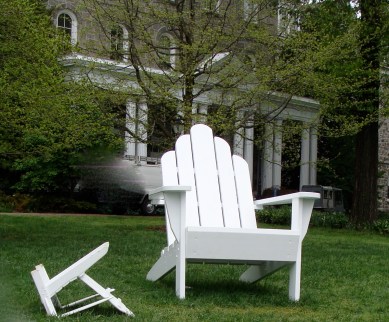
What’s the big deal about a chair? Actually, this chair is so big, about four times larger than a typical chair, and it’s a work of art that has taken on a life of its own. Jake Beckman, a student at Swarthmore College, conceived and built the original chair, which found a place among the other standard-sized Adirondack chairs that dot the stretch of lawn in front of the main hall on campus. Even The Colbert Report featured a segment about the famous chair.

Several years ago the original chair fell apart and was discreetly removed from the lawn. However, the campus community, becoming attached to the Big Chair, clamored to bring the chair back. Jake agreed to return to rebuild the structure, and the chair resumed its place with the others.

I guess I wasn’t the only one beginning to think metaphorically about the Big Chair. Some unnamed inventives would come by during the night, leaving the chairs in different arrangements, such as the Big Chair leading a line of the other chairs or the Big Chair in the middle of a circle. One morning, the Big Chair stood upright while a semicircle of normal chairs tipped down in front of the Big Chair.

Now I was thinking hard. The chairs assumed the metaphor for power dynamics .  .  . and not just at Swarthmore! I thought about “Big Chair” people, folks that tell us what to do or think: politicians, pundits, advertisers, bosses, CEOs, presidents, board of directors .  .  .  and I’m sure you can think of a lot more. Do we perceive these folks as big in influence, power, authority, and wealth and get drawn into a mindset that binds us to a deferential attitude? Many normal chairs sit on the lawn–there is strength in numbers when we act collectively. And normal-sized chairs serve a real function. We wouldn’t make 25 more Big Chairs.

On reflection, perhaps we do need the Big Chair–reminding us to keep the right perspective.

The Wren’s Vanishing Act

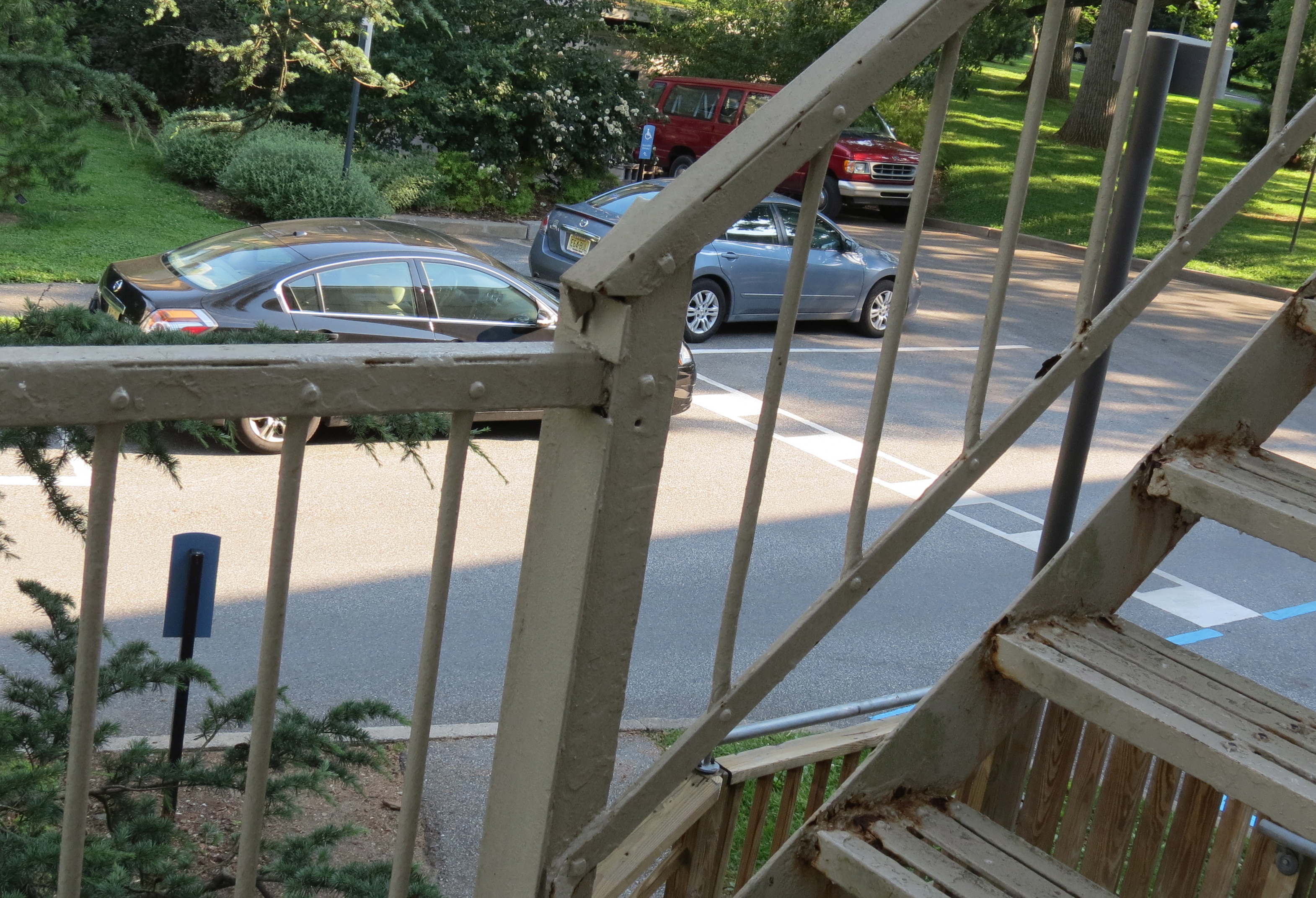
Every morning I hurriedly climb a back staircase to get to the office to begin another day of work. A week ago a small brown bird danced along the hand rail as I came up the steps. The little bird stood her ground. I admired her defiance.

On the second morning, she was back flitting between a nearby tree and the railing. The night before I checked my bird book and identified her as a House Wren, with her turned up tail and warbling tweetie song. I thought she must have a nest somewhere. I looked in the tree and scanned the walls of the building to see if twigs might be sticking out from a light fixture or downspout, but no such signs appeared.

Checking the Internet, I learned that Wrens can build their nests in strange places. A cavity nest builder, their nests turn up in abandoned bee hives, old hats, tin cans or flower pots. I couldn’t see any such cavities in the area.

On the third morning, the Wren appeared again. This time I watched her from the window on the second floor. Surprisingly, the little Houdini just disappeared! I had to get a closer look to discover the magic trick.

I inspected the railing and found a tiny opening between the pieces of metal. Evidently her brood had already hatched judging from the beak full of breakfast she prepared.

Her magic disappearing act worked well as almost no one noticed her on the stairway–until those babies started squawking, drawing attention to themselves. I guess a loud voice trumps discretion for the young ones.

As I rise and fall on the steps, I think about the deliberate actions of the parent Wren on the railing and the little ones tucked in the metal encasement. I wonder at their place on the staircase, intentions as deliberate as mine heading to the office.

My Favorite Book: Condemned by both the Left and Right

Perhaps the only thing the Left and Right might agree on is that the author pokes fun at politicians . . . “of any stripe, who had no regard for how folks had to live and get by.”

If you think that you might have any interest in reading Education of Little Tree, I’d suggest doing that before reading further in this blog post. I was glad I had read the book before knowing the back story on this novel.

Everyone Banned this Book!

I seem to have found myself embroiled in plenty of controversies and heated debates in my life, even down to my favorite book: Education of Little Tree. For me this touching story spoke to a longing for loving and enduring relationships in childhood, while offering the wisdom to live a thoughtful life through deep insights into human psychology. The name of my blog derives from a story in Little Tree, explained on the Welcome Page.

This book appears on the banned book lists on the Right because of profanity, references to sex and negative portrayals of charity organizations and Christians. Critics on the Left condemn the author, Forrest Carter, a.k.a Asa Carter, who as a white supremacist and one-time member of the Ku Klux Klan, wrote hate speeches for George Wallace. Critics became infuriated at the first categorization of the book as an autobiography. Some in the Native American community labeled the book a hoax. “Why do they [white people] prefer fake to real, when it’s about Indian people/history/phony mysticism?” (Guise).

Upon learning about the controversy around the author, I felt that becoming familiar with Native American literature might offer other perspectives. I enrolled in Native American Autobiography, taught by a professor from the Seneca tribe. As part of the requirements of the course, I wrote a research paper on Little Tree.

Appalachian Mountains

Controversy Surrounding the Author’s Identity

There’s no denying that Forrest Carter was a speechwriter for George Wallace, penning the words, “Segregation, Now. Segregation Forever.” Carter’s life was peppered with most despicable incidents of racial hatred.

One wonders how Carter could write articles for The Southerner, a white-supremacist publication, within a few years of writing Little Tree? Carter’s own family provides contradictory testimonials as to his motivation in writing this book. Talking to a reporter in 1984, Carter’s brother, Doug, said that Asa’s writing was a scheme to raise money for a political comeback in the ’80s. Carter’s widow, India Walker Carter, faxed a letter to Carter’s original editor and agent saying that “the philosophy in Little Tree was so much of part of Forrest’s being . . . he did not write Little Tree to make a fool of anyone . . . he didn’t have to change, to write this book” (McWhorter). In an interview India said that Little Tree was a “pastiche of family legends” that Forrest used to tell his children (McWhorter).

Did Carter remake himself or does it matter?

In order to answer this question, consider two issues:

1.  Do we assess only the merit of the art, or are we obligated to also investigate and analyze the motives of the writer/artist? Consider . . .

  • Should we discount the Constitution because one of the primary contributors, Thomas Jefferson, owned slaves?
  • Beethoven beat his musicians; should we refuse to listen to the 9th Symphony?
  • Uncle Tom’s Cabin is credited with helping to fuel the abolitionist cause before the Civil War, but the book also created and spread common stereotypes about African-Americans. Should the book be discredited?

I’m sure we could add many other examples.

2. How do we decide “authenticity” of a book? Critics claimed that the book was not autobiographical because some major factual elements of the story were not true.* In authenticity, the facts may not add up to historical truths (although in researching the Trail of Tears and Indian schools, I found Carter was reasonably close to the facts) but a novel can capture the essence of humanity that cannot always be revealed in language of factual discourse. Perhaps Carter should not have claimed originally “an autobiography” . . . but maybe he wanted the story to be his autobiography.

Summary and History

Set in the Smoky Mountains of Tennessee during the Depression era, the story begins when the orphaned five-year-old Indian boy, Little Tree, ascends the mountain that will be his new home with his grandparents. His “full-blood Cherokee grandmother and his “half Scot but thought like an Indian” grandfather educate Little Tree by reading to him and encouraging him to see “the way” of nature including the nature of humankind. He learns the history of the Cherokee nation, hardships of the post-Civil War era, and the injustices suffered by sharecroppers. Little Tree experiences the forced separation from his grandparents by the government, whose agents send him to one of the notorious Indian boarding schools.

Upon publication by the University of New Mexico Press, the book was widely reviewed, almost universally acclaimed and was number one on the New York Times nonfiction paperback bestseller list.  Earning the 1991 Abby Award, Little Tree has now sold almost a million copies.
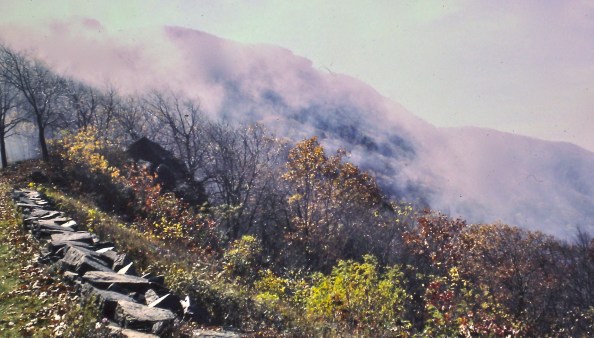
Smokey Mountains in the Morning

Understanding Asa Carter through his Own Words

Forrest Carter and Asa Earl Carter were the same man. In the first chapter in the book, Asa was both the Indians getting on the bus and the people sitting in the seats. He understood hatred from both views and portrayed that hatred, not in bitter remembrances but rather as a view of human nature that sometimes humans are “sick” or unwell (mentally or physically) and that requires the understanding of that pain. Part of Carter was revealed in the character of Wilber, the boy who stood in the lineup for adoptions, secretly hopping someone would adopt him but never being chosen. “His anger showed in that he said he would kill everybody that run banks and orphanages . . . Wilber cried at night . . I never let on I knew, for he stuck his blanket in his mouth, which I figured he didn’t want anybody to know” (F. Carter, 189).

Is Little Tree a mischievous deception? I would suggest that Carter’s agonies, forged during his boyhood in rural Alabama—a hotbed of racist bigotry—and his probable alcohol addiction, followed him to the grave. Carter knew injustice even if he could not wrestle the demons of hatred from his own mind. Whetted by alcohol, Carter never escaped verbal or physical violence. His life ended in a drunken brawl with his own son (Bowlings). His death certificate stated, “aspiration of food and clotted blood due to a history of fist fight” (Rubin). Forrest Carter’s wrote his last novel, Watch for Me on the Mountain, just a year before he died; but unlike Little Tree this novel describes in horrific detail scenes of violence and death. Perhaps the following passage from that novel best captures Carter’s impasse that seems to have followed him to the very last moments of his life,

Geronimo! Trying to say the name, coughing great gushes of blood from his mouth, he fell against the wall.  It was a trick? He felt hurt at the unfairness of it all (156).

Waterfall in the Blue Ridge Mountains

How do you look at art . . . just on its own merits or do you consider the creator? Should any publication ever be banned?



Drawing Inspiration from the I.W.W. and the Free Speech Fights 1908-1917

The working conditions at the turn of the century placed workers under incredible hardships as they faced both health and safety risks on the job. At that time, half of all worker deaths occurred in two industries—coal mining and railroading. Around 1900 between 25-35,000 deaths and one million injuries per year occurred on industrial jobs. In the Pacific states a lumberyard or camp worker earned on the average 14 cents an hour with working hours averaging 61 per week. Employees had to sign a contract to waive all rights to damages in case of injury or death. Migratory workers depended on hopping on freight cars to follow employment opportunities across. Railroads estimated that 500,000 hoboes at any given time were attempting to board the trains. Migrant workers made up a large percentage of the 24,000 trespassers who were killed and 25,00 injured on the railway lines just from 1901 to 1904.

Understanding that the root of this misery rested in the capitalist system, workers established a new kind of labor union.  The Industrial Workers of the World (IWW) believed in organizing all workers. Ahead of their time, the Wobblies refused to accept the society’s racial, ethnic and class prejudices and welcomed the most dispossessed into their ranks. They possessed a revolutionary spirit which provided the catalyst to create greater democracy through worker participation.

The I.W.W. organized the free speech initiatives to prove that direct action was the mechanism to stand up to the Establishment on labor rights. The system threw every weapon at the I.W.W., and the courts, police, newspapers, even encouraging mob rule. The politicians and industrialists formed alliances to protect their business interests and profits.

The public sometimes becomes confused with the rhetoric and propaganda of I.W.W. opponents who claimed that the organization despised the Constitution and rejected traditional American values and ideals. To understand this criticism it is important to differentiate between economic and political systems. Capitalism is an economic system, and the U.S. Constitution provides no support for any economic system. The I.W.W. rejected the elitist business interests of the capitalistic class in favor of workers. Elites labeled the I.W.W. unpatriotic because the membership refused to fight against their fellow workers in other countries. Translated: the I.W.W. is a bastion of democratic principles and follows an ethical philosophy of the highest calling: to join in solidarity with all workers and put an end to war.


Protected: Memorial for Corvin

This content is password-protected. To view it, please enter the password below.

Solace in the Face of Grief: Three Expressions of Comfort

In addition to experiencing the tragic loss of someone dear to us, grief visits us, as life sometimes overwhelms us with despair. As life events were making me feel that I had lost something, I realized I was experiencing feelings of grief. At first, I dismissed this notion as how could the loss of someone close compare with other tragedies? Nevertheless, I allowed myself to name the feelings as grief and look for comfort.

Years ago I came across a letter entitled Consolatio ad Uxorem  by Plutarch, a Greek who in 6111AD composed a letter of consolation to his wife on the loss of their two year-old daughter. I revisited the letter again to see if I could find comfort from what Plutarch had written so long ago.

With a close reading of his letter, I found three phrases that offered solace and peace.

“. . . something that you believe will make your grief easier to bear, that too you shall have, so it be done without excess or superstition . . . “

Plutach cautions his wife to beware of excess and superstition as the first steps toward reconciliation.  Experiencing grief, my emotions overcome logic and balance. Emotions flood my brain with excesses probably related with the flight or fight response. I find it almost impossible to draw on reason. It seems that these excesses compounded with superstition, which fosters the belief that one cause is linked to another without evidence, encourages illogical and discouraging thoughts to dominate. Thoughts cycle round and round, locked by emotions and driven by assumptions. Aware of this cycle, it is possible to disengaged from thinking in loops.

“any extravagance of distress in you, this will be more grievous to me”

In my feelings of grief, I’m constantly aware that if I allowed myself a selfish response by indulging grief, I would actually hurt people I am close to. This is not meant to say that we can’t let others know how we feel. Of course, we must do this, and loved ones want to offer comfort. Part of our comfort is accepting what others can give us, and sometimes holding back a bit of all that is overwhelming us might be a consideration. A friend of mind wisely once said when I suggested a disastrous possible outcome, “Don’t put that out in the air,” she said. I think what she meant is that some of our irrational thoughts gain momentum and validity, reinforcing what may not be helpful.

“we must not sit idle and shut ourselves in, paying for those pleasures with sorrows many times as great”

We can do nothing about some of the circumstances we find ourselves on this earth, such as living and dying. Sometimes injustices and life events are beyond our control. We can control our responses to these events. Should our grief overpower and destroy all the beautiful moments of life? Would our loved ones want us to suffer endlessly with their memory or difficult life outcomes? Does misfortune outweigh all the kindnesses shown us? How can we now bring some good on this earth by reaching out to others? We should not consider the small good a great evil, nor, because Fortune did not add what we hoped for, be ungrateful for what was given.

* * * * * * 

We experience lovely moments on this earth as we spin around the sun in the vast universe of emptiness. We are precious, for if we were found on a distant solar system, we would be celebrated as miraculous. We live on this planet after fourteen billion years as our universe continually expands at exactly the perfect rate. Supernovas create the elements necessary for life, and like the supernovas, we exist in a flash of time.

Plutarch comforts his wife to resist those manifestations that darken our thoughts leaving us unable to accept soothing influences. That is all we can do and all we must do, for our moments are precious and soon lost to the passage of time.

Enya ~ A Moment Lost

Two excellent links:

Part One, When You’re Grieving

Part Two, Helping a Grieving Friend

Do Movies Influence Children’s Psyhe?

When I was six years old, my mother took the family to see the movie, Lili, released in 1953. My mother purchased the sheet music from the theme and would play the song on the piano, singing along. I remembered liking the song, too, and we’d talk about the movie.

The central plot of the story centers around Lili, a young woman left alone, and finding her place at a carnival. She falls for a magician, who rebuffs her. Thinking that all is lost, Lili contemplates suicide. Paul, the lame puppeteer watching her from afar, draws her into conversation with his puppets. Paul hires Lili as part of his act, and her innocent and sincere interaction with the puppets becomes an instant success. Although Paul falls in love with Lily, he is unable to express that love except through the puppets. After an argument, Lily leaves. As she wanders down a long road, the puppet images come alive in her imagination. Through dance, Lily realizes that Paul is the puppets, and she rushes back to the carnival.

Leslie Caron plays the part of Lily, who I remember as most convincing as the naïve girl finding her way in a harsh world. Her brimmed hat and sweater with the lace collar convey a sweet innocence. The photograph below of my mother taken in 1945 reflects style similarities of the time.

My Mother 1945

The expression of love through the puppets stayed with me long after my mother stopped playing the song. I came to believe that showing kindness, but from behind the scenes, made that moment magical. Elements of reality and fantasy co-mingle and mimic the puppet master and the puppets. Everett Ferguson wrote on the modern perspective of magic, which is a result of a universal sympathy.

The laws governing these connections may be unknown to most of us, may be hidden even from the magician; but it is in virtue or organic, natural, that magic works.

Where this all becomes interesting is understanding the effect of movies on children especially as an intersection to their parent’s reactions to the same film, which supports or negates the child’s experience. The borderlands between reality and fantasy are part of all movie-going experiences. While the movie Lily captured my imagination, I’m somewhat convinced that my mother’s influence played into my remembrances and taking in elements of the film personally.

I’d be interested to know if others connect to films through some aspect of their parent’s reactions. Let me know.

Giving thanks on Thanksgiving? No thanks!

With one statement, I’ve probably offended almost everyone about this most sacred cow of American holidays but I’m going to put it on the table  nonetheless. I am contemplating the implications of the concept of thankfulness and what it means to me. For a moment, I’m suspending the idea about being grateful to a “higher power,” as often thankfulness extends upward. For now I’m focusing on generic thankfulness in non-religious way.

Recently someone explained to me that when living under a monarchy, citizens are supposed to feel infinitely grateful for all that the king has bestowed upon them, which reminded me of the song from the King and I where Anna considers confronting the king about the continual ingratiating behavior of his subjects:

Everybody has to grovel to the King.
All that bowing and kowtowing  . . .
To remind you of your royalty

Recently a student posted a reply to an article in a college news forum about the first general assembly held at their college, modeled after how the Occupy groups use general assembly as method of bringing greater voice to all participants. She remarked that complainers and discontents filled the assembly. She argued that students should realize how lucky they were and how grateful they should be for the privilege of attending their college.

When I was working on the living wage campaign at Swarthmore College, a comment we frequently heard was that employees should be grateful that they had jobs, let alone a job with a living wage.

The common thread through these instances has me pondering the question: is it wise to extend thankfulness to any person or institution?

The problem with being grateful is that it serves as a convenient excuse to keep the status quo. We get uncomfortable when change is threatened. Being thankful soothes and placates the mind to consider or act on greater possibilities. A mindset that allows us to accept our “losses” also cajoles us by thinking that surely someone out there is worse off than ourselves. If I say,  “I am so thankful for the food on this table,” the implication is . . .  compared with what? . . . little children in Darfur? So by the fates that have fallen on us, we are fed while others go hungry and so we are thankful that WE have food?

We could use a new tradition to replace thankfulness, as the danger lurks right beneath all that heartfelt sentiment that this is the best we can do now. Rather, we might consider giving each other encouragement in our endeavors. If Dad cooks a great Thanksgiving meal, mention specifically what you enjoyed or ask about the ingredients. When Mom receives help with the dishes, she doesn’t have to reply with “thank you.” She can just acknowledge how nice it is to have help or company in the kitchen.

We neither have to grovel for favors granted nor expect thanks but rather acknowledge that we can share moments of equality that we all contribute to each other’s well-being. Happiness, optimism and compassion replaces gratefulness. Love what you do rather than expecting praise and thanks, which act as false rewards. Acknowledge what we have done to make the world a better place and renew our commitments and responsibilities. On a day that we come together and share our food with family and friends we can enjoy Thanksgiving more fully because we’re not beholding to the customary and clichéd expressions of gratitude.

And if this philosophy works for you, no need to send me a thank you note.

Tag Cloud