Humble Contributions to the Peoples' History

Lark Rise to Candleford

My favorite PBS show from the BBC this season is not Downton Abbey, but rather Lark Rise to Candleford, a costume drama set near the end of the 19th century in the Oxfordshire hamlet of Lark Rise and neighboring town of Candleford. The BBC adapted the series from a trilogy of semi-autobiographic novels written by Flora Thompson, published between 1939 and 1943. What sets Lark Rise apart from other costume dramas, where sometimes the characters come across as self-centered and petty, the folks of Lark Rise seem genuine as they struggle to find the right path, even if their best attentions sometimes fall short. The program shows human frailty tenderly as the characters search for answers to their challenges in difficult times.

Because I am a big fan of EastEnders, the popular, gritty British soap opera, I laughed when I read this review of Lark Rise in The Guardian, “A rural Victorian EastEnders with telegram deliveries instead of murders.”  Whereas EastEnders offers an intriguing and somewhat addicting storyline in an unending series of hopelessly agitated characters, unable to find one modicum of mindfulness in response to each other’s failings, Lark Rise characters offer philosophical insights to the latest crisis. Those insights often happen through the humblest character.

Shall We Assist?

In this recent episode, Season 4, Episode 1, the townsfolk accused Dorcas Lane, main character and post mistress, as meddling in everyone’s business, causing untold distress. Dorcas, who consistently affirms that she only has one weakness, whether it is banbury cakes, feather pillows or baths, decides that this weakness of meddling must be addressed, and she vows to no longer interfere in her neighbor’s lives. The problem she almost immediately faces is whether to step into a situation in which she could be genuinely helpful. Standing on the edge of disaster seems cowardly but backing off from her commitment also seems like a half-hearted effort to check her interference. I won’t give away how the rest of the story unfolds, but this theme gave me pause.

What factors do we measure when to step into a situation. Of course, if someone asks us to help, we can without hesitation. What about if someone cannot see their situation objectively, overcome with emotion? After careful thought, can we offer assistance in form of advice, money or help? How do we assess how any of our generous offers might affect outcomes? We might ask ourselves if somehow this offering of advice plays into our own ego. Are we giving advice to sound important or because we feel we have the authority to do so? Are we responding to a dangerous situation that needs immediate attention? It takes courage to speak up in unjust situations where our input may not be welcome.

Offering advice is a difficult negotiation with only a few guidelines. Like Dorcas, best not to make hard and fast rules but rather carefully evaluate the factors in each situation. We may not always get it right, but a thoughtful response might offer folks in our times some comfort and help.

Lark Rise Celtic Tune

Links

Lark Rise to Candleford, E-Book

Lark Rise to Candleford on Youtube

Pinterest Collection of Pictures

9d644af5a34b4df212c9c1003eb38ea7

Christmas Episode
Inclusive of ghosts, as Brits like so much at the holidays!

Once I thought about what I had inadvertently done, I stewed for days trying to decide whether I should write this particular blog post, admitting my mistake. I’m somewhat of a perfectionist. Something internal drives the compulsion that I should never make a mistake, including following rules that benefit us all. I know, that’s sounds a bit obsessive, but telling of the level of my concern.

Back Story

One of my favorite artistic devices is the tromp-l’oeil, which is a French word meaning fooling of the eye. My introduction to this device came when I was a child and visited the Philadelphia Museum of Art and gazed upon The Staircase Group by Charles Wilson Peale. As kids we always referred to it as the “painting with the step” and immediately knew the reference. Wooden colonial molding frames the painting; and an oak step, matching the color and textures of the painted steps, protrudes from the staircase at the bottom.

The painting must have made an impression as I’ve used trompe-l’oeil technique myself in some of my artwork.

Seed packets

Seed packets on a garden bench

Window Treatment

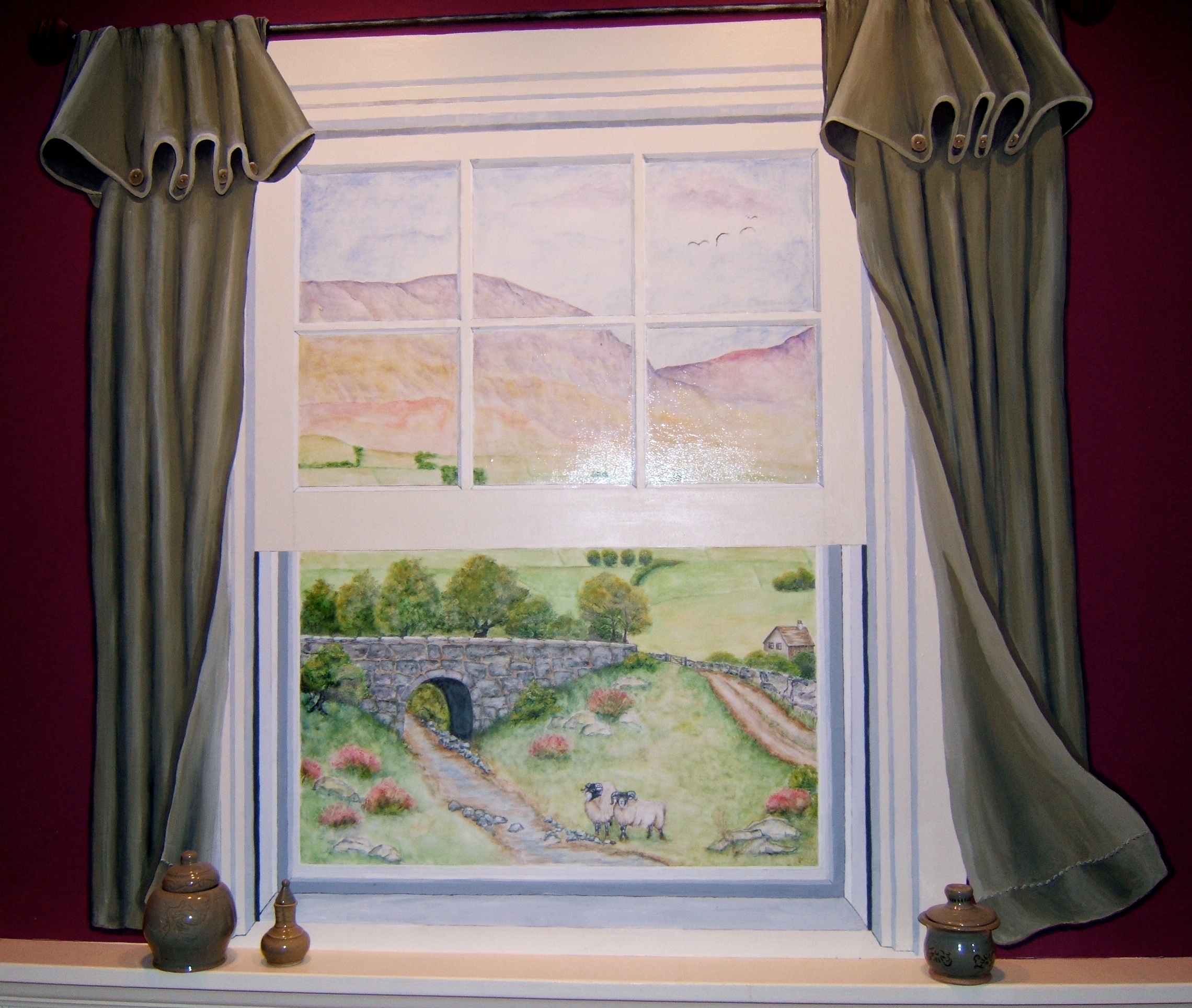
Adding a window without construction

You may have seen this device used by artists, such as Julian Beever, whose anamorphic illusions are created by a distortion that enhances a three-dimensional effect. When I read over his web page, he wrote that he worked as a street busker in various busy thoroughfares throughout Europe, practicing his 2-D techniques using pastels on sidewalks. When visiting Venice in 2008, I took this photograph. Now I wonder if this art was his.

Venice Painting

In another example, Eric Johnson, a Swedish photographer, installed a 3-D photograph in one of the main squares in Stockholm with his Mind the Step creation, which is a perfect lead-in to my misstep at the museum. On New Year’s Day I returned to the art museum, accompanying the Philadelphia Chorus, to take photographs and videos of their holiday concert. Between concerts, my son and I wandered through the galleries and came across the Staircase Group painting. Without thinking, I asked John to place his foot on the step with the idea that I would carry the illusion further in a photograph. Earlier I had asked a guard if the museum allowed non-flash photography, which is permitted.

Staircase Group2j

Reflection brings Anxiety and some Relief

When I returned home and began researching the painting, I then realized we had touched the piece, breaking the rule about refraining from touching artwork! I was horrified. What if everyone put their foot on the step? It would be ruined in no time at all. I sat in front of the computer, reading more about the painting. Had the illusion distracted me from the fact the step was actually part of the painting? According to several accounts of when the painting was first displayed, George Washington supposed tipped his hat to the boys on the staircase thinking they were really there. I read in Marcel Duchamp in Perspective by Joseph Masheck,

The main feature of Charles Wilson Peale’s Staircase Group . . . is the extreme, quasi-Dadaistic, illusionism by which the imaginative space of the picture invades the real space of the gallery: a real wooden step (now reconstructed, but originally planned) extends out from the bottom of the canvas . . . (p. 7)

Ah, was I saved by the fact that the step was reconstructed? Given that the museum places ribbons across chairs to remind visitor not to sit in the displays, I asked myself why they didn’t place a reminder note at the the step. In the book, Citizen Spectator: Art, Illusion, and Visual Perception in Early National  America, Wendy Bellion quotes a catalogue published in 1854 that recounted how viewers of the Staircase Group would place a foot on the first step. (p. 92). Well, that somewhat relieved my conscience that the urge to step was just about irresistible.

One of the web pages of the Philadelphia Museum of Art states, “let your creativity soar” but from now on, I will watch my step.

I’ve thought of several ideas on helping the environment and finally inspired to carry through and write down suggestions after reading a Daily Kos article, Two Small Changes in the Bathroom Could Improve the Environment and Your Health by Laura Clawson.

1. Add water to just about everything, especially when soaps and cleaners have a small amount left. Yes, probably shouldn’t add water in some cases, but if you can think about diluting where might be proper, do so. Detergents get thick at the bottom and adding water and shaking vigorously stirs up a lot of extra product.

2. Cut toothpaste and other tubes in half. I’ve managed to get two extra weeks out of a cut tube of toothpaste.

3. While making purchases, don’t use plastic bags for anything you can put in your pocket or purse. Have large reusable bags handy in the car and use for all of your shopping trips, not just to the grocery store. As our family was driving through the Delaware countryside, I noticed plastic bags stuck in the fields, ditches, trees and streams. We could organize crews to clean up, but far better that as consumers, we decide not to use plastic bags.

4. Think about the right measure to use for each product. Corporations may promote bigger portions to sell more. I realized that I don’t need to take a big swig of mouth wash. A little bit does the same job. A judicial amount of shampoo gets the job done and less soap goes down the drain.

5. No recyclable trash cans nearby? Carry home bottles and recycle.

You’ve probably figured a few things to do that help the environment. Please contribute to the list, as these serve as reminders or new approaches to consider.

Every bit helps and a few steps we take together mount up to big savings for humanity and our planet.

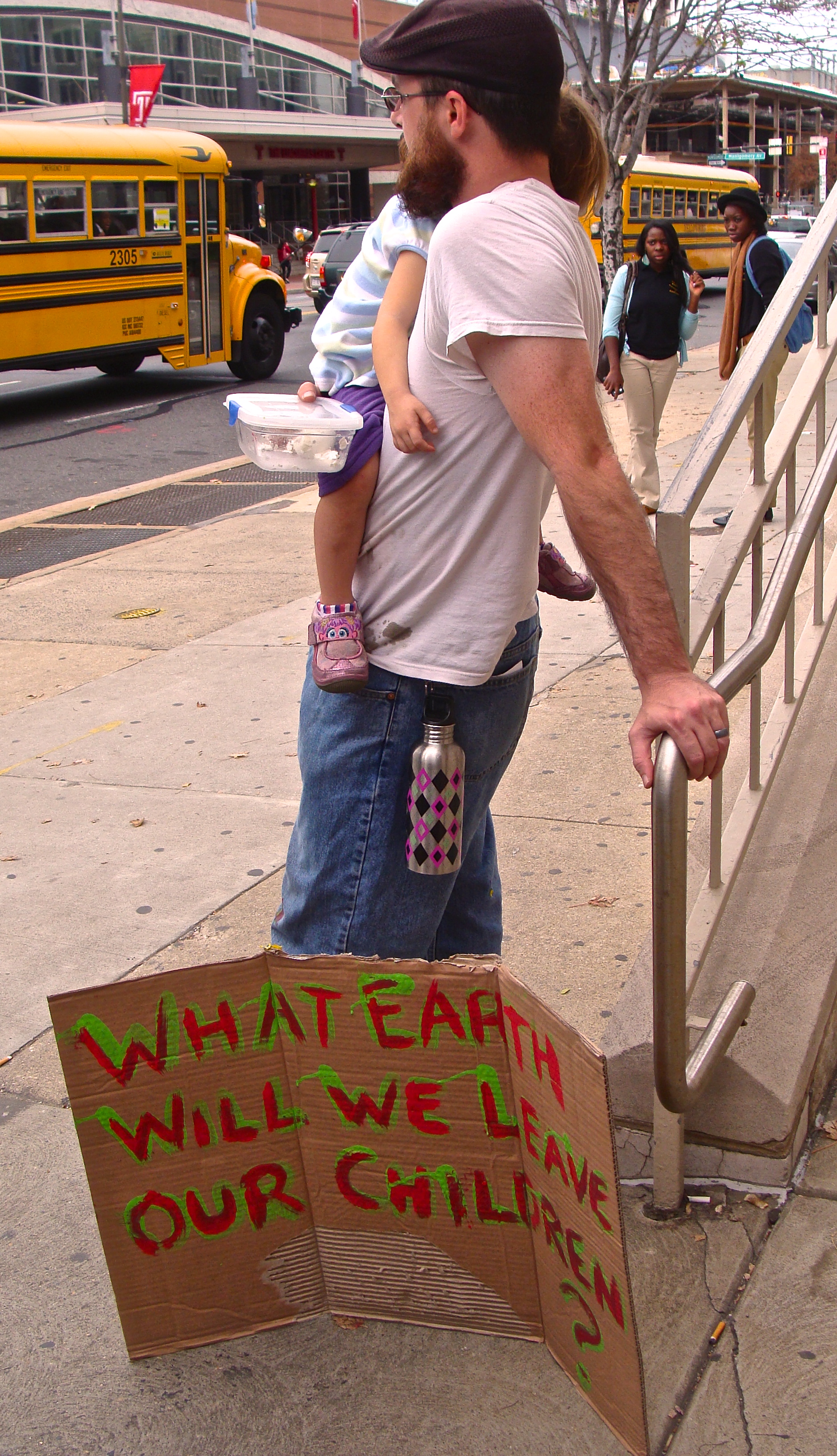
Protester, Philadelphia 2013

Protester, Philadelphia, 2013

art museum

Philadelphia Museum of Art

Happy New Year!

chorus

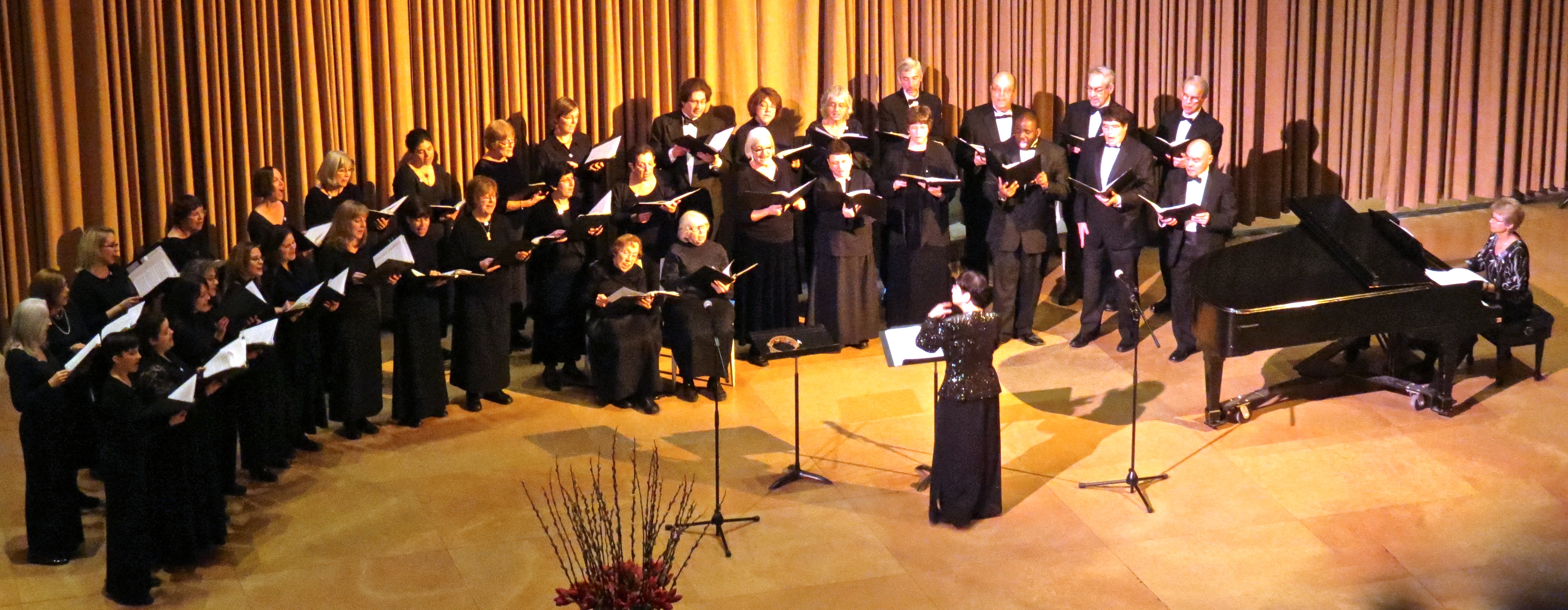
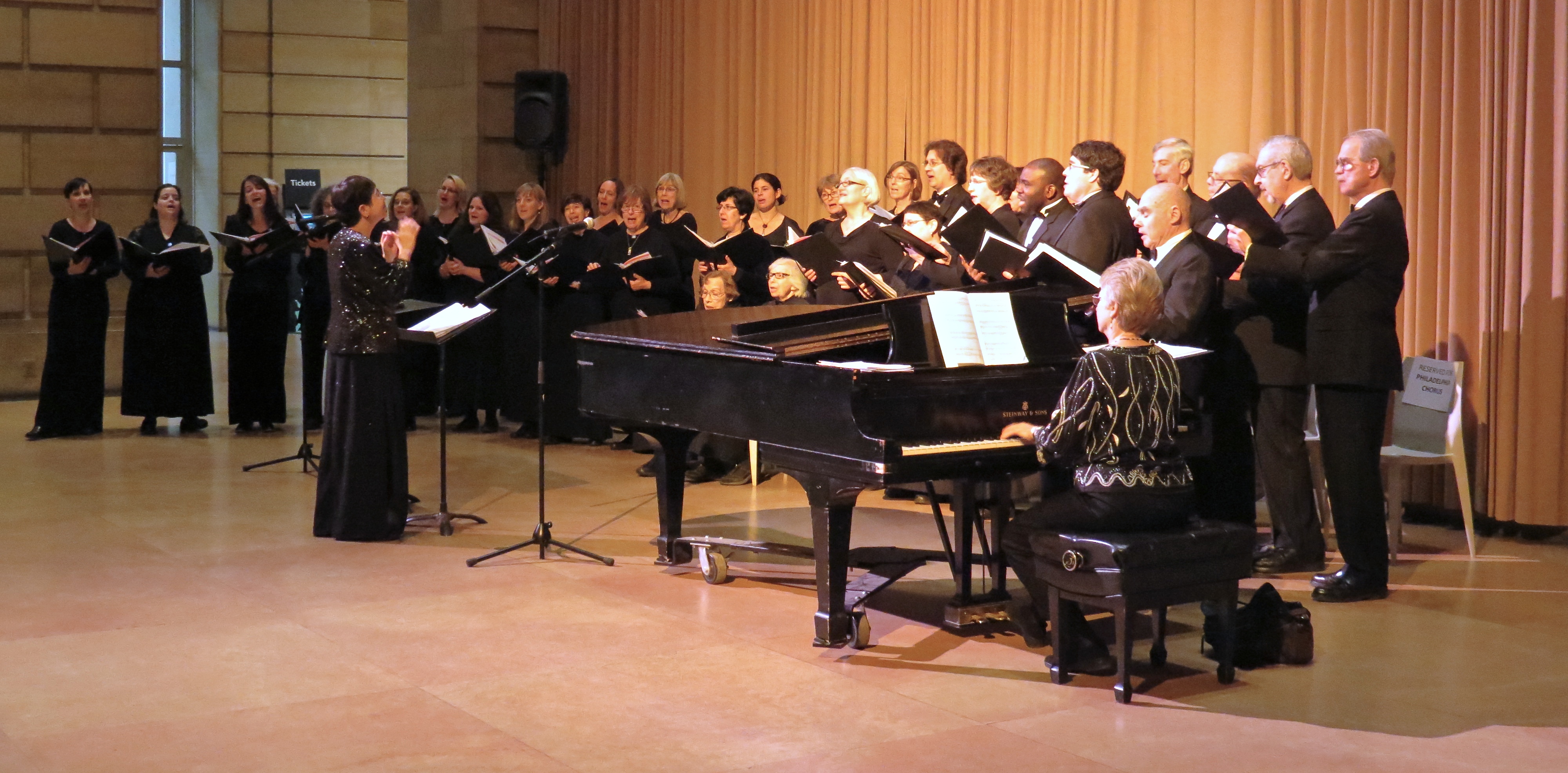
The Philadelphia Chorus began the New Year with a concert at the Art Museum. The chorus sang a selection of carols and spirituals at the main entrance, while the audience found seats on the grand staircase leading up to the second floor.

IMG_5728

Raquel Garcia, Conductor and Music Director

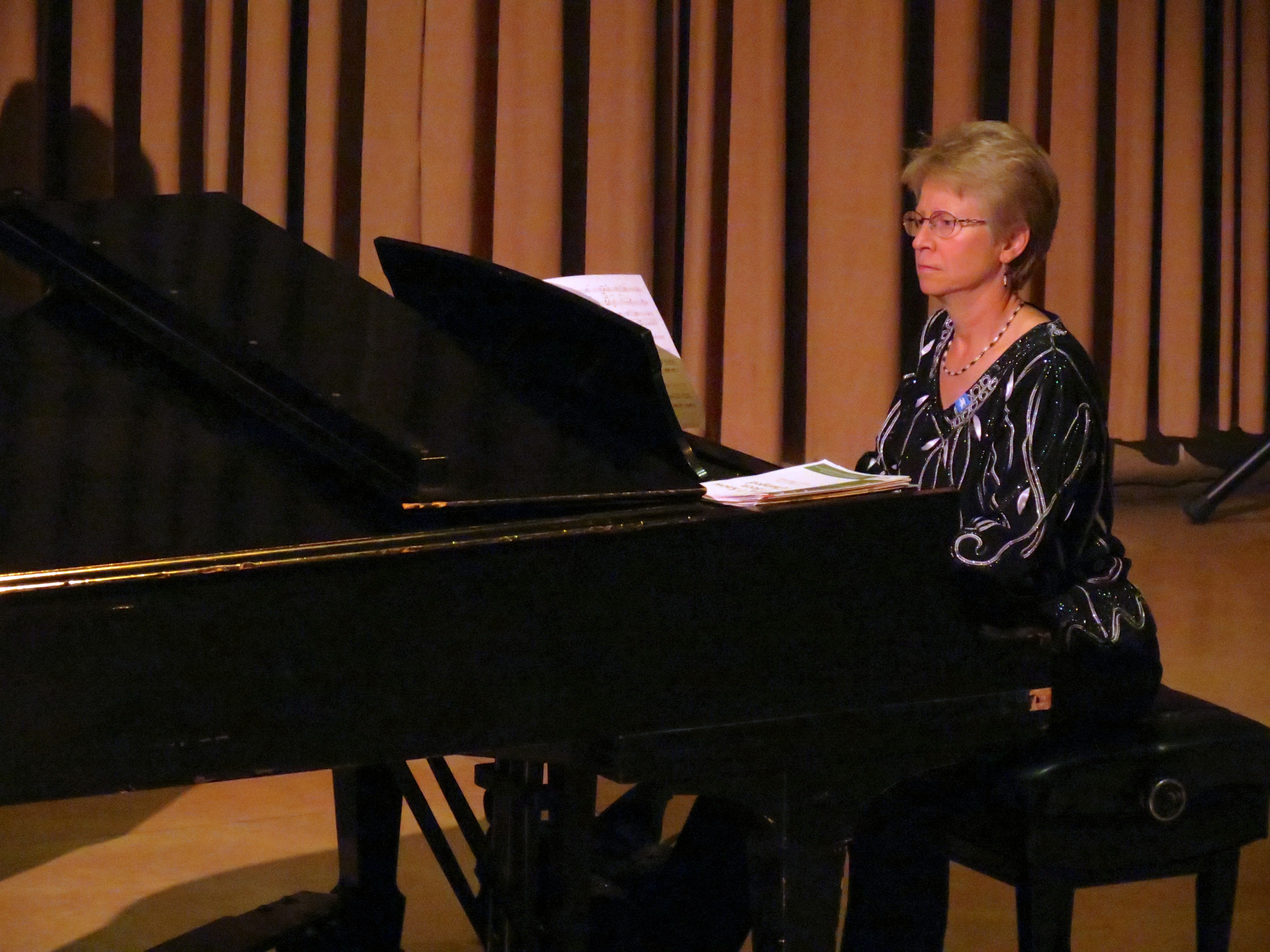
Judy Large, Accompanist

Judy Large, Accompanist

The video features “Didn’t My Lord Deliver Daniel”;  Aaron Jones is soloist.

IMG_5764

Celtic Connection

Years ago I happened to be in Ireland during the celebration of the Summer Solstice, which was truly a magical experienceWinter_solstice as folks lit bonfires on beaches and hillsides in every town in the countryside. This year, just a day after my birthday on Saturday, December 21, the first day of winter, was time to reconnect to my Celtic roots. This event in Manayunk would be my first celebration of the Winter Solstice and held in a nearby neighborhood in Philadelphia. Fire plays an important role in the Winter Solstice, too. The Druids believed that at this time of year the sun stood still for twelve days, starting the tradition of burning the Yule log to banish evil spirits and preserve light during the darkest days of the year.

Manayunk (pronouced man-ee-yunk)

The Lenape Indians, the first settlers in the Philadelphia region, named the area, translated means “place to drink.” Located in the northwestern section of Philadelphia, the town lies on the banks of the Schuylkill River. Canal View Park on Main Street stands in recognition of the first canal started in the United States and was the scene for the solstice celebration. A tow path follows the canal. Victorian storefronts and mill buildings line Main Street where eclectic shops and a variety of restaurants offer many opportunities to enjoy holiday shopping and eating. Santa made several appearances, extending greetings to all who strolled along the Main Street. The Mummers added to the merry mood playing holiday favorites.

Birds of Prey

Before the winter solstice events, Damien Ruffner from the Schuylkill Center gave an informative lecture and presentation on local birds of prey, including a Red-Tailed Hawk, Peregrine Falcon, Great Horned Owl, Eastern Screech Owl, and Barn Owl. Having the chance to view and photograph each raptor up close was amazing.

Why does it seem as if the birds are actually listening to the lecturer?

Drums, Torches and Fires Celebrate the Return of Light 

As the torches along the canal were lit and the wood pilings on the oil drum set ablaze, the ceremonious drum circle, a Native American tradition, began the rhythmic pounding. The audience was encouraged to make affirmations on wishing sticks, which were added to the bonfires. For 6,000 years our ancestors have celebrated the return of lighter days with friends and family to honor earth’s seasonal rhythm. Feeling connected to family and community, including all the creatures that share our planet, I thoroughly enjoyed the Winter Solstice celebration of harmony with nature and the ancients.

Undaunted by a forecast of fog, snow and icy rain, hopped a train into Philadelphia for a visit to Waterfront Winterfest held at Penn’s Landing during the holiday season. The blowing snow whipped around the bus as I caught a glimpse of the Benjamin Franklin Bridge from the last stop on the route. Despite the snowy weather, the Blue Cross RiverRink was filled with skaters, including Santa. A forest of trees and shrubs, lit with twinkly white lights, surrounded the ice rink. A warming tent held a village of restaurants and small shops. Skaters huddled around fire pits with the aroma of burning wood scenting the air. Blue lights outlined the trees along the Delaware River. As difficult as holding the camera was while trying to get videos, the snow enhanced the site making the seaport truly a winter festival.

A short walk, while holding an umbrella that billowed up and down in the driving wind, brought us to the Independence Seaport Museum, which was hosting its 4th annual Seaport Parade of Lights. The Jupiter, a vintage tub from 1902 and maintained by the Philadelphia Ship Preservation Guild, led the parade of decorated boats, including both working vessels and pleasure craft. The crowd, having a great time watching the boats glide out of the blizzard, applauded the floating light displays as each passed by.

In the Trees

Way Up in the Trees

An Activity for Twenty to over Sixty+?

The thought occurred to me that an activity following Thanksgiving Day might be an opportunity for some more family bonding. After scanning the Internet and casting away ideas that probably would not appeal to our 20+ something kids, I found a zip-line and obstacle course adventure at Lums Pond State Park, in north-central Delaware. According to the GoApe website,

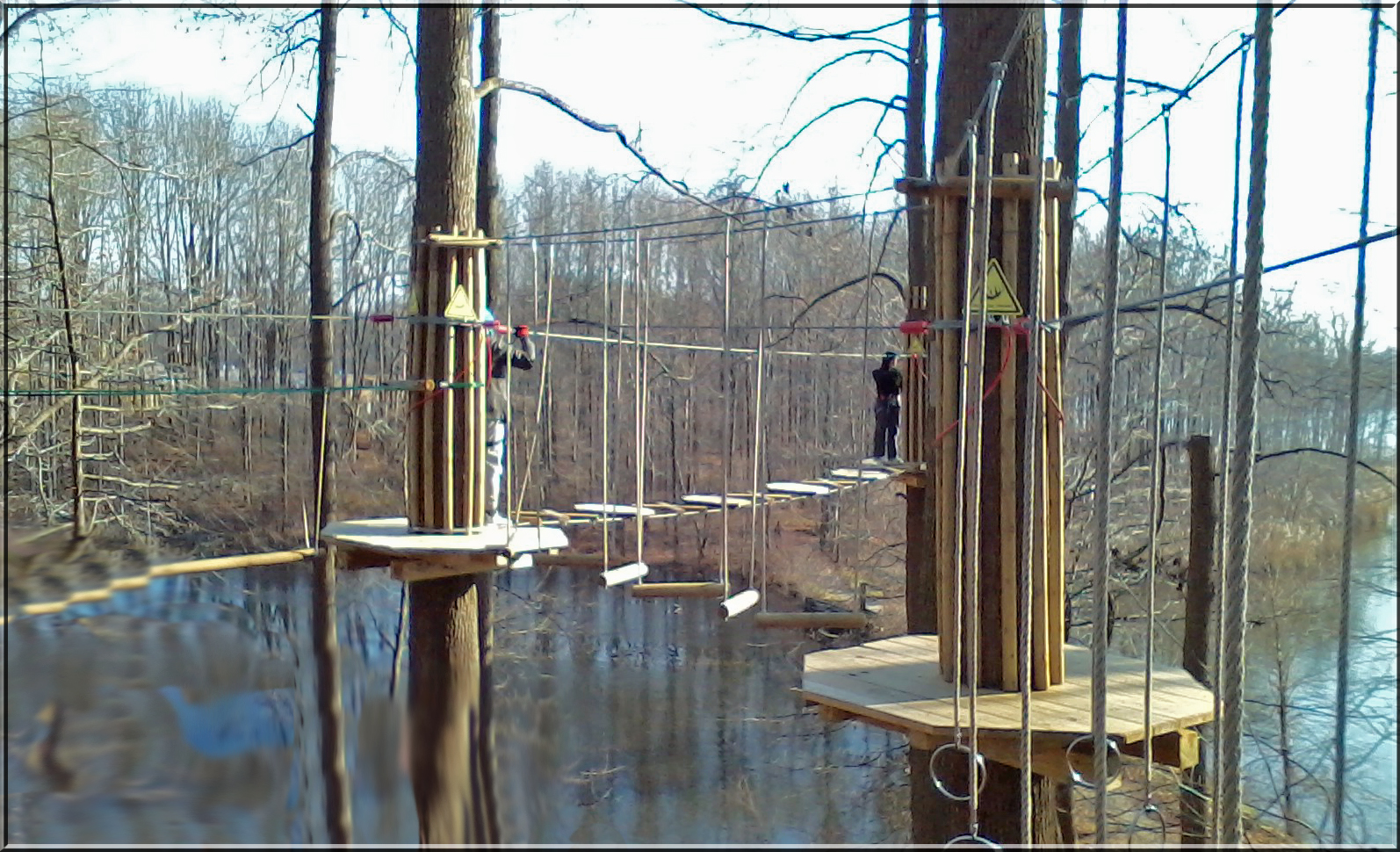
The course is made up of numerous rope ladders, 42 exciting crossings to include the Double Stirrups, Zigzag Trapeze, Flying Carpet and Canyon Crossing, 2 Tarzan swings and 5 zip lines.  Overall, there are 5 individual sections within the course, each section taking you higher into the forest canopy and finishing with a zip line longer and with more expansive views of the pond than the previous one!  Zip Line #4 and #5 are both well over 650 feet and the entire course consists of over 2,191 feet worth of zip lines, providing some of the longest zip-lining experiences in the state and region!

I know that our young-uns would be excited for the experience, but what about us “mature folks” . . . would we survive over 2,000 feet of zip lines? These zip lines, an aerial runway consisting of a pulley on a cable, work on gravity pulling the passenger down to the end of an incline, with zip very much the appropriate word.

The Adventure Begins

After an hour’s drive from Philadelphia, we arrived at the park, which is centered around the largest pond in the state of Delaware. The pond was man-made in the early 1800’s when the C & D canal was built, the water used to fill the locks. I didn’t have much time to admire the picturesque scenery, however, as we soon started our training for the course. At first, it seemed a bit complicated as our trainer instructed us to hook and unhook two or three lines every time we changed position, but the color-coding helped, and we eventually mastered moving the hooks quickly as we went through the course. After the training, the guide left us to continue on our own. We were provided with an emergency whistle, where five blasts would bring immediate assistance. Our guide’s parting words, “Don’t wind up upside down.”

The Course

Our physically fit youngsters had no trouble with any of the challenges and even selected the more difficult options, such as walking on rings hanging from ropes. For me, the hardest part was climbing up the rope ladder, which required strong arms and upper body strength. The rest of the course, high in the trees, presented a variety of moveable walkways. Sometimes I decided not to look down. After getting over the initial fear of stepping off the platform for the ride on the zip-line, the trip down over the pond was thrilling! On the last zip line, I held my cell phone, video taping while gripping the cable with two hands. So if you want to see if the zip line experience is for you, that video is at the end of the movie.

Everyone had a great time and even making plans for when to return.  Maybe we’ll make this a family tradition!

What is it that makes it so hard sometimes to determine whither we will walk? Thoreau

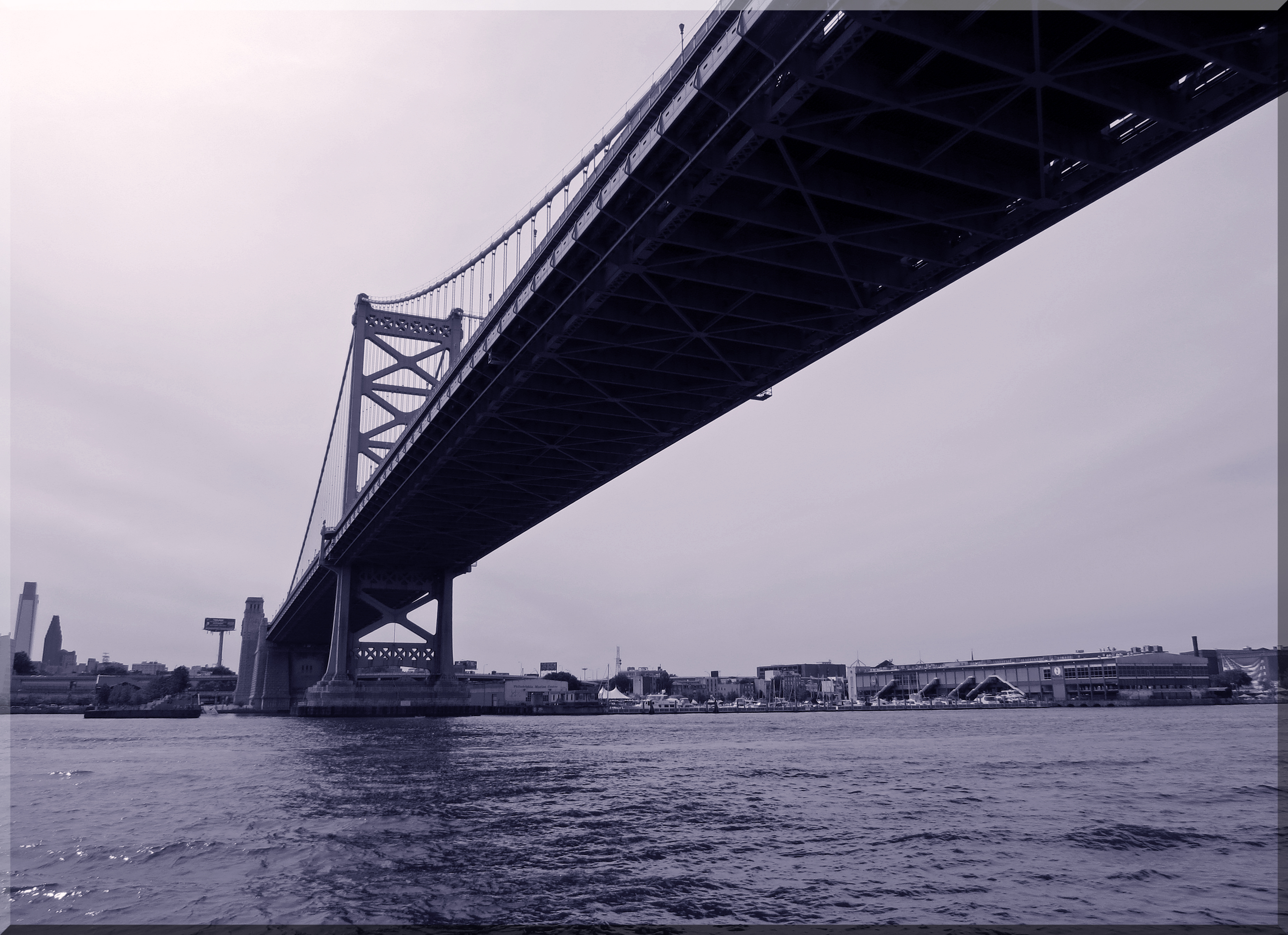
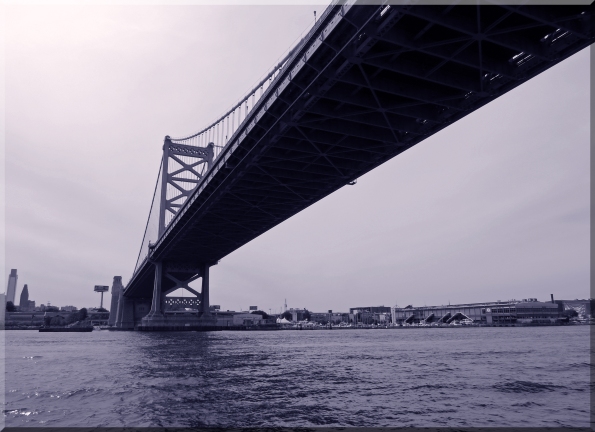
When the Amistad schooner sailed into Philadelphia in May of 2012, I signed up for one of their voyages on the Delaware River. The Amistad glided under the Benjamin Franklin Bridge, and from that perspective, I could view the massive steel superstructure and study the span across the river, stretching from Philadelphia to Camden. When workmen finished building the structure back in the 1920s, it was the longest suspension bridge in the world. 

With the bridge’s magnificent arch across the river still fresh in my memory, I now had the chance to walk up and over the bridge on the Architectural Walking Tour sponsored by the Preservation Alliance for Greater Philadelphia. What drew me to cross the bridge was more than a curiosity about the structure, but I didn’t realize my motive until I had finished the walk to the other side.
Under BFB

Stopping by the Constitution Center

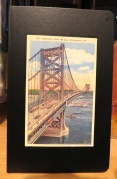
Watercolor BF BridgeOn a bright September day, my sister and I walked down Market Street in Philadelphia toward the bridge, passing the Constitution Center. Having a few minutes, we stopped in at the Museum Shop. We browsed through the various sections, especially admiring their collection of t-shirts. In the book section, I found a diary book with a watercolor of the bridge on the cover. After our brief visit to the shop, we headed back on Market Street and made our way to 4th Street.

Bridge’s History Retold

Our tour began in the Philly Olde City neighborhood, in front of two historic churches, St. George, the oldest Methodist Church in the US and St Augustine, a Catholic Church once burned to the ground to punish the immigrant Irish for having the audacity to settle in the area. In 1922 the first draft of the construction suggested that the bridge go right through St. George; but the congregation protested, and architects made an adjustment, with a 14-foot leeway that preserved St. George. Each church had to accommodate to the bridge by constructing walls, one floor below the original structure, lowering their doors, so that 4th Street could go under the bridge.
BFB Garden View

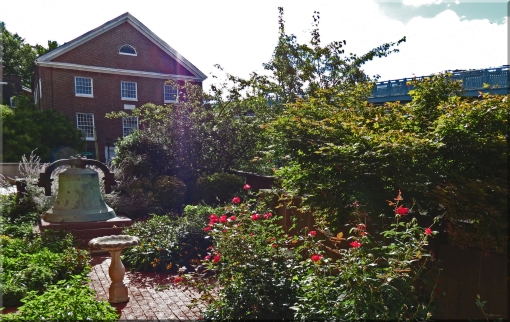
Garden at St. Augustine, looking across to St. George Church and the Bridge to the right.

Walkway along the Sky

Our guide led us up a side street to the pedestrian walkway that runs along the East side of the bridge. As the tour group started to walk up the inclined sidewalk, we could see the hubbub of activity on the side streets below and point out landmarks, such as the steeple of Christ Church. Art deco lanterns lined up on the railings that followed the sidewalk.
Granite Station

Bridge Station Never Used

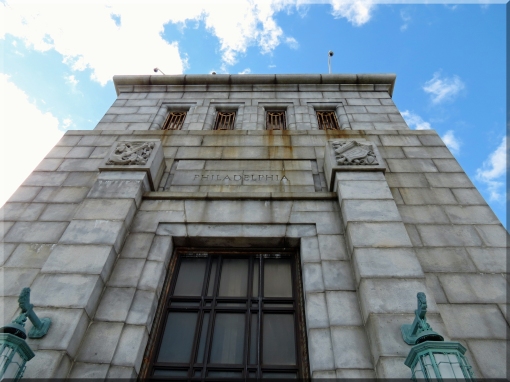
As we approached the first granite anchorage, originally constructed as a trolley station, cars along Route 95 sped by underneath. The highway ribbons along the Delaware and stands as a central feature in the landscape from that view-point. Christopher Columbus Boulevard shadows the superhighway, and one lone building, municipal Pier Number 9, is reminiscent of the days when the Philadelphia port had been a major thoroughfare of commerce, with wharfs and docks lining the Delaware port. The twentieth century saw much of the historic riverfront razed. Condominiums now occupy spaces along the river as well as Penn’s Landing, Seaport Museum and The Olympia, the world‘s oldest steel ship still afloat. 
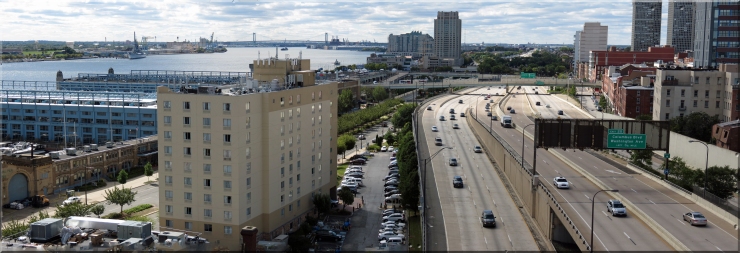
Panorama BFB road river

A grand landscape stretched before us. I looked back on the city, and noticed how the steel cables, extending up the 380 foot towers, framed the walkway. Even though built 80 years ago, the bridge is a marvel of invention and esthetic wonder.
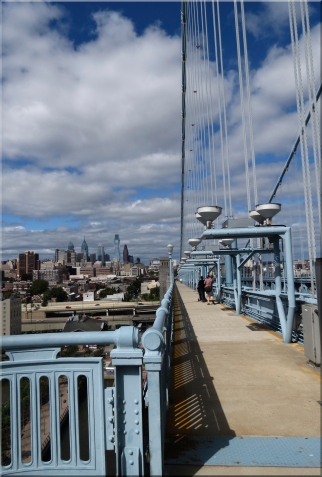
BFB Looking Down City

Study in Blue

From the top of the bridge, we gazed down the river on the New Jersey side to the Adventure Aquarium and Penn Treaty Park and then more distant landmarks, the Battleship New Jersey and the Betsy Ross Bridge. We watched the boat traffic, everything from a schooner, passenger ferry, container ship, motorboats and tugs.
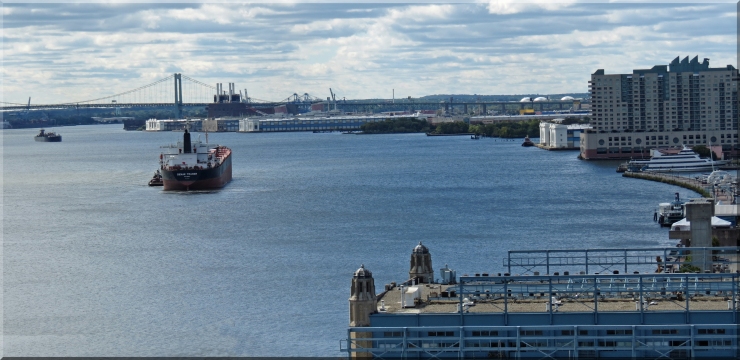
BFB River Boat

A schooner sailed alongside the working boats of the river.
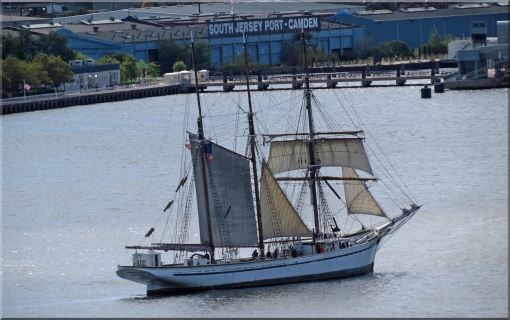
BFB Sailboat

Walking toward Camden, we focused on the city’s waterfront where neat-looking parking lots were surrounded by green spaces with trees and landscaping. The baseball field and stadium, home of the Camden Riversharks minor league baseball team, sported an attractive brick exterior and the look of yesteryear with peaked roof lines. A game was just getting underway as we walked by.
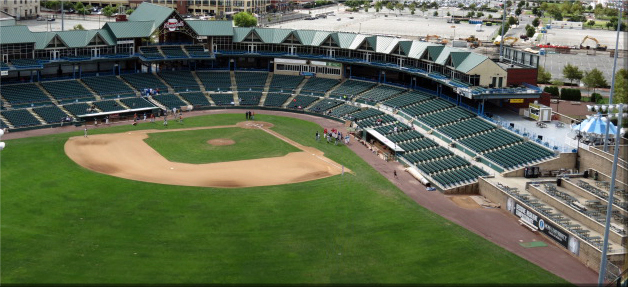
Campbell's Field

Campbell’s Field

Looking for the Dog on Top of the Building
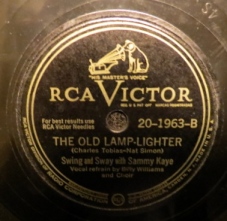
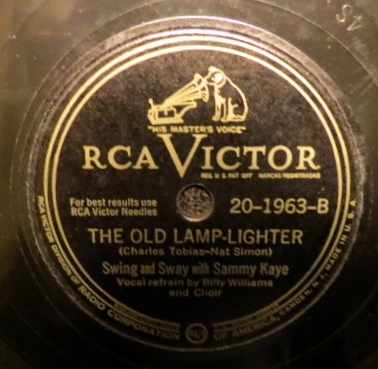
IMG_4579When we were children, our family would drive over the Ben Franklin Bridge to vacation at the Jersey Shore, and I remember we would look out the car window searching for the dog on top of “Dad’s building” where he worked. The puppy sitting in front of the gramophone was the famous RCA, or Radio Corporation of America, trademark, and the image appeared on all of their records. The Nipper Building, the nickname for what was once labeled as Building 17 of RCA’s Camden Plant, was built during the second decade of the twentieth century to house the Victrola cabinet factory. In 1916 the company installed on the tower four stained glass windows depicting the dog and gramophone. The RCA Corporation bought the building in 1929, using the Victrola names and logos on their own line of products into the 1970s.

My Father’s Commute

For over 25 years my father commuted from the Western suburbs of Philadelphia by way the Media trolley, the Market Street El, and the PATCO High-speed Line, which crosses the bridge, to his workplace at the Camden plant, just a few blocks from the bridge exit. RCA was an electronics company and one of the leaders of television technology from the 1930s and right into the next three decades. The plant manufactured broadcast equipment as well as television sets. The engineers at the Camden plant were responsible for building the first radio transmission from the moon of Neil Armstrong’s famous line, “One small step.”
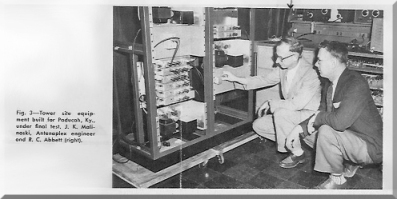
John Malinoski RCA

I wished that I could go back in time and ask Dad to take pictures of the bridge, plant and river because the area looked entirely different back then as factories, smokestacks, utility buildings and railroad lines occupied the landscape. For over two decades Dad worked for RCA as an electronic engineer, and I have only one picture that documents his work at the plant.

Our family didn’t realize the larger implications of my father’s transfer from Camden to Massachusetts in 1968. RCA began to reduce and sell off most of their broadcast products, finally going out of business in 1986. Buildings along the waterfront area were torn down as the area became abandoned and neglected. Building 17 also fell into disrepair and almost met with the wrecking ball, saved in 2001, when the New Jersey Economic Authority awarded a grant to preserve the structure.
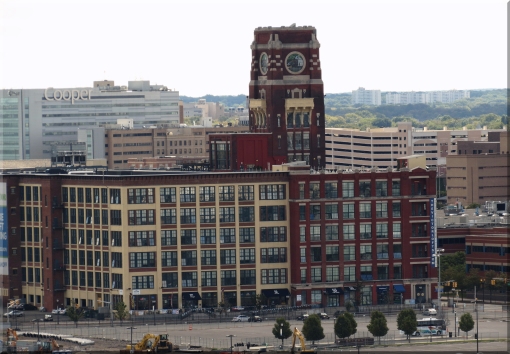
RCA Building

The Nipper Building is now listed on the National Register of Historic Places. I don’t believe my father ever suspected that someday, the well-worn factory where he worked, would be considered a national treasure, but my sister and I always thought there was something special about that dog atop the tower. Forty years later, the iconic image guards the memory of my father and thousands other workers, whose electronic inventions pioneered broadcasting technologies.

The bridge had guided me back through our family history that I had almost forgot.
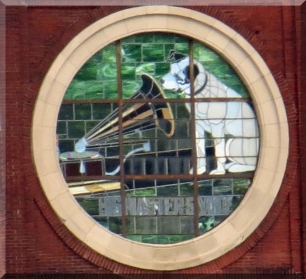
Nipper

Links of Interest

Historic Camden County
RCA TV Equipment Section of the Broadcast Archive
Eyes of a Generation
Eight Blocks in Camden that Made History

How a Heap of Mud Becomes Something

I’ve been away from sculpting for a while, but now with a few new ideas, its time to get back to carving clay. I enrolled in a class at the Community Arts Center with Bob Deane, potter extraordinaire.

Down the Rabbit Hole

White Rabbit, Wikipedia

White Rabbit, Wikipedia

A tree in my front yard became the inspiration for a whimsical addition: the door to the rabbit hole in Alice in Wonderland, the novel written by Lewis Carroll in 1865. In Chapter One of the book, the story introduces us to the rabbit wearing the iconic waistcoat and carrying a pocket watch. The rabbit’s classic line, “Oh dear! Oh dear! I shall be too late!” reminds us of the ever-present passing of time and the immediate responsibilities we carry.

The project began with buying a 25-pound bag of sculpting clay. The clay is soft and malleable, perfect for making objects; but for creating walls for the rabbit hole and door, I needed to create slabs that would harden so that they could stand and then be attached together. That process included rolling the clay into flat pieces and allowing them to dry either by putting them under a heat lamp or letting them dry out over time. Once the slabs were solid but not completely dry, I could attach the pieces by using a paste of clay and water after roughing up the surfaces. Before attaching the pieces, I carved out the door so that it would lay flat allowing me to add the details including the hinges and door handle.

The rabbit began as a two wads of clay, one for the body and the other the head. Once I figured the right sizes, I roughly hollowed out the two, and adding feet and arms. I attached the two pieces, and added extra clay to form the waistcoat. Creating a chain for the watch is almost impossible in clay, so I’m going to use a metal chain, which I will attach when the rabbit is finished. I made openings for the chain, making sure that with a 23% shrinkage, the chain would still fit through the opening. With the clay at the right consistency, I carved out the details. I used three or four pictures as guides.

Slides reveal the transformation from slabs of clay to whimsical art for the yard . . .  with help a little help from my friends, with Jean, assisting with the painting, and Bob, who advised on the glazing technique.

This slideshow requires JavaScript.

Terrarium Centerpiece

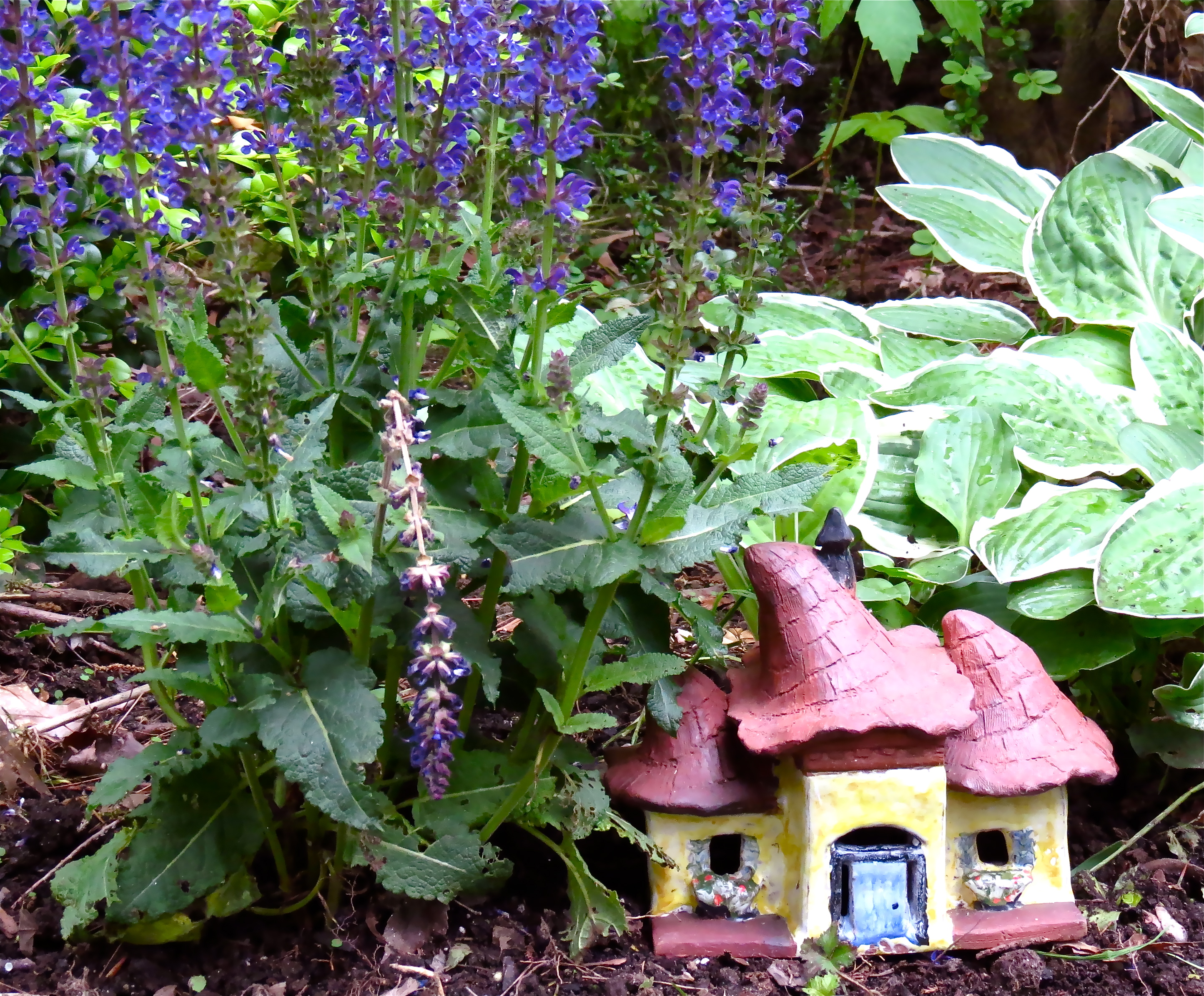
Fairy House in GardenFor the next project, I carved a “wee house,” inspiration coming from Pinterest, pages which display every kind of fairy house imaginable. Years ago, I had  carved a few houses for my garden and enjoyed the project.

This house required a great deal of measuring for all the pieces to come together. Not all parts, especially the windows, are perfectly square. With clay, it is easy to add a bit here and there to make the pieces line up. I gained a new-found respect for carpenters, knowing that they could not do as much fudging with wood as I did with clay. The most difficult part was getting the roof to align with each side, especially the tall center window. Eventually, I would like to create a terrarium around the house.

This slideshow requires JavaScript.

Imagine, Make It So: Following my Own Advice

My last project was more abstract and larger than the other two. At one point attempting to close it up at the top, I thought I might have inadvertently caused the entire piece of fall to pieces. I quickly added extra clay on the inside to support the structure. I applied Bobby’s white glaze and sent it to the gas kiln. A little Jon Luke Pickard and a little John Lennon were the inspiring forces to this project, which will find its way into the garden.

This slideshow requires JavaScript.

The Artist: David “Dee” Craig

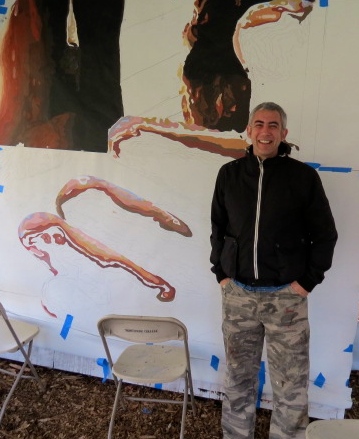
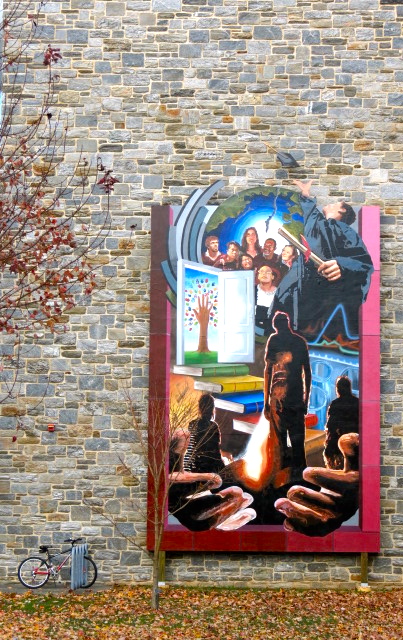
IMG_5192Early in the Fall semester, Lee Smithy, Associate Professor of Sociology Peace and Conflict Studies Program, announced that David “Dee” Craig, a mural artist from Belfast, Northern Ireland, had been granted a residency by the Tri-College Creative Residencies Program.

Dee  was raised in a working class community of Belfast, and those experiences focused his art. “Fear, pain and solitude; the discrepancies and gap between the rich and poor are also emotions which Dee aims to portray.” Dee has completed art projects in his neighborhoods in Belfast, working with the Ulster Museum, and outside of Northern Ireland, including the US, Israel and Spain.

This description of his artistic style explains Dee’s approach to his work.

He uses bold hard lines to represent the strength and steadfastness that working class people ooze, while at the same time using dark colours drawn from thoughts and feelings to portray a somewhat lack of aspiration imbedded in the set in stone belief some view as ‘imprisonment’ in a level or class of life. Brighter colours are also used to represent how we can over come these obstacles to strive forward in life and adapt in a more modern society.  About Dee

As part of the residency, the College commissioned Dee to paint a mural on campus, and Lee invited community members to take part in planning meetings to discuss the theme and content of the mural. During these meetings faculty, staff and students brainstormed ideas. Lee sent the notes and suggestions to Dee. Within a few weeks, Dee sent preliminary sketches back to Lee so that we could offer feedback.

Collage Project in Kohlberg Hall

1023131406-01 - Version 3

At the first residency event, Dee and Paul Downie, mural artist who has been consultant and instructor for the Philadelphia Mural Arts Program and Director of the Community Arts Center in Wallingford, installed a mural in the Sociology and Anthropology wing of Kohlberg Hall. The artists composed a collage of colorful designs on a wall facing the windows overlooking Parrish Hall. What was once a rather bland entrance to the second floor, now featured a masterpiece of color.

This slideshow requires JavaScript.

Opening Exhibit & Discussion

IMG_5151

On October 24, an exhibit in McCabe Library Atrium opened: “Murals, Memory and Transformations: The Mural Art of David “Dee” Craig in Northern Ireland. Lee interviewed Dee, followed by a question and answer session with the audience.

This slideshow requires JavaScript.

Meanwhile, college staff erected a tent to serve as the studio, and in addition, assembled scaffolding along the wall.

Mural Unfolds

Over the next several weeks, Dee painted the various sections of the mural. At the early stages the brilliant colors against the white canvas were striking. I could see the beginnings of an inspiring piece. In the slides below, the mural progresses from the first sketches to the installation on the wall.

This slideshow requires JavaScript.

1023131406-01 - Version 3

November 18, 2013

Final Mural Resize

IMG_5354

IMG_5372

Links

Northern Ireland Mural Artist Begins Creative Residency at Swarthmore College

Troubled Walls


Tag Cloud