Humble Contributions to the Peoples' History

Archive for May, 2013

Tides of Freedom: Amistad’s Visit to Philadelphia, May 2013

Bridge, Boat, Philly Panorama1

The chance to experience a voyage on a schooner while reflecting on the circumstances that brought free people into the imprisonment of slavery was an opportunity I could not miss. On Saturday and Sunday high winds cancelled the river tours aboard the Freedom Schooner Amistad, but by Monday the breezes died down, and we were good for a launch from the Independence Seaport Museum’s dock. The Freedom Schooner Amistad, a replica of the original La Amistad, has collaborated with international organizations throughout the Americas, Europe and Africa to commemorate the 200th anniversary of the former British empire and the United States abolishing the slave trade in the first decade of the 1800s.

Before starting the sail on the Delaware River, I had to get “onboard” with some research on the history of the La Amistad.

Brief History 

300px-Amistad_revolt

1840 engraving depicting the Amistad revolt. Wikipedia.

In 1839, Portuguese slave hunters kidnapped Africans from Sierra Leone and sent them to Cuba, a center for the slave trade. Treaties at that time banned the practice; nevertheless, Spanish planters purchased 53 Africans, including four children, who were shipped toward a plantation in the Caribbean aboard the schooner La Amistad. The Africans seized the ship, killing the captain and ordering the planters to sail to Africa. On August 24, 1839, the La Amistad was seized off the coast of New York, and the Africans were imprisoned on charges of murder. Despite having the charges eventually dismissed, the Africans were held in prison because of the issue of property rights. The case went to the Supreme Court; the justices ruled in favor of the Africans, and 35 survivors were returned to Sierra Leone. The Amistad case advanced the abolitionist movement, which eventually led to the abolition of slavery.

Julia Weathers related the story in her own words . . .

Films and Books

Steven Spielberg’s 1997 film, Amistad, popularized the story and received mostly positive reviews. Roger Ebert wrote,

What is most valuable about Amistad is the way it provides faces and names for its African characters, whom the movies so often make into faceless victims. 

The Amistad Rebellion: An Atlantic Odyssey of Slavery and Freedom  by Marcus Rediker, published in 2012, retells the story from the point of view of the slaves. An article in the Philadelphia Tribune offers a detailed description of this book. Previous films and books centered on the legal battle and interplay of the politicians, abolitionists and judges rather than on the rebellion and the experience of the Africans. By taking this short voyage on the Amistad, I could imagine how the first sparks of rebellion were ignited against those who had the audacity to believe they could enslave another human being.

The Crew
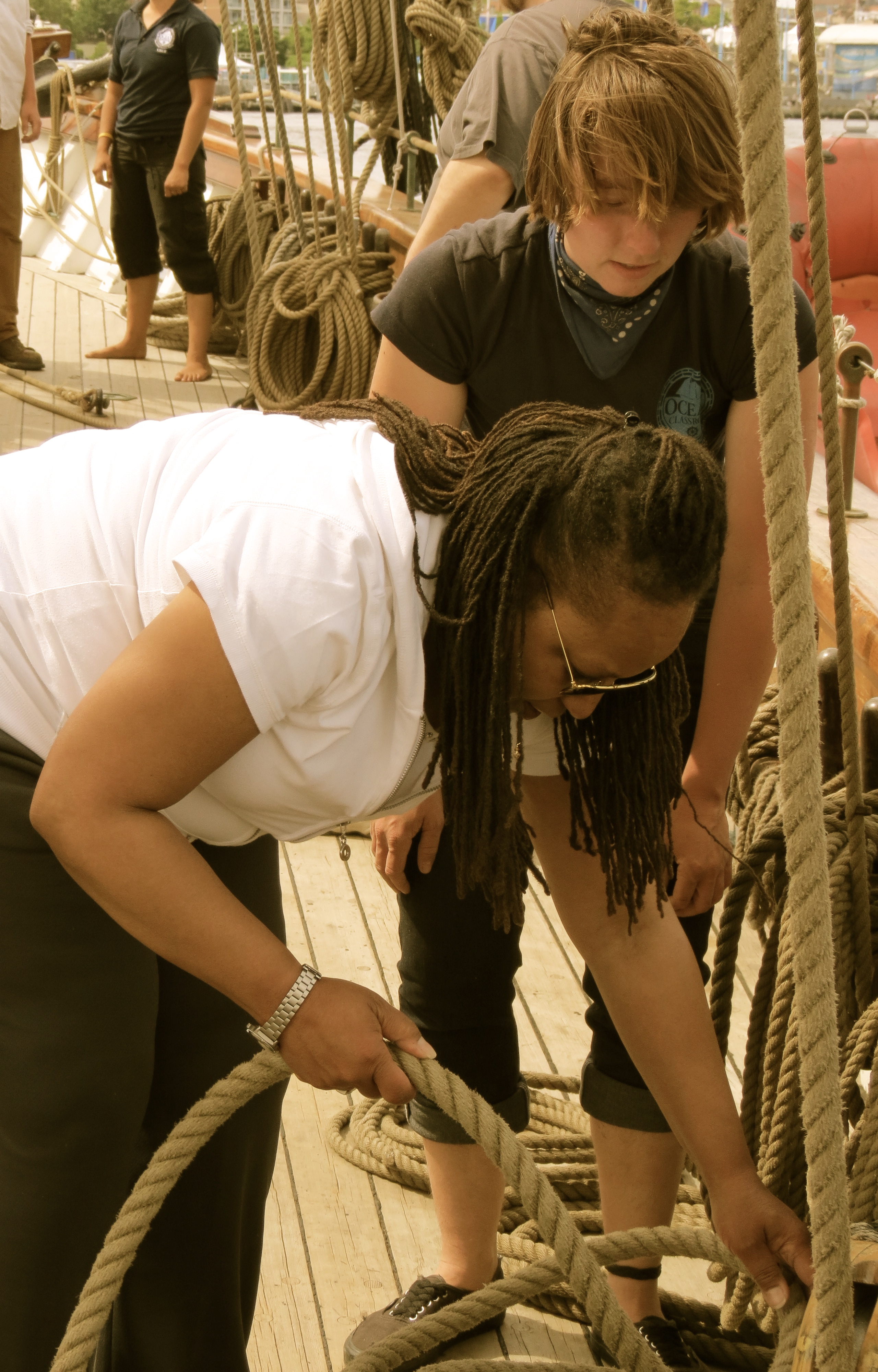
IMG_2589Twelve members of the crew are part of the Ocean Classroom Foundation, an organization that offers programs of sea education to students. Watching the students do their tasks was amazing as they climbed the rigging and hoisted the sails. What was great about the experience was the crew encouraged passengers to take part in helping out with some of these chores. Passengers pulled the ropes in unison to bring the sails into the wind. A student assisted my friend, Frances, in stacking the rope in a pattern of thirds.  It then occurred to me that this is where the expression “learning the ropes” came from.

The Schooner

The Amistad, built in 2000, is a 129-foot Baltimore Clipper and a replica of the original vessel. Classified as a Sailing School Vessel, the schooner is equipped with modern navigation equipment and is certified to make international voyages.

IMG_2632 - Version 2

The rig and construction are authentic; and as I walked the deck, I admired the wooden pulleys, steering wheel and mast, which retained that old-world feel of craftsmanship, the wood shining with the richness of spar varnish.

The original ship has been long-lost somewhere in the Caribbean, but the Freedom Schooner Amistad will not let the story of 53 determined freedom fighters be forgotten.

Music Video

“Dry Your Tears Afrika,” written by John Williams, is from the movie, Amistad.

Thanks to Abi Iverson for rearranging our tickets and providing additional information for the blog.

Memorial Day: Remembering Normandy

The American Cemetery was our final destination the day we visited Normandy. The grounds, landscaped with perfectly shaped trees and gardens, were well ordered. The blue waters of the English Channel framed the far side of the cemetery, and along the walk we could view cliffs in the distance. The beach, stretching for miles, vast and remote, rested against a scrub forest. On the carefully manicured lawn rows and rows of grave markers stood at attention facing the West. The trees swayed in a gentle breeze as the stillness of the markers remained ever-present.

DSC01511 - Version 2

Where have all the flowers gone?

On the dunes below the cemetery, we found these delicate pink blossoms entangled in barbed wire.

Flowers grow entangled in the barbed wire.

The Bumper Book: Enchanting Stories from Childhood

Bumper BookWhen I was a child, the book I treasured most was The Bumper Book: A Harvest of Stories and Verse. The condition of my book would not command the $350 that this vintage edition is selling for on eBay: the binding is gone, pages are torn and the cover is well-worn. Published in 1946, and given to me for my fourth birthday, these stories, fables and poems were my bedtime companions. “Wynken, Blynken and Nod” by Eugene Field, “Animal Crackers” by Christopher Morley and “The Swing” by Robert Louis Stevenson were some of my favorites. The colorful illustrations, printed on heavy glossy paper, fascinated me, drawing me into the stories because of the sweet depictions of the children in their vintage clothing.

 W, B, and Nod2

Thoughts on Anachronisms

One particular poem featured vignettes of the days of the week, illustrated with a little girl doing chores for each day. Around the turn of the 20th century, women’s chores were assigned a day of the week, as described on the blog, A Hundred Years Ago. When I was a child, I loved play houses, and the settings in these illustrations seemed to take place in child-sized surroundings. I marveled that somewhere children played in these finely crafted miniature homes.

The Week’s Calendar

Monday, Watch the bubbles fly –

Monday

Tuesday, See the wash get dry –
Wednesday, Mend with all our might  –

Wednesday

Thursday, Make things clean and bright –
Friday, Bad for dust and flies  –

Saturday

Saturday, Good for cakes and pies.
Sunday, From all tasks we’re free
After church we have our tea.
–Frances Heilprin

Because the little girl was cleaning and cooking in these picture frames, I wonder about the message that gave me about preparing for the eventual role of running a house. And then I wondered again, was that such an unfortunate model? Regardless of our path in life, we do have to take care of a home, either as a single person or with a partner and children. Of course, the drawings would have been more socially progressive if she had a boy to help out.

In our hierarchy of important jobs, our culture views work inside the home as a lower value. Yet today, with so many demands on our time, managing a home is a difficult responsibility. Cleanliness, orderliness, household finances and meal preparation offer considerable challenges. Work inside the home is the glue that keeps any society held together. This is honorable and necessary work that is best shared by all in the household.

PICT0017 - Version 2

My  laundry circa 1949.

Question: Artistic Greatness

Eulalie Banks, a British/American illustrator, born in 1895 and who lived to be 102 years old, did all the artwork in the book.  In her obituary, Nicholas Tucker wrote,

Eulalie Banks illustrated over 50 children’s books during her long lifetime. Never a great artist, she was always a popular one.

Interesting how the terms never a great artist, fill the second line. Really? I’ve seen many testimonials on the Internet to the Bumper Book, as adults reflect on how the stories and artwork became part of their childhood. Many, like myself, read the stories to their own children. The delightful illustrations offered a window into a rich fantasy world, enhancing the writing of the authors and poets. Conventional interpretations of greatness rarely include the breadth of experiences of children, which would lead to wider interpretations of artistic influence and “greatness”.

More on Antique Books

Children’s Books Online: The Rosetta Project: Largest Collection of illustrated antique books on-line . . . we think.

Literature with Girls as Strong Characters

Strong Girl Character: Middle Grade and Young Adult Novels


Social Justice Dilemma: The Unsettling Nature of Activism

“The hottest places in hell are reserved for those who in times of great moral crises maintain their neutrality.”          Dante

As social justice activists, we often identify with Dante in his frustration with those who either criticize the most nobel of justice campaigns or refuse to become involved.

What I’ve learned from doing activist work is that some folks just don’t like being bothered by our latest efforts to bring light on various social justice issues, and it almost doesn’t matter what the cause is: environment, poverty, corporate power, or gun control. The issue is not just about people’s indifference but also that some people actually become irritated by activists who generate discomfort with the status quo. It’s a universal problem that faces organizers but infrequently identified as a problem in solving the issue of understanding reactions to our most reasonable requests for social change in response to oppression. I would like to offer some thoughts on how we might consider what making change means to those who stand on the sidelines.

Protest Picture

1. I’m frazzled. Facts, figures, charts, graphs are logical approaches to making our case, but what we sometimes don’t address are the emotional responses to change, which makes some folks get out of sorts when they feel change is thrust upon them. Often first responses are instinctively negative.  

It’s important for activists to be aware of this problem before beginning to strategize solutions. Figuring out what emotional responses might surface assists in anticipating reactions from the community. In this way the organizers will have fewer surprises or objections when their campaign begins.

2. Don’t bother me in my bubble. People get comfortable with familiar routines, while thinking differently takes a great deal of energy. Folks may not want to hear that their water is dirty, their neighbor doesn’t have health care or that the schools are short on funding. If we examine even superficial social changes, like in the 1960s when guys began to grow their hair long or when mini skirts came into the fashion scene, there was a huge backlash against even these relatively minor cultural changes. 

Don’t be surprised that your cause, no matter how compelling, has brought on criticism and resistance. Expect it and prepare for it. Look for possible scapegoats, either persons or ideas. It is important to help the community think rationally and critically. Hold educational events on neutral subjects such as researching and critical thinking. Later, you may become involved in panel discussions and open forums; be ready to clarify  your reasonings, demystify assumptions, consider points of view, and support your data by evidence.

3. I’ll follow the pack. Since we are social creatures, we are part of a pack of similarly thinking people, which encourages a group think mentality.

Sometimes people have difficulty making decisions because they lack the information to make an informed decision. This is where the reports and data that are easily understood are important. Answer specific questions that arise. In some cases, experts can offer clarity to the community.

4. Don’t Tell Me What to Do. When change is imposed by others, people naturally resist, which seems especially true when this happens with peer groups. People sometimes accept authority from those with status, wealth or power. People feel they have to acquiesce to these authority figures, who get a pass because they are seen in status positions. Authorities also command the comfortable status quo and can use the comfort of the old familiar routines to sway opinion to their side when controversy strikes. When peers bring change, there is a vulnerability, as they may have little power or position, from which many view as legitimacy to make change.

Identify groups, people and organizations that may command attention because of the hierarchical position, and break down the power structures by giving people a voice to their concerns. Create venues in which people can participate.

5. I’ve got my own problems. And who’s paying attention to those, they may ask. People see the world from their own view and cannot face another distraction about other people’s’ problems. Facing up to social justice issues brings the next logical step: solving the problem and that puts folks on the spot. Then they may feel compelled to do something about it.  But they don’t really want to solve the problem so they often find a convenient scapegoat.

Identify ways in which your cause may create difficulties for others, whether real or imagined. Listen carefully to those who express concerns and address those concerns. Invite them to be part of the process of change. You may have to alter your focus to include larger groups. 

6. I’m  above the fray. Some folks have privileges that allows them the luxury to ignore the problem. For example, they have enough money to get by or they are wealthy and can afford to fix problems for themselves.

Most people experience some form of discrimination because others have privileges. Find ways in which people experience oppression. One common form of almost universal oppression is lack of voice in the work place. Most employers do not operate in a democratic fashion, and workers resent injustices they have experienced in their place of employment. Point out the advantages of everyone contributing and how that helps the organization and democratic practice. Don’t make people feel guilty about their privilege. Talk about how liberation benefits everyone.

7. I’m scared. Perhaps they are a gun owner and fear that the privilege they have had with unfettered regulation will in some way be restricted. Others fear that what little they have will be taken away. If you advocate to pay a living wage to lowest paid workers, the middle-rung workers may feel neglected. They might wonder, where’s my pay increase?  Institutions perpetuate this way of thinking. I was at a meeting recently where activists were pressing the administration to provide a day care center. An administration minion said, “What will employees be willing to give up for a day care center?”

Activists and social justice organizations must look at the bigger picture and listen to as many different constituencies as possible. It may be difficult, but try to involve them in the process or at least invite them. Create specific steps and supporting documentation for each step. Try to dispel rumors and myths. Look for ways in which your message might be undermined by fear messages from the opposition.

Organizations and activists will not be able to bring everyone on the side of their cause. However, it is possible to bring along folks who stand at the fringe or even the center who might consider what you have to say. Don’t be discouraged as staying strong in the face unrelenting criticism is part of our responsibility and not to be taken personally. Changing a culture is a long process and takes careful attention to detail while remaining compassionate to all involved. Integrity should always be the cornerstone of your campaign. People respect that even if they disagree with your mission. You might just might cancel a few of those reservations to the inferno.


Philadelphia’s May Day Celebration 2013

Honoring Workers Who Fought and Won the 8-Hour Work Day

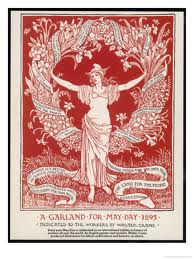
images Many people believe that May Day is a socialist or communist celebration, when in fact the May Day holiday grew out of  the eight-hour working day movement in the United States in 1884. The struggle for a shorter workday began in the factories as the unions pressed their employers for shorter hours and higher wages. At that time, millions of people were out of work. During the convention of the Federation of Organized Trades and Labor Unions announced that eight hours “shall constitute a day’s work from and after May 1, 1886.” Honoring May Day is an important part of our American heritage, and in Philadelphia Elmwood Park provided the perfect place for a rally and celebration in front of the monument by Irish artist, John Kindness, which stands as a tribute to the American worker.

IMG_2515

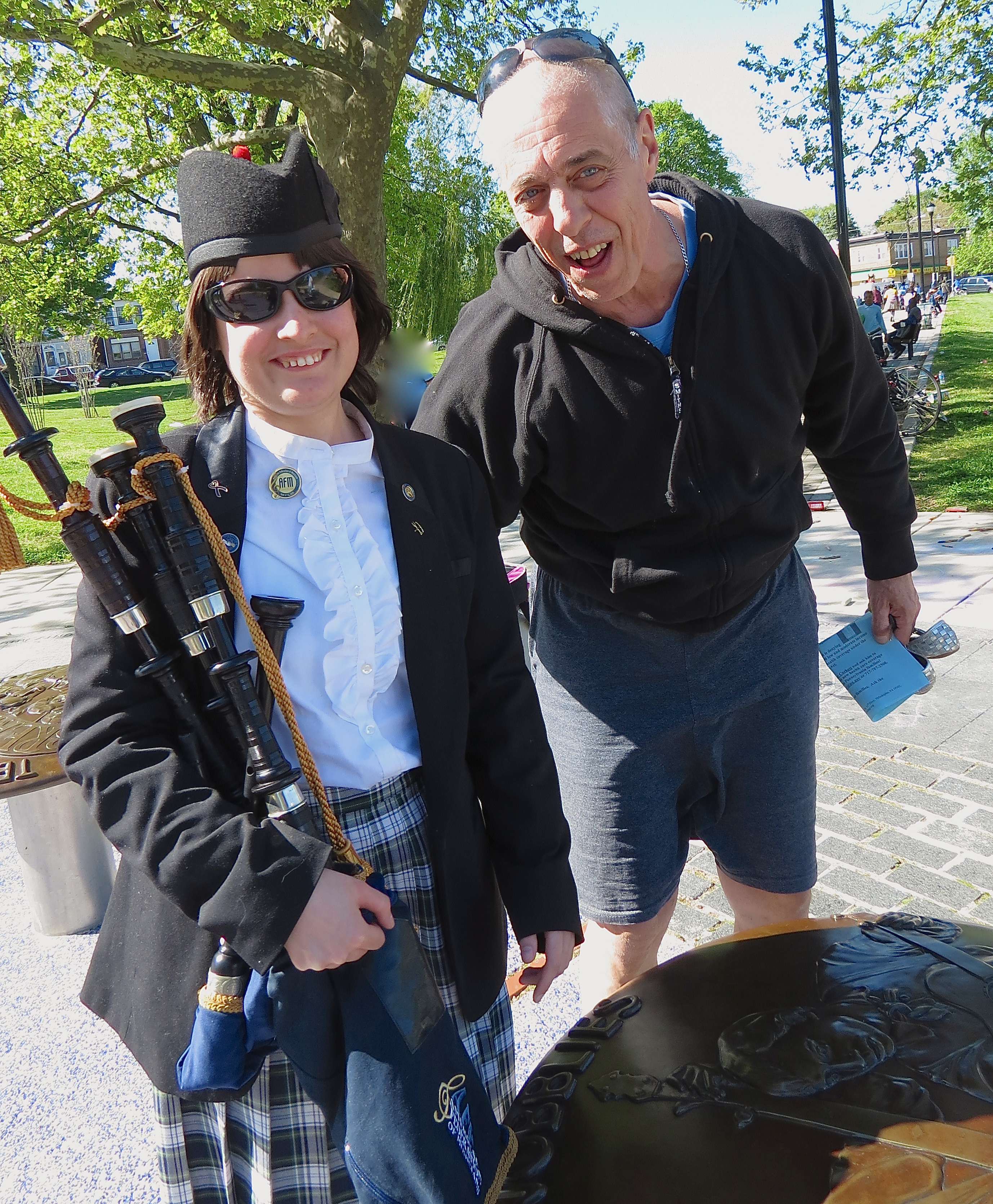
Alexandria with John Jerzak, member of Friends of Elmwood Park who advocated for the labor memorial.

Jim Moran, Committee Chair of the May Day Committee introduced Alexandria Knox, proudly representing her union, the American Federation of Musicians, Local 349, Manchester, New Hampshire. Alexandria played a rousing version of Scotland the Brave on the bagpipes, beginning the afternoon’s entertainment. We were extremely fortunate that Alexandria, who is dedicated to the cause of unionization and solidarity, had agreed to play for the event as she is one of a very small number of totally visually impaired Highland bagpipers throughout the world. Next up Mike Stout & The Human Union Band  filled the air with energetic rock music with a worker message.  I was moved by their first song, The Triangle Shirtwaist Fire Song, especially in light of the recent tragedy in Bangladesh, where over 1,000 workers were killed in a building collapse. I immediately bought three of their CDs. Mike describes himself as

a socially conscious singer song-writer and community leader who leads crusades against local and global economic injustice, rallying people with his music, and he organizes them to take action.He tells his stories from the heart about people who are affected by unemployment, or social injustice or war.

IMG_2485

Mike Stout and the Human Union Band

Other musicians performed including K&A Mob, Tha Truth, Dina Yarmus and Maryta Fields, who sang the National Anthem. IMG_2489Pete Matthews-AFSCME DC 33, Gwen Ivey-APWU 89, Cathy Scott-AFSCME DC 47, John Johnson-TWU 234, Helen Gym-Parents United for Public Education, Philadelphia Student Union, Chicago Teachers Union 1, Cathy Brady-Friends of Elmwood Park & SEIU HCPA were some of the scheduled speakers. A member of the Chicago Teachers Union, Andrew Heiserman, shared stories of  their courageous battle against the city’s austerity measures against the schools. . Sonia Sanchez, Philadelphia’s Poet Laureate, spoke about peace benches. Jim Moran presented the Aggie Moran Human Rights Awards to Sonia as well as to labor historian, Alice Hoffman, labor rights campaigner, Barbara Rahke, and the Restaurant Opportunities Center. The “SRC 19,”  the activists arrested at the last School Reform Commission meeting in Philadelphia when the SRC voted to close 23 Philadelphia Public Schools, were also honored. Occupy Philly Food Committee provided a great selection of food: sandwiches, bbq, salads, cake and beverages.

Selected video highlights from the event:

May Day Celebrations around the World 2013

Art Imitating Life

on 47th and Baltimore Avenue in West Philadelphia.

The city of Philadelphia displays the largest collection of public murals in the country. One of the 2,000 murals rests on the wall outside of the A-Space, a collectively run anarchist community center and art gallery. Titled The Heart of Baltimore Avenue, the muralist, David Ginn, depicts West Philly neighbors working together.

Passing by on May Day 2013, caught this moment . . . which stands as a tribute to all workers who make our cities great.

Life Imitating Art

Tag Cloud