“This is a fine mess you got yourself into.”
“You got yourself into this, you get yourself out of it!”
Supply your own caption. : )

“This is a fine mess you got yourself into.”
“You got yourself into this, you get yourself out of it!”
Supply your own caption. : )
Returning to Red Clay Creek, Delaware


Photo credit: J. R. Blackwell
The first day of October brought me back to ride the rails again of the Wilmington and Western Railroad. On several occasions, I have boarded the train, pulled by the magnificent steam locomotive, the American 98, black, formidable, and puffing grey steam out from its chimney. The train followed the Red Clay Creek, a mostly shallow winding stream through woodlands and fields. I photographed several Civil War reenactments along the creek. Now I looked forward to returning for another journey through the Delaware countryside, this time on a geological expedition.
 This would be my first outing with the Delaware Mineralogical Society, joining folks who know a great deal of information about rocks, of which I have almost no knowledge, although I have always picked up a souvenir rock during my travels.
I have an affinity with rocks. Now I was about to get some education on the subject.
Building a Railroad through the Rocks
In 1872 the Wilmington & Western Railroad began service to bring goods and passengers among the mills along the creek. Building the line had many challenges including cutting through significant rock outcroppings. According to an article in the Delaware Public Media,
They didn’t really understand geology back then, and Delaware’s got a lot of rock and it’s the foothills of the Appalachians. So their construction costs skyrocketed. Robert Elwood
Not knowing about rocks can cost money!
Robert authored Special 50th Anniversary Historic Timeline: the Wilmington & Western’s Half-Century of Operation and reported that “two massive rock outcrops would require extensive black powder blasting to cut through.” p. 3. One outcropping at Cuba Hill consisted of blue granite; at Wooddale, the rock was more massive but softer. A powder keg exploded at Wooddale, and three workers died as a result. Even opening a powder keg with a sharp tool could cause a barrel to explode. The names of these workers seem to be lost to history, but their involuntary sacrifice is noted in Robert’s timeline.
Subduction Leads to Orogeny . . . Really?
Delaware Geologic Survey scientist William “Sandy” Schenck, presented an introductory lesson to the geologic history of the land beneath our feet. The process is best described in this quote from the Geological History of the Delaware Piedmont,
It is surprising to find that although the Delaware Piedmont has passed through the whole series of tectonic events that formed the Appalachians, the mineralogy and structures preserved in Delaware were formed by the early event that occurred between 470 and 440 million years ago, called the Taconic orogeny. This event was triggered by the formation of a subduction zone off the coast of the ancient North American continent that slid oceanic crust on the ancient North American plate beneath oceanic crust on the overriding plate, produced magma, and fueled an arc-shaped chain of volcanoes.
The expression does make a quirky bumper sticker, if you’re into geological humor.


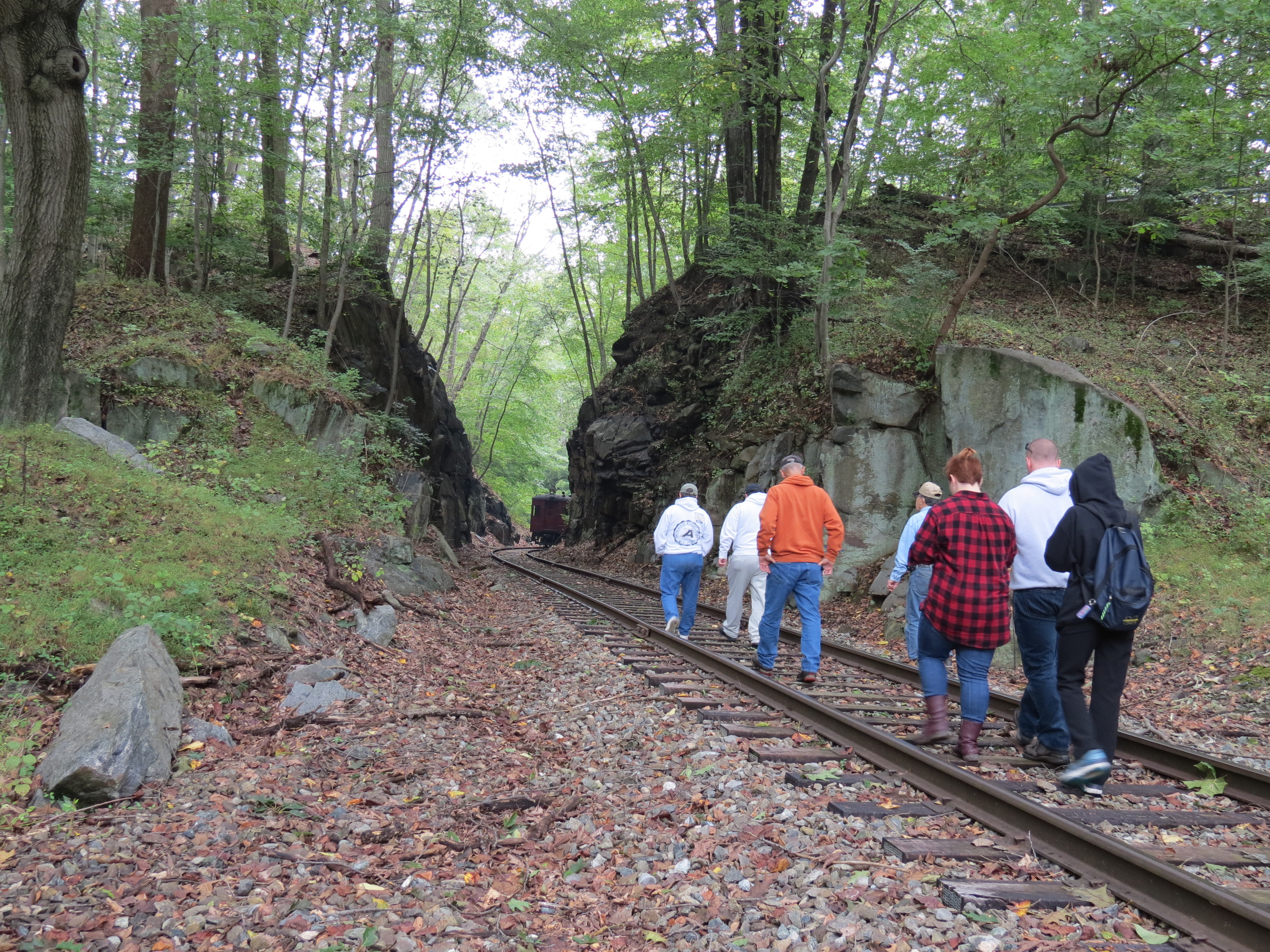
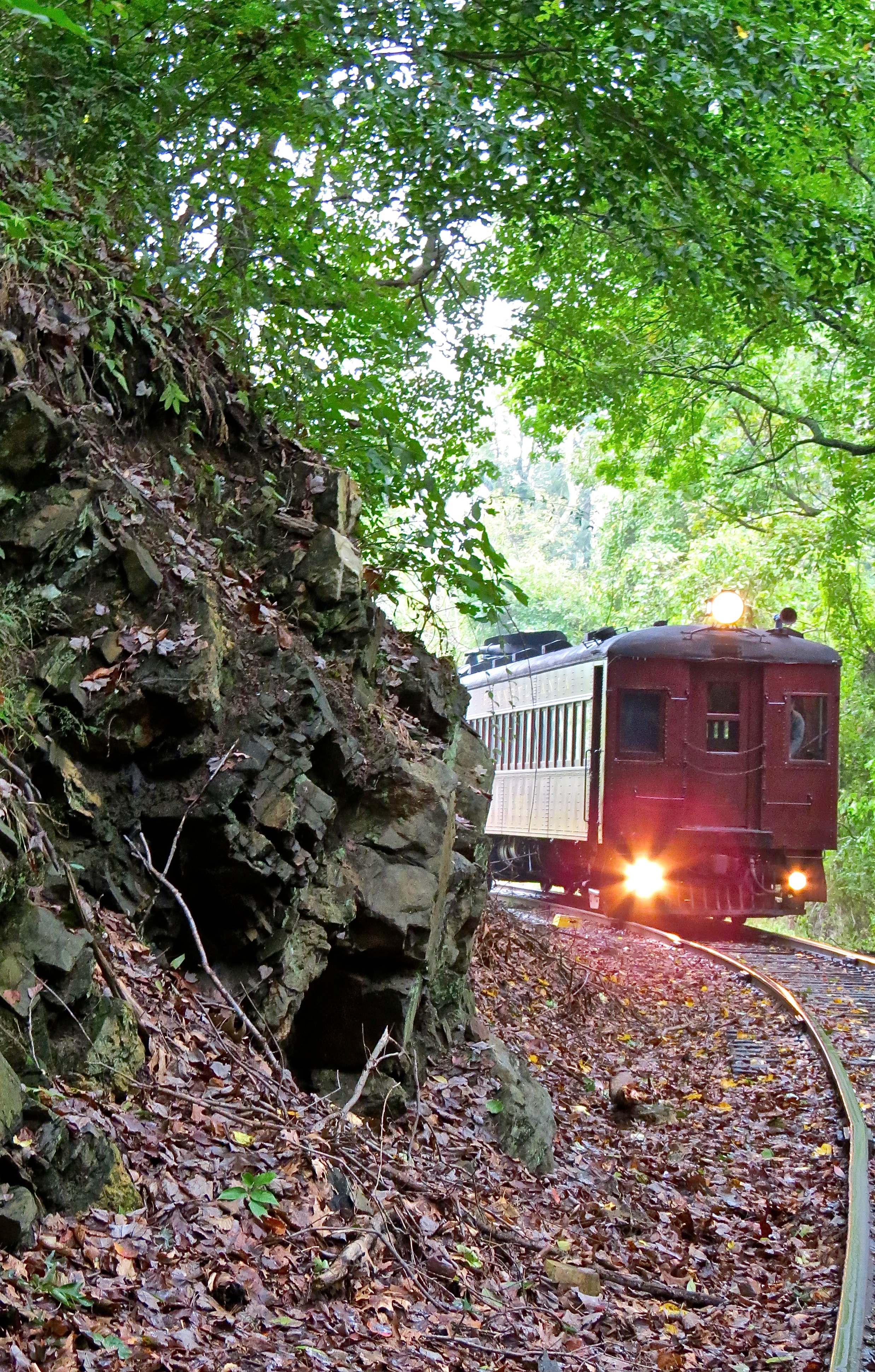
We boarded the 1929 railcar, “The Paul Revere,” to view and understand the rock landscape as it exists now.

If you like the sound of the train, here’s a video as we left the station.
Southeast of Greenbank Station


At our first stop, Sandy pointed out the metamorphosed igneous rocks jutting out along the track. We could see the fractures caused by expansion that crisscrossed along the formation. The third photograph in this series is a close-up of the “bright eyes” feldspar surrounding black grains of magnetite, formed by the two tectonic plates colliding.
Studying the Cliffs
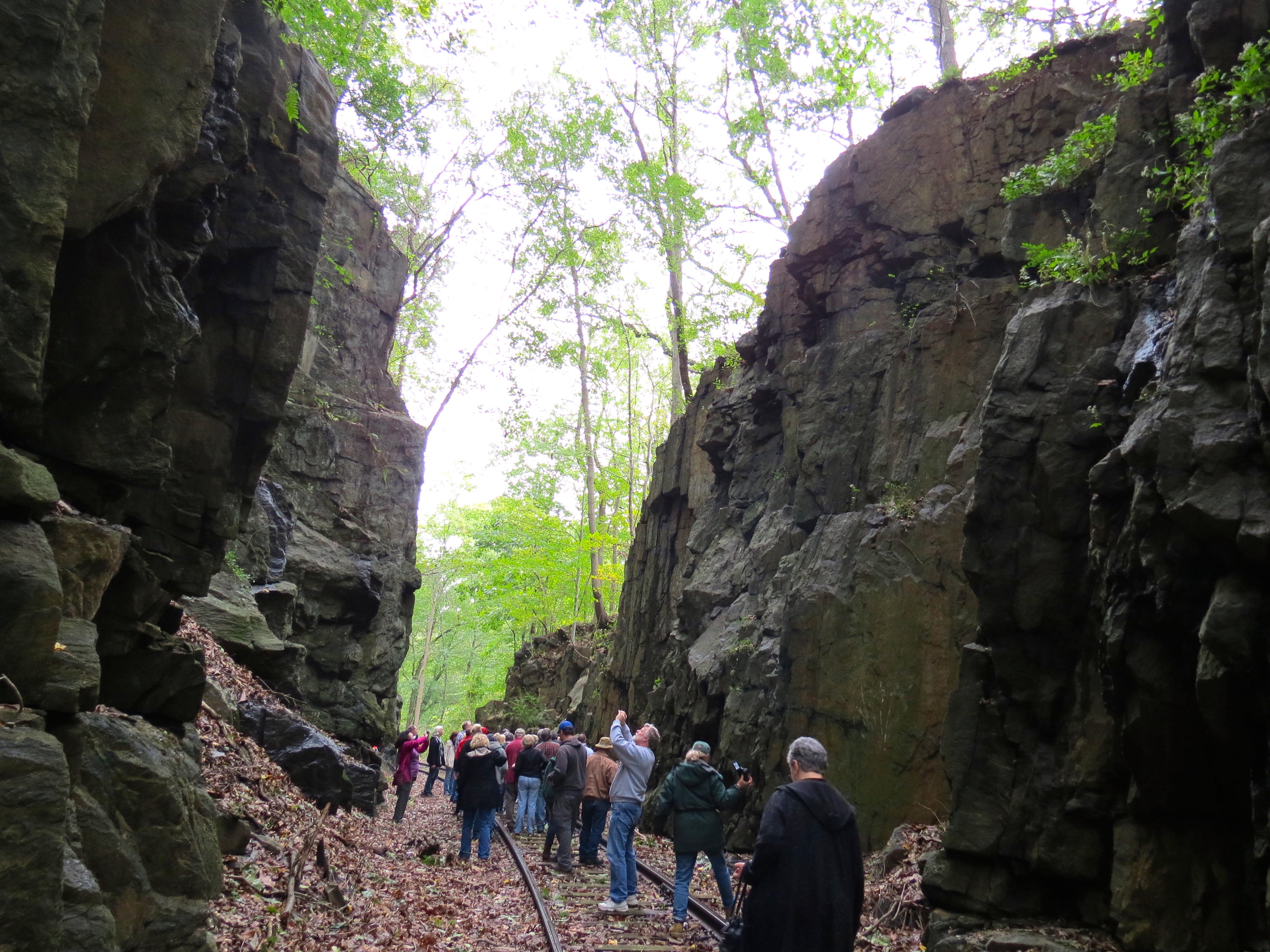
The Paul Revere headed back through the Greenback Station, letting us off at several different locations, allowing us to walk through the cliffs on either side of the tracks. It was amazing to imagine the labor necessary in 1870 to carve out a narrow space for the train to pass through what looked like impenetrable rocks. These metamorphosed rocks were originally sedimentary, now layered and jagged.
Piedmont Prospectors Pan for Garnets
Part of the fun of rock collecting is panning for something, in this case, garnets. Garnets are commonly a reddish-brown colored silicate mineral, which can be polished into a red gemstone. Prospectors can find garnets in stream-worn pebbles, as they are often found at the earth’s surface. Garnet often forms at convergent plate boundaries, a gift from the collision of the Appalachian Piedmont and the Atlantic Coastal Plain. The prospector uses a pan to wash away the sand, leaving magnetite, which can be pulled out with a magnet, and the garnet crystals. Prospectors enjoyed the hunt for these little treasures. A woodland creek is a wonder in itself, creating the soothing sounds of rippling water over the rocks.


Garnet in the rough. Photo credit, Jeff Chalfant
A Stepping Stone into the Past
Rocks hold the historical record of the earth. The lowly stones we step over have a history and tell us about earlier environments on our planet. Reading the rocks could uncover how humans used the rocks or dealt with destroying them. The next time I ride the Paul Revere, I’ll recall the history of two plates colliding and the story that the rocks tell us on the hillside landscapes of the Red Creek Valley.
When I think about the past, I get a warm feeling. Wistfully, I fondly remember things of the past . . . old photographs, a typewriter, my grandmother’ quilts, my father’s train set from the 1920s. Sometimes the scene is recreated for us, such as an old general hardware store or train station. There’s something quaint in those scenes that’s missing today. Despite all of our technology and modern gadgets, objects from yesteryear carry with them the skill and creativity that is still valued. The objects are embedded with memories. We never know what will stay with us and what will be gone some day.


WordPress assigned this week’s photo challenge as “quest,” and when I think about quest, I immediately recall Joseph Campbell’s PBS series on the hero’s journey. The adventure begins in the everyday world when a herald calls the hero or heroine to action. Mentors along the way reassure the hero, as the quest continues. The heroine is tested as she faces a final ordeal. The way home can be fraught with danger, but in the end, the heroine has succeeded because she has dared to stand up for a noble cause.
Those who make the journey on the path toward social justice face enormous odds to create a society that respects and cares for all people. Ordinary people are drawn to speak up for what’s right, marching in the streets, often proclaiming an unpopular belief. Detractors label them as “troublemakers” and “rabble-rousers.” Authorities engage armed legions to contain and control demonstrators, even when protesters are unarmed and peaceful. The media catch one individual engaging in undesirable behavior and then demonize the entire protest. Despite all obstacles, the hero persists and continues the mission to create a just society.


I’m expanding the “photo” challenge by posting a video. While visiting Zaragoza, Spain, a Renaissance Fair was well underway with colorful tents filling the square and the smells of cheese, incense, burning wood, and olives intertwined on whiffs of air. Crowds poured over the Roman bridge, as it seemed the entire population of Zaragoza showed up to visit the varied venders who came to sell their wares. Musicians played drums and a bagpipe troop snaked their way through the crowd. I wandered past the booths displaying pottery, jewelry and clothing as people cued up to get a photograph with a raptor or a snake charmer.
A vintage merry-go-round, cranked by hand by the operator, caught my attention. I watched the children enjoy the quintessential steampunk ride, with airships, balloons and other flying contraptions. A rare sight, indeed.
On my Bucket List: Ride a motorcycle! Well, how about a scooter instead?
Riding a motorcycle has always been on my “gotta do list,” but I always asked myself how would I secure a motorcycle, find an instructor, and meet insurance requirements without spending lots of money? So when I saw an advertisement for an opportunity to scooter through Lancaster County, Pennsylvania, I said to myself, “Here’s my chance!” Several years ago, I visited the area to see the Strasburg Railroad and Museum and to take a ride on a steam-powered train through the cornfields. I remembered that the views were spectacular.
Strasburg Scooters advertises several tours, and I opted for the covered bridge tour and signed up for the scoot coupé, a two-seater in the moped category. One of my friends kindly offered to drive so that I could take photos and videos.
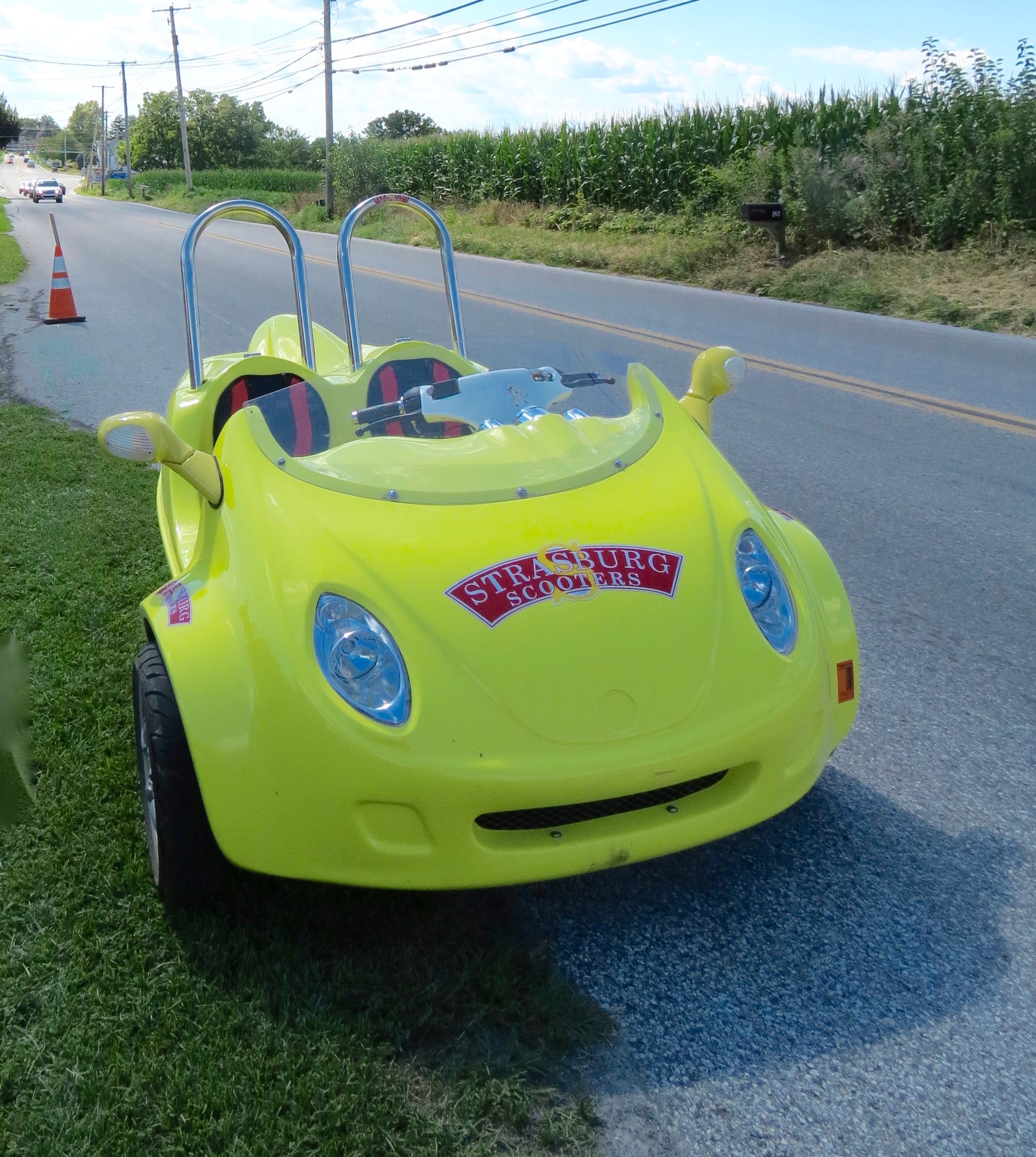 We found Strasburg Scooters right next door to the railroad museum. We introduced ourselves to Marc, our guide, who fitted us with helmets, followed by a quick tutorial on operating the scooter. He then sent us off on a trial run around the block. The coupé handled well and chugged nicely along between 20 and 30 mph. After the other tour participants took turns practicing on the their scooters, we started down one of the narrow roads.
Marc stopped along the Amish farmland to explain some of their cultural traditions and practices. Horse and buggies passed by, and folks acknowledged us with a peace sign or a wave. Children peeked out from the back window of their coaches, smiling at us. At one house, little children, girls wearing bonnets and boys donning straw hats, ran over to the side of the road to watch us ride by.
Horse and Carriage through the Bridge
The farms stood like jewels on the landscape, silver silos gleaming in the afternoon sun. Rolling hills supported squares of various shades of green. The Amish keep all their buildings and houses in pristine condition. Black and white cows and tan horses grazed on grasslands while fields of corn, tobacco and alfalfa swayed with the light breezes.
Countryside by Scooter
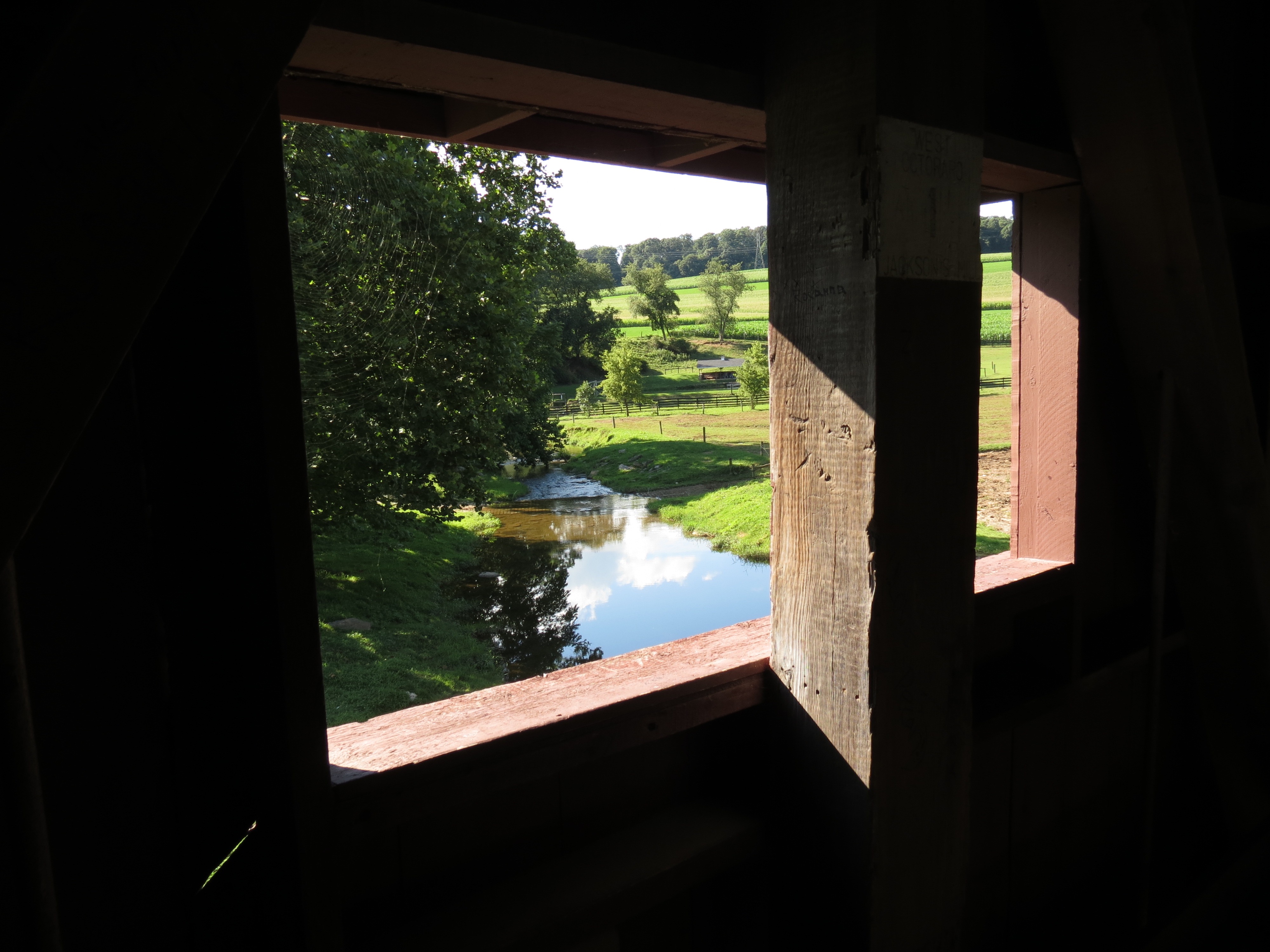 We stopped at three of the 29 covered bridges, all listed on the National Register of Historic Places. Huge beams which supported the structure, arched on each side, called the Burr arch truss design. The bridges were painted red, with white portals standing at the entrances. A central window allowed travelers to look out to the stream and countryside beyond.


Our final stretch included a spin through the historic village of Strasburg. We saw several log homes from the 1700s along the main highway through the town. Inns and restaurants were tucked between 19th century houses, each one a study in different architectural styles.
Strasburg Downtown
Riding along the quiet country roads offered us views of expansive scenery of fields, forests, farms, flowing streams–every turn a different postcard scene. The scoot coupé delivered us in the landscape and in the moment, the scent of the land filling the air. I was thoroughly thrilled with my first scooter ride.
I hope to return in the Fall, and repeat the ride all over again.

How Social Services Provide the Mechanism to Help our Fellow Citizens




 Psalmboxkey's Blog