Echo the far-off roll of thunder,
Rumbling loud
And ever louder, under
The blue-black curtain of cloud,
Where the lightning serpents gleam.
–Storm-Music by Henry Van Dyke

Weekly Photo Challenge: Forces of Nature
Echo the far-off roll of thunder,
Rumbling loud
And ever louder, under
The blue-black curtain of cloud,
Where the lightning serpents gleam.
–Storm-Music by Henry Van Dyke
Weekly Photo Challenge: Forces of Nature
A wind carves concave sails against the sky
Above I see clouds and sun alternating
in revealing themselves. I hear new waves
being born in the ship’s rushing wake.
And I feel the bow undulating
into the sun’s reflection of a churning sea.
All this, and beneath me a silent life
streams on into eternity.
Written to Captain Bruno and his Crew, Revised

Lisbon’s Tram 28 Tour

Hometown Trolley: Red Arrow
A photograph of a little yellow tram-car against the backdrop of a twisted alley way on a cobblestone street, enticed me to visit Lisbon. National Geographic lists the Lisbon trams in their top ten list of trolley rides. I have an affinity for trolleys because I grew up next to a the Red Arrow Trolley Line that ran in the back of my childhood neighborhood; we always looked forward to riding the trolley.
So when public transportation takes on a mystic quality, I know a ride is not to be missed. My experience with the hair-raising Amalfi Coast bus ride comes to mind. I always prepare references of places I plan to see and “visit” locations on Google maps still I didn’t find the right place to pick up the tram in the historic Amalfa section of Lisbon. I was proud of myself for negotiating a metro transfer and arrived at the Martim Moniz Plaza only to stand a station for 20-minutes, wondering if I was lost. A man wearing a transport vest looked like a good candidate to set me straight, and he affirmed I was in the right place, but the next tram that stopped was the Number 12 not 28! I decided to explore around the plaza, turned the corner . . .

Ah, yes, I should have scouted out the stop with the long queue. I thought a rainy day in April would be safe bet against hoards of tourists. As rain intensified, everyone, including myself, stood our ground as we waited patiently for the trams to arrive until we, too, could be squeezed into the trolley car. Many of the guidebooks warned against pickpockets, but with cacophony of foreign languages and folks holding city maps while taking cell phone photos, there was no room for pickpockets . . . just hawkers selling umbrellas at inflated prices.
The Lisbon trams, once drawn by horses, have a steampunk quality, with their 20th century fittings and polished wood. The vintage cars, built over seventy years ago, sport bright yellow paint. The narrow cars jounce (made up word) through cobbled streets and narrow alleys, like Mr. Toad’s Wild Ride from Disneyland–with sudden turns, avoiding what would seem to result in an inevitable crash. The tram wheels, positioned at the center of the car and not at the ends, make the trolley seem to float over the tracks.

Dark Tourism at its Best
 I stayed on the trolley, with a mysterious transfer to another, to the end of the line. I never did quite figure out their system, but did reach the last stop, the Prazeres, for my verified “Dark Tourism” experience. Ironically named “Cemetery of Pleasures,” the spot has an otherworldly feel, the rainy day contributing to the misty atmosphere. Lines of cyprus trees stretched toward the sky, breaking up the line of marble buildings. This cemetery reminded me of our visit to the Cimetiere Du Pere-Lachaise in Paris, where many of the rich and famous found their last resting place. Seems like Europeans like to create stone villages to the dead, perhaps trying to create immortality in stone. Each mausoleum is characterized by its own personality, with a variety of sculptures decorating the façade. Elaborate doors served as the entrance, either painted or with intricate ironwork in front of a window. Each building has a strange quality of enticing visitors to look into the little houses while still conveying an eerie caution. I couldn’t help but peek through the windows to see alters with pictures, as well as the coffins. I would have lingered longer, but as the rain spilled over my umbrella, the bone chilling dampness, no pun intended, drove me back to find the trolley.

Tram Stop: Castelo de S. Jorge
The trolleys stop at over thirty locations, and I found it challenging, if not impossible, to figure out exactly where we were at any one time. I did have a list of stops, but small print named the stations names and the conductor did not make announcements. In any case, every stop along the way seemed like a great place to get out and explore so it didn’t matter about missing the stop for Castelo de S. Jorge. The massively huge castle, which dates back to the 11th Century, sits atop the tallest of Lisbon’s seven hills. A shaded courtyard spread out toward expansive views of the city and surrounds, providing a great perspective of the area. The Tagus River, sparkling in the sun, surrounded the landscape.

The massively huge castle, which dates back to the 11th Century, sat atop the tallest of Lisbon’s seven hills. A shaded courtyard spread out toward expansive views of the city and surrounds with the Tagus River, sparkling in the sun, surrounding the landscape. Viewing from the ramparts, I looked down into the neighborhoods of Alfama. Cottages and castle stand together as extreme contrasts in size and style.


I walked up and down the steps of the ramparts, being careful not to lean too far over the short walls. Steep steps provided a workout, but with so many interesting places around every corner, I wanted to see all of it. At the archaeological site, I viewed the ruins of the Moorish quarter. Before the Moor invasion, other civilizations occupied the site dating back to the Iron Age.
Lunch with a Peahen
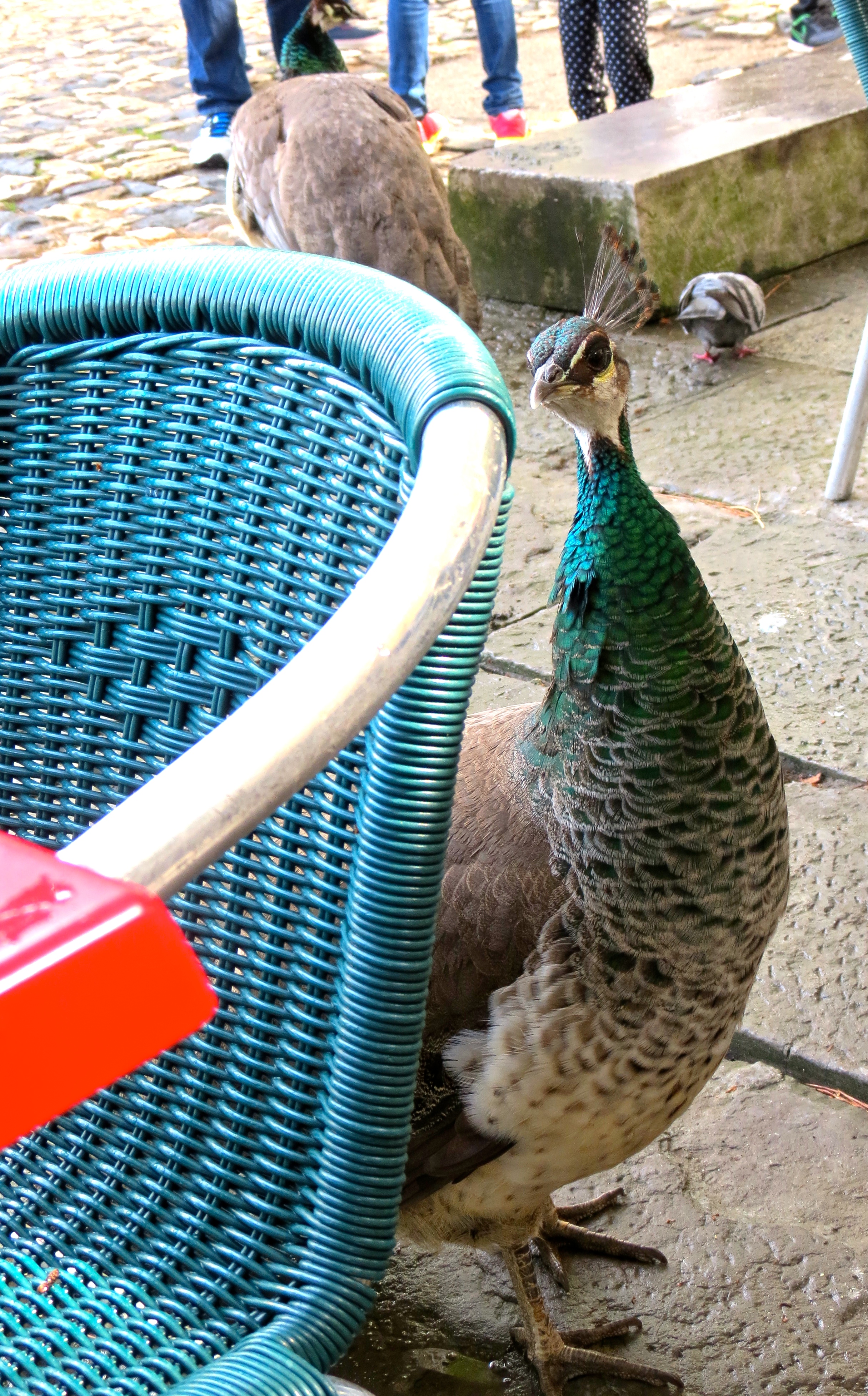 Peacocks and pea hens sat in the trees and on the walls and paraded around the café. I don’t believe I’ve ever seen peacocks of such size. When the male spread his feathers, he needed at lease ten feet. I bought a baguette for lunch and settled down at an outside table. Can you enjoy a meal while being watched? A peahen took an interest in my sandwich, cocking her little head as I tried to dissuade her with a conversation littered with, “no, no.” Being a Portugese bird, my words did not translate, but being a persistent creature, she was eventually rewarded with a handout, which worked for her and provided me with the knowledge of why these birds were so large.
I hopped back on the trolley and then the Metro to my hotel. Lisbon’s Metro had been easy to negotiate and surprisingly spiffy and clean. Shiny blue tiles lined the walls along the series of escalators that carried passengers to lower levels. Not a single piece of paper littered the floors. Crowds jammed into the cars at rush hour. A fist fight broke out right in front of me, the result of pushing and shoving that jostled the passengers caught in the crush. A women on the platform broke the fight up, leaving the two agitators apart as the doors shut on the car and separated the two.

Metro Platform
With four fitful hours of sleep on the plane the previous evening and a full day of exploring, I fell into bed exhausted, as the “Trolley Song” came into my head,
Clang, clang, clang went the trolley
Ding, ding, ding went the bellChug, chug, chug went the motor
Bump, bump, bump went the brake
I thought I would sail about a little and see the watery part of the world. –Herman Melville, Moby Dick
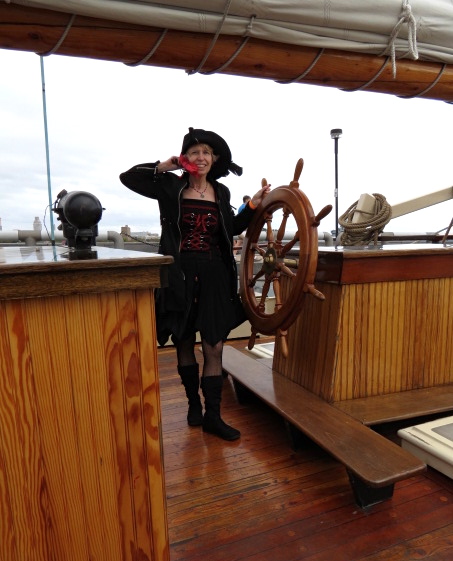
In a earlier post, Paranoid Traveler or Conscious Consumer? I questioned whether I should even make this trip. Attempting to weigh the prospect of ISIS lurking off the coast of Libya against the probability of all going well, I decided to go ahead with my travel plans. Therefore, I’m returning to the sea once again, inspired by my recent sailing adventure off the coast of Maine on a windjammer, the Mary Day. On this trip, the Star Clipper, tallest sailing ship ever built, will carry passengers and crew across the Mediterranean, starting in Lisbon, Portugal, 17 days at sea with stops along the way and finally ending in Athens.
Because of the recent terrorist attack at the Bardo Museum in Tunis, the ship will not be stopping at Tunis, as previously planned. The Bardo Museum had been selected as one of our excursions, and that knowledge make the tragedy of lives lost even greater for me. Cruise management also removed Pantelleria, an Italian island off the coast of Tunisia, from the ports of call. The Tunisian people transitioned to a democracy after the Arab Spring and installed a secularist-led government. Extremists target such initiatives. On March 29, 10,000 Tunisians marched through Tunis in solidarity against those who would threaten their democracy.
Before the March 18 attack on the museum, I was already feeling I might be taking on an adventure that might be more than I could handle. Some friends questioned whether it was safe for a woman traveling by herself and on a sailing vessel, which is far removed from the typical cruise ship experience. The ship rocks in the waves and tilts at an angle on the downwind side. I’m excited about taking photographs of the sea and landscapes. One of the best observation points will be from the crow’s nest, climbing up the rigging for 360-degree views from the top of the mast. I can cry, “Land A-Hoy!” and point to the horizon . . . aways wanted to do that.
I searched for blogs recording a similar sailing adventure. The closest journal I found was Mark Twain’s, Innocents Aboard, his humorous account of his travels on the Mediterranean onboard a side-wheel steamer in 1897. As I do my version of what Twain subtitled his journal, The New Pilgrims Progress. I hope that you’ll join me by participating in the comment’s section.
Dark Sides of Tourism
Three continents border the Mediterranean, creating the cradle of world civilization connecting people from different cultures. I’ve read an overview of historical accounts of aggression, invasion and conquest. Any territory bordering the Mediterranean or island surrounded by that sea has been repeatedly screwed over, yes, I’ve said it, screwed over–for the word conquest sounds sanitized, and the second definition: winning of favor or affection, softens the horror that followed invaders. Many civilizations carry the blame: Egyptians, Phoenicians, Romans, Greeks, Ottoman Turks, Normans and throw in the Crusaders and the Barbary pirates, and it seems likes Mediterranean people have never had a moment’s peace, even up to the present moment with ISIS controlling territory in Syria and threatening attacks on Italy, putting that country on high alert. Little more than one hundred miles separates the Sicily from the Libyan coast.
Why are conquering civilizations called “great” or “golden”? What mechanisms spawned those grand titles, achieved through madness and mayhem, causing endless personal tragedies, rarely recorded in history books or on tours? Dark Tourism, defined narrowly as travel to any sites associated with death, more broadly can apply to visiting almost any place on earth! Making pilgrimages to graveyards or catacombs fits the obvious definition, but if we scratch below the façade of any place, we experience Dark Tourism.
Long before the attacks on Tunisia, I had researched one of planned tours to the ancient city of Carthage, a UNESCO World Heritage Site. One tour describes Carthage as “perpetuating values of openness and exchange.” The ancient city stands in ruins today, scattered stones and standing columns representing architecture that once housed the civilization. Archaeologists who study the evidence, uncover other layers of culture. I read in horror that Carthaginians sacrificed their own infant children, and the civilization relied on slave labor. It is extremely difficult to feel impressed with their architectural prowess given that the Carthaginians conscripted prisoners of war into the service of backbreaking stone masonry. If these people killed their own children, one can only imagine how they treated their slaves.
I am not planning a gloomy travel experience; I do want to learn history and appreciate art and geography of these countries. I’m in the last quarter of my life and time is short! I want to climb the ship’s mast, hike rolling hills, explore castle passages, find spring wild flowers poking out from the rocks or photograph children playing in the village alleyways. Like Mark Twain, who writes in the Preface of Innocent Aboard, this is a journal of a “pleasure trip” and not an effort at historical documentation. The discerning traveler/blogger might still be able to share some degree of insight of a culture based on their experience. Right? Or not so much? Will I be wondering, I am safe?
A Traveler or Tourist?
How does one evolve from a tourist to a traveler or is that even possible? Is a tourist a passive observer where travel becomes a commodity rather than an experience? Is searching for places that are “less touristy” a desirable goal or is almost any form of travel superficial? What if the tours present a “Disneyization” of a place, the stripping away the culture and presenting either sanitized interpretations or theater that presents tourists with big doses of what the tourists think represents a culture.
For example, I found a tour in Tangier that included riding a camel, seeing a snake charmer, watching “local” entertainment and visiting a market. I could argue that tour is the reality for all of those folks who are entertaining the tourists, but do these tours reinforce our stereotypes? Tourism is big business, and the economy of Tangier relies on tourism, so tours tend to recreate expectations. Is it possible to explore and discover less theatrical cultural practices?
Perhaps being aware of these questions is the first step in understanding these complex issues.
The Question of Sustainable Travel
Air travel, unfortunately, is responsible for between 2 and 3% of carbon emissions, ballooning my carbon imprint. Planes are inefficient and use toxic fuels. At present, few technological advances fix this situation. This ecological problem creates a question whether I should travel at all by air.
Link:
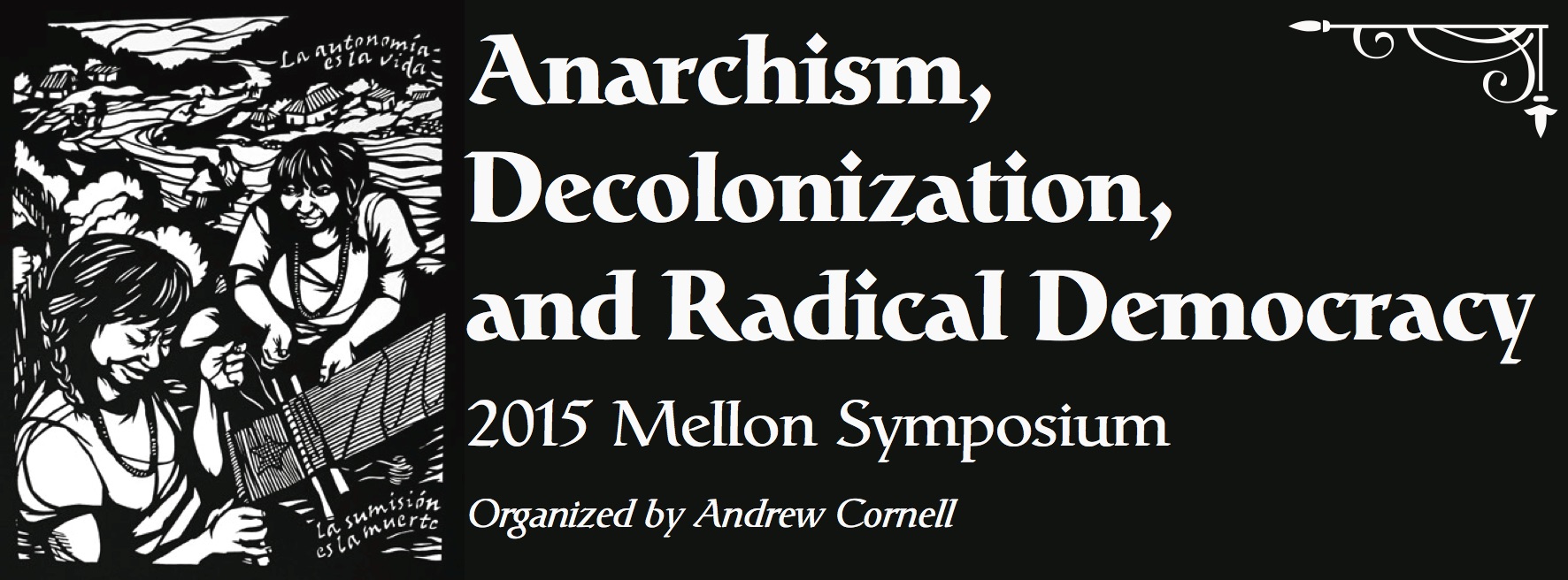
Because of my interest in anarcho-syndicalism and my connection to Swarthmore College, a participant in the Tri-College Consortium, I could not miss the opportunity to attend this Mellon Symposium. Andrew Cornell, Mellon Postdoctoral Fellow and Visiting Assistant Professor of American Studies organized the event, which featured a group discussion on “What We Mean When We Say . . . Anarchism, Decolonization, Radical Democracy,” and then broke into three panels: Limits of Liberal Democracy, Self-determination without a State? and Putting Principals into Practice.

Event organizers moved the overflowing crowd into the auditorium. Students, professors, staff and members from the West Philadelphia anarchist community participated in the discussions:
“Slavery and the Anarchist Rejection of Democracy”
Ruth Kinna, University of Loughborough, UK
“From Anarchism to Ranciére: Radical Democracy as Active Democracy”
Todd May, Clemson University
“Nothing Common about ‘the Commons’: Settler Colonialism and Indigenous Difference”
J. Kēhaulani Kauanui, Wesleyan University
“Liberating Democracy from the Premises of the Dominant Global Order: The Rojava Revolution”
Dilar Dirik, University of Cambridge and Kurdish Women’s Movement
“‘Making power’: Another Politics, Democracy, and Radical Movements”
Chris Dixon, Anarchist social justice organizer
“Decolonizing Borders and Undoing Border Imperialism”
Harsha Walia, co-founder No One Is Illegal Network
Each discussion began with an acknowledgement that we occupy the lands that once belonged to the Lenni-Lenapi tribes that lived in eastern Pennsylvania before being driven out by the Europeans. The organizers and scholars presented compelling presentations, explaining the extent to which colonization frames the social and economic circumstances that we find in societies today.
The YPJ in Syria
I was not familiar with the current events surrounding the Kurds defense of their homelands against ISIS in Syria so I was very much interested in learning more during Dilar Dirik’s presentation. Dilar, A PhD candidate in the Sociology Department of the University of Cambridge, is an activist and advocate of the Kurdish Women’s Movement. Dilar is from Rojava territories within the borders of Syria.
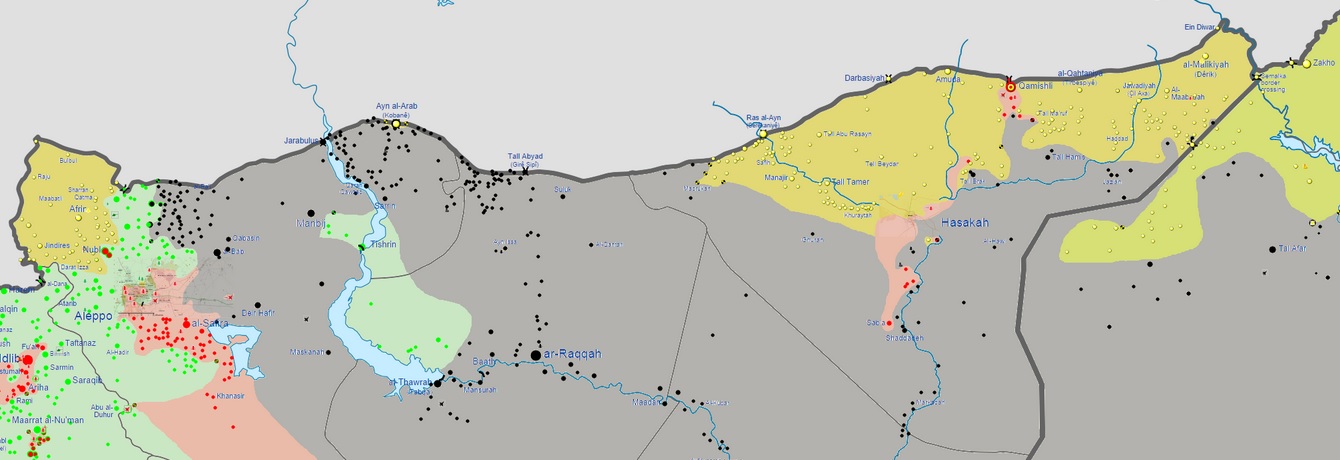
Territories held by Kurdish forces, jihadists, by the Syrian Army, FSA, or contested in northern Syria, as of October 2014. Wikipedia.org
The Kurds in Syria are fighting to prevent a takeover of their homelands by the Islamic State militants or ISIS, but the YPJ in Syria is loosely associated with the PKK in Turkey, who oppose and resist Turkish rule over the northern Kurdish region. The United States maintains a policy that is favorable to Turkey, a NATO ally, and in support of Turkey, rejects the self-determination of the Kurds because Turkey does not want to lose territory to a Kurdish independent state. In addition, the PKK originally had a communist ideology.
The Kurds’ attempt to organize stateless communities in Norther Syria, called the Rojava Revolution, is often compared with the Zapatista’s experience in Chapatas, Mexico. The YPJ has made efforts to initiate democratic reforms that represent the interests of the people.The Kurds in Syria and their YPJ Star militias are making heroic efforts in a war-torn country for self-determination and receive no support from the Western powers.

Kurdish-inhabited_area_by_CIA_(1992) Wikipedia
According to Infoshop:
The US is now maintaining that the PYD is a separate organization from the PKK, so Washington is not breaking its own law by backing a State Department-listed “foreign terrorist organization.” In November, left-wing German lawmakers actually unfurled the PKK flag inside the parliament building to protest the EU’s listing of the group as a “terrorist organization.”
Now that the US, of necessity, is backing the PYD against ISIS, what will become of the Rojava autonomous zone? Once ISIS is defeated (insh’allah!), will the PYD ultimately be crushed in deference to Washington’s ally Turkey? It can seem that the PYD stands an almost inevitable chance of being betrayed—as both anarchists and Kurds, two groups that have historically been subject to serial betrayals.
The Term “Terrorist” Becomes Coopted
When the US labels a group as terrorist, we think of al-Qaeda and ISIS, and yet our diplomatic corps has deemed that the Kurds in Syria should also be labeled “terrorist.” The YPG considers itself a democratic people’s army and conducts elections to select their officers. What most of the West does not realize is that the women, long marginalized, have begun to organize around feminist issues. The YPJ (Women’s Protection Units) is the female brigade of the YPG. They do not however, want to perpetuate the old forms of government and power, and are seeking to establish communities that achieve equality with men.
Dilar’s answer to the question: What can we do in the United States to support the Kurds in Syria?:
Dilar’s Webpage: Post, Why Kobani did not Fall
Begin doing what you want to do now. We are not living in eternity. We have only this moment, sparkling like a star in our hand – and melting like a snow flake. ~M.B. Ray

As a photographer, I enjoy taking pictures of birds. They bring life into a photograph and have a way of conveying freedom because birds either take to sky, spending part of their existence in the vastness of the earth’s troposphere or swim almost unimaginable distances in the oceans. The metaphor of flying captures our hearts . . .
There are only two lasting bequests we can hope to give our children. One of these is roots, the other, wings.
–Johann Wolfgang von Goethe
During my childhood, my sister and I would sometimes find abandoned birds, bringing them home to care for them until they were able to fly. These experiences gave me insights to their nature. The birds appeared to enjoy a gentle caress, and they recognized the signs of when they would be fed. We developed a bond, much the same as with a dog or cat.

Understanding our Connection
Some critics accuse those who support animal rights of anthropomorphizing the animals’ experiences, but I would argue that our neglect in seeing the similarities remains the problem. Humans do not stand at the top of the animal kingdom as an isolated entity. All life on earth began with a single common ancestor. Our DNA reflects this shared ancestry, and in the case of birds, we share 50% of the same genes. Our common ancestor was an Amniota, an amphibious creatures that laid eggs on land.
The Bible has perpetuated the idea of human’s domination as absolute–even over the creepy-crawlers:
Then God said, “Let us make man in our image, after our likeness. And let them have dominion over the fish of the sea and over the birds of the heavens and over the livestock and over all the earth and over every creeping thing that creeps on the earth.”
Many have come to believe that humans are masters of their domain and have every right to exploit any creature, regardless of the suffering that may cause. Unfortunately, that entitlement interferes with logical reasoning, empathy, and compassion.
 Birds are intelligent. The African Grey Parrot understand human words, and members of the crow family have shown in experiments that they can think from the perspective of another and have self-awareness. “Their total brain-to-body mass ratio is equal to that of great apes, and only slightly lower than in humans.”

“As explained in the NOVA scienceNOW segment, FOXP2 also plays a role in the processes involved in human speech and birdsong: people with an altered form of the gene have difficulty with many aspects of speech, and birds whose FOXP2 activity is disrupted have trouble learning songs.”
What is Cruel?
In clarifying the amount of stress that animals experience in captivity, my argument rests with determining the difference between the environment that animals are genetically designed and for and their circumstances in captivity. If the gap is too great, we can interpret the animal’s treatment as torturous. We cannot ask the ducks how they are doing; but if we alter or remove too many factors in the following list, we can assume these birds’ discomfort would be significant.
Fly and swim in their natural habitat
Pair bond
Eat a variety of food choices
Access fresh air and water
Nurture a brood of chicks
Avoid unpleasant/dangerous conditions
Human Nature and Entitlement’s Righteous Indignation
Thinking about human nature, particularly our perceived entitlements, offers insight into our relationship with animals. When humans become accustomed to a way of living that becomes so much a part of us, we begin to believe that our view is the only right one, which transforms into a strong emotion. We cannot pull ourselves out of that entitlement belief. Several examples:
Entitlement can trump self-interest. Sometimes people will defend the entitlements of the rich, even if they are not rich themselves or do not have the same privileges. One case that comes to mind is when people or their families do not have healthcare, and they still rile against government healthcare benefit programs.
Entitlement becomes their moral compass, and if that entitlement is threatened, they feel victimized.
Here’s a comment copied from an article on foie gras that demonstrates an example of how one consumer flaunts his entitlements:
In honor of you vegan preachers, I’m going to have a nice medium rare veal chop made from a baby cow caged in a pen, covered with a lobe of force-fed foie gras, and for dessert, I’ll have a nice panna cotta made using real animal gelatin and cream from a cattle factory finished off with a honey creme anglaise made using battery caged eggs and honey we stole from bees, all while sitting on my leather couch.
Commenter ESNY1077–The Physiology of Foie: Why Foie Gras is Not Unethical
Foie Gras: the Controversy
Fois gras is a food product made from the liver of ducks or geese that typically have been force-fed with a feeding tube to create a fatty liver. The industry uses male ducks; female chicks are killed by either being tossed alive into a grinder or by gassing or are shipped to other processing plants. In their 100 days of life, the birds go through several stages in the food production cycle. For their last 15-18 days, the birds are force-fed between two to four times a day: workers force a rod down their throat. The ducks stand in metal cages, which restrict their movement. Then they are slaughtered.
Appetite for Ethics
It was beyond my comprehension how anyone, after looking at the evidence, especially the videos, could justify eating a product that creates such misery in these creatures’ lives.
I came across this article, The Physiology of Foie: Why Foie Gras is Not Unethical, to look for the answer to my question. Some of the comments praised J. Kenji Lopez-Alt’s analysis, claiming that he wrote a well-balanced article. On careful examination, however, I found many flaws in the arguments and reasoning, the first being anecdotal fallacy, which is relying on a personal experience, an isolated example of conditions on the farm. The farm managers expected Lopez-Alt and his team, so they had time to correct any improprieties. Lopez-Alt was neither a trained inspector or biologist. Because Lopez-Alt had “learned to love” foie gras, he may have held prejudicial biases that influenced what he reported or observed.
In order to present a logical argument, the premises and the conclusion must be statements, capable of being true or false. The conclusion must follow from the premises. J. Kenji Lopez-Alt does not put his case into a logical format, so I will make an honest attempt at interpreting his argument:
The physiology of foie is not cruel or tortuous, therefore, the practice of raising ducks or geese for foie gras is ethical. Lopez-Alt makes a further qualification:
Foie gras production should be judged not by the worst farms, but by the best, because those are the ones that I’m going to choose to buy my foie from if at all.
Therefore, refining his argument:
The physiology of foie is not cruel or tortuous, therefore, the practice of raising ducks or geese for foie gras is ethical as practiced at LeBelle Farms.
Let’s check the arguments used in the article.
But video or photographic footage of one badly managed farm or even a thousand badly managed farms does not prove that the production of foie gras, as a practice, is necessarily harmful to the health or mental well-being of a duck.
Since the argument only concerns LeBelle Farm, we would have to throw out this argument. And neither does it prove the opposite: that one plant managed ethically does not prove that foie gras as a practiced at other farms is ethical. Also, we don’t have the specific evidence that only one farm has been accused of cruelty.

A Mallard Pair
Straw Man Arguments
In these statements, Lopez-Alt throws out the straw man. “All cities smelled” before plumbing implies justification of unpleasant odors. “Certainly far better lives than the millions of . . . ” Lopez-Alt diverts the reader’s attention to the treatment of other farm animals. The reader becomes distracted from the original premise by justifying and referring to what the author believes are other standard practices. He argues because “nobody will listen” is reason enough to not confront the problem.
Granted, it did smell—a distinct barnyard aroma with a hint of ammonia (the chicken shed we visited afterwards had a much stronger ammonia smell to it), but as anyone who’s worked on an animal farm will tell you, all farms smell, just as before the introduction of modern plumbing, all cities smelled as well.
We’d seen the process from start to finish, and from all outward appearances, the ducks seem to live perfectly comfortable lives—at least as well as you can expect for any farm animal. Certainly far better lives than the millions of cows and pigs and billions of chickens that are raised every year for our consumption.
Personally, I find this kind of protesting abhorrent. If you are going to protest anything, it should be the industrial production of eggs, where chickens are routinely kept in cages so small that they can’t even turn around for an entire year. The problem, of course, is that you tell people to stop eating cheap eggs, and nobody will listen.
Anthropomorphizing in Reverse
Lopez-Alt inadvertently uses anthropomorphism, as he believes he can interpret the ducks’ experiences in each of these examples.
The facts so far: for at least the first 12 weeks of their lives, these ducks are sitting pretty in a stress-free, spacious environment.
A machine whirls, a small bulge forms where the food is deposited, and the duck walks off, giving its head one shake, but otherwise seemingly unaffected.
First off, the key to understanding this is to make a very conscious effort not to anthropomorphize the animals. As waterfowl, they are distinctly not human, and their physiology differs from ours in a few key ways.
As long as the animal shows no sign of stress or discomfort—and the ducks we saw today certainly did not—then what harm is a few extra pounds?
The stunning [in electrified water] makes for a quick, painless death . . .
Fallacy of Unwarranted Assumption
In the fallacy of unwarranted assumption, the argument’s conclusion is based on a premise which is false. In the following quote, he assumes that because the duck does not struggle, the duck has acquiesced to the treatment because “it is the same type stress in the wild.” He creates an equation: ducks natural behavior to eat heavily before migration = force-feeding. Prior to migration, ducks eat voluntarily until it has enough food for a migration; in the force-feeding case, the duck is gorged with many more feedings than that the bird would typically eat; the two comparisons are completely unequal.
But the question I had was, why aren’t they more uncomfortable? Why doesn’t a duck struggle with its large liver or having a tube forced down its throat? . . . Incredible, right? And that, folks, is the reason why ducks don’t struggle when a feeding tube deposits food in its throat. Its body is built for exactly the same type of stress in the wild.
Do the ducks refuse to struggle because if they resist the process that consequent behavior becomes painful, a behavior they may have adapted through conditioning?
Reductio ad Absurdum Argument
This argument attempts to show that a statement is true by declaring a false or absurd result follows from its denial or acceptance.
It’s a food product that is marketed directly at the affluent, and the rich are always an easy target.
In what way are the rich an easy target? Here the use of the faulty generalization, “thought-terminating cliché,” finishes the debate with the “easy target” phrase.
Amber Defense Fund
Amber is a courageous young woman who exposed the force-feeding processes and saved two geese from their confines. Please consider helping Amber with her legal fees. Because she entered a factory without permission, Amber is facing felony burglary charges and could be sentenced up to seven years in prison. Link.
For me, even one case of animal cruelty is cause for investigation by the animal protective institutions. To witness the conditions in the video is heart wrenching. Is that observation scientific–no. I can conclude, however, the practice of foie gras deprives waterfowl of all of their behaviors that are part of their DNA. Twenty-two countries have banned farming animals for foie gras, but France continues to sanction the industry stating,
French law states that “Foie gras belongs to the protected cultural and gastronomical heritage of France.”
To use the reasoning for cultural gastronomical heritage could also justify cannibalism! France has used two red-herring fallacies in one statement: first, red-herring appeal to authority by evoking French law, and second, the appeal to tradition, a conclusion justified because the custom is considered part of their heritage.
Links:
Stop Force Feeding
Foie Gras, Force Feeding of Geese and Ducks
Foie Gras: Delicacy of Despair
Video: What’s Wrong with Foie Gras?
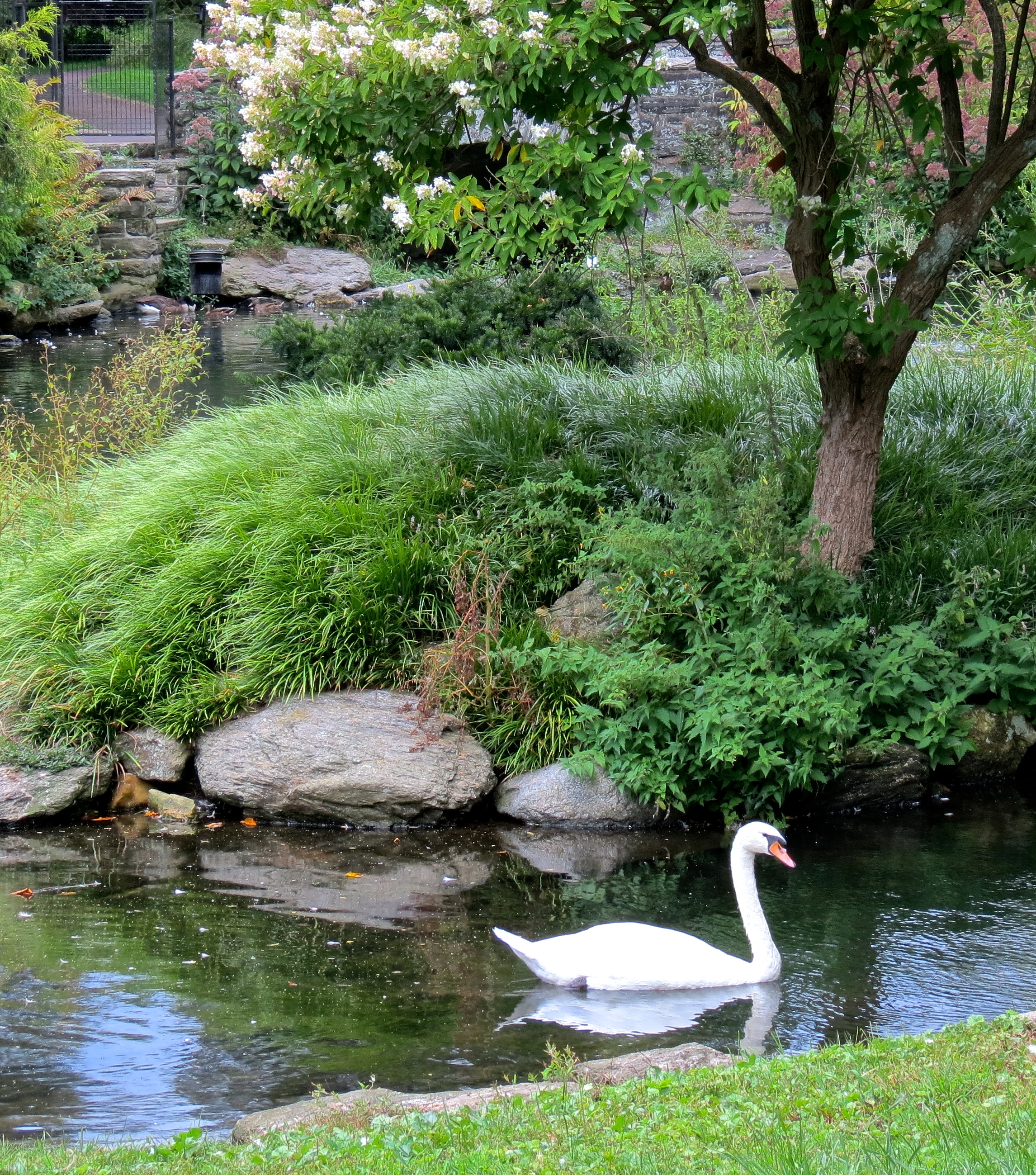
Be as a bird perched on a frail branch that she feels bending beneath her, still she sings away all the same, knowing she has wings.
–Victor Hugo

How Social Services Provide the Mechanism to Help our Fellow Citizens





 Psalmboxkey's Blog
Written
on 05/09/2015