Humble Contributions to the Peoples' History

Archive for the ‘Family History’ Category

1950s Retrospective on Children’s Fashions: Petticoats and Mary Janes

To Write or Not to Write about Fashion?

Two years ago I started writing this post but then stopped, thinking that perhaps no one would be interested in reading about children’s clothes sixty years ago. So I just left this post sitting in the draft box. It wasn’t until I started to read Flora Thompson’s memoir of her life during the 1880s in a small hamlet in Oxfordshire that I began to think again about vintage clothing. In my previous post, I described Lark Rise to Candleford, which the BBC broadcast as a series. An excerpt from Flora’s book tells us about what children wore back then:

. . . but it was difficult to keep decently covered, and that was a pity because they did dearly love what they called ‘anything a bit dressy’. This taste was not encouraged by the garments made by the girls in school from material given by the Rectory people—roomy chemises and wide-legged drawers made of unbleached calico, beautifully sewn, but without an inch of trimming; harsh, but strong flannel petticoats and worsted stockings that would almost stand up with no legs in them—although these were gratefully received and had their merits, for they wore for years and the calico improved with washing. Chapter 1

Inspired by Flora’s descriptions, I returned to compiling pictures and content for this post.

Fashionably Dressed, Yet Unaware 

By looking at the way children dressed, we can discover a few clues about life in the 1950s. When I was a little girl, growing up in a working-class suburb of Philadelphia, I remember my mother dressing my sister and me in matching outfits. I couldn’t find any history about this custom, but I remembered that in the movie, The Sound of Music, Maria dressed the children in matching play clothes. Dressing children alike may be a way of cementing family kinship. My mother fostered a close relationship between my sister and me, and dressing us alike may have been part of that plan. I never minded dressing the same as my sister, but I didn’t know there was an option.

Mom selected all of our clothes, and we wore whatever she purchased for us. With play clothes, we had some degree of flexibility in picking out what we wore for the day, but for school or dress up, Mom was fully in charge. I don’t remember rebelling against her choices because clothes were not that important to me.

In our school and neighborhood, the children were clean and neatly dressed. Because we came from a fairly homogenous community, there seemed to be little emphasis on clothing as fashion statements. No one dressed better than anyone else, as I recall, and we didn’t talk about clothes. I can remember only one exception. In third grade, a girl joined our classroom in the middle of the year, and I noticed she looked disheveled. At first, I thought perhaps that just moving in created a lapse in hair and clothing care, but her appearance never improved. That one example stood out because uniformity in neatness prevailed.

This slideshow requires JavaScript.

Three Basic Outfits. We wore three basic outfits, always starting with white cotton underwear, including an undershirt, with short sleeves for winter and sleeveless for summer.

Play Clothes: A Hodge-Podge but Sometimes Matching. Pants, peddle pushers (pants that ended between the knee and the ankle so material would not get caught in bicycle parts), shorts, shirt or blouse, light canvas sneakers, and socks. In the summer, we would wear rompers, tied with a bow at each shoulder, or one-piece zippered shorts and shirt set. A “skort,” a very short pleated skirt with attached matching bloomers underneath was another option when the weather was warm. This was the age before the t-shirt, which we never wore. In winter, corduroy pants lined in flannel would keep us warm while sledding. As older children, we transitioned from long coats to the more practical “car coat”, which came to just below the waist, square-cut in shape, and usually with an attached hood.

This slideshow requires JavaScript.

School Clothes: Keeping Order with Flouncy Attire. Dress or skirt, slip, socks, and sturdy shoes (white and black saddlebacks) or shoes with straps or laces or Mary Janes, which was a slip-on dress shoe made of black patent leather, usually with a strap that buckled on the side. Girls’ clothes mimicked women’s fashion trends at the time: a full-circle skirt and a cinched waist. Full skirts were always worn with a petticoat or slip. Hemlines remained above the knee, at varying lengths.

Almost every public school in the U.S. required that girls wear dresses or skirts. I didn’t like wearing dresses because keeping modest while on the playground was a continual nuisance. Every girl knew the one rule of wearing a dress: keep it down. Also, there was a rule that your petticoat should not hang below the dress, requiring some effort yanking on straps to make the necessary adjustments. Sometimes I would slip slacks on under my dress, which was strictly against school rules and almost immediately the teacher would ask me to remove them. Girls could change into shorts or pants for gym class.

First day of school

School Girls J and K

Pastels and Plaid

Dress Clothes: Petticoats and Mary Janes. Church, visiting, or special occasions meant a complete outfit including a fancy dress, petticoat, Mary Janes, socks, coat, hat, and sometimes purse and gloves. Crinoline petticoats made the dresses flair out. In the winter, wool coats and matching leggings, usually with side zippers, would keep us warm. Coat collars were sometimes trimmed in velvet. Sunday School always required a fancy dress. Our family was not religious, but my parents must have felt that we should be exposed to some religious training and also dress the part. Easter brought out the best finery, including an Easter bonnet, trimmed with ribbons and silk flowers. When we were older, we wore suits for Easter.

This slideshow requires JavaScript.

Hair Styles

Mom fixed our hair every morning, usually in a ponytail or left down, supported by four colored barrettes. Most nights, Mom would roll our hair in soft curlers before we went to bed. She didn’t like hair too much longer than shoulder length. For some reason, I hated having my hair cut, which resulted in a confrontation with Mom. I still have that vision of Mom coming toward me with the scissors, and no amount of tears would prevent the inevitable chopping off of a couple of inches. I always wanted long braids, but Mom disliked braids.

Girls had all ranges of haircuts from short bobs to long hair down the back. However, we didn’t seem to care about each other’s style. In the early ’60s, we stepped into another time when hairstyles became more important.  My sister went for her first hairdresser appointment when she was in 5th grade and had her hair cut in the famous “page-boy fluff”.

Parenting Styles Have Changed

When I became a parent, I read many texts on parenting techniques, and most of the advice suggested allowing children to select their own clothes, both to purchase and to wear. That was surprising to me given that my own childhood experiences put Mom in charge. I would agree that it is probably best to allow children to make their own choices. Perhaps, however, allowing those choices might direct the child’s concern about outward appearance, which may not be the place that we want children to focus most of their attention.  
Daily Post: New Sensation

Walking the Benjamin Franklin Bridge: Uncovering a Bit of History

What is it that makes it so hard sometimes to determine whither we will walk? Thoreau

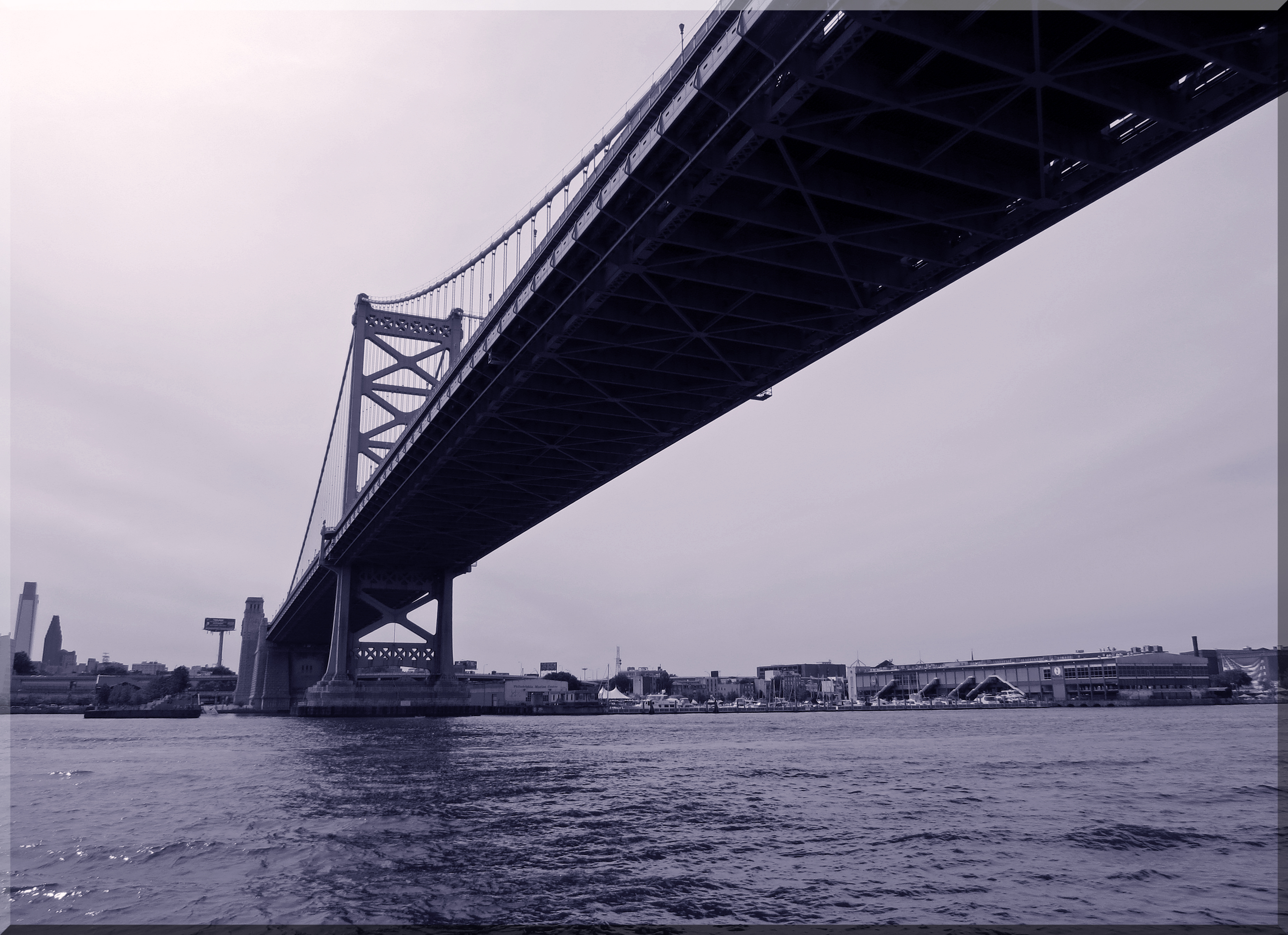
When the Amistad schooner sailed into Philadelphia in May of 2012, I signed up for one of their voyages on the Delaware River. The Amistad glided under the Benjamin Franklin Bridge, and from that perspective, I could view the massive steel superstructure and study the span across the river, stretching from Philadelphia to Camden. When workmen finished building the structure back in the 1920s, it was the longest suspension bridge in the world. 

With the bridge’s magnificent arch across the river still fresh in my memory, I now had the chance to walk up and over the bridge on the Architectural Walking Tour sponsored by the Preservation Alliance for Greater Philadelphia. What drew me to cross the bridge was more than a curiosity about the structure, but I didn’t realize my motive until I had finished the walk to the other side.

Under BFB

Stopping by the Constitution Center

Watercolor BF BridgeOn a bright September day, my sister and I walked down Market Street in Philadelphia toward the bridge, passing the Constitution Center. Having a few minutes, we stopped in at the Museum Shop. We browsed through the various sections, especially admiring their collection of t-shirts. In the book section, I found a diary book with a watercolor of the bridge on the cover. After our brief visit to the shop, we headed back on Market Street and made our way to 4th Street.

Bridge’s History Retold

Our tour began in the Philly Olde City neighborhood, in front of two historic churches, St. George, the oldest Methodist Church in the US and St Augustine, a Catholic Church once burned to the ground to punish the immigrant Irish for having the audacity to settle in the area. In 1922 the first draft of the construction suggested that the bridge go right through St. George; but the congregation protested, and architects made an adjustment, with a 14-foot leeway that preserved St. George. Each church had to accommodate to the bridge by constructing walls, one floor below the original structure, lowering their doors, so that 4th Street could go under the bridge.

BFB Garden View

Garden at St. Augustine, looking across to St. George Church and the Bridge to the right.

Walkway along the Sky

Our guide led us up a side street to the pedestrian walkway that runs along the East side of the bridge. As the tour group started to walk up the inclined sidewalk, we could see the hubbub of activity on the side streets below and point out landmarks, such as the steeple of Christ Church. Art deco lanterns lined up on the railings that followed the sidewalk.

Granite Station

Bridge Station Never Used

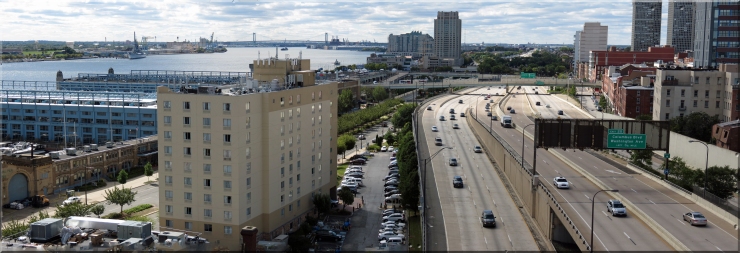
As we approached the first granite anchorage, originally constructed as a trolley station, cars along Route 95 sped by underneath. The highway ribbons along the Delaware and stands as a central feature in the landscape from that view-point. Christopher Columbus Boulevard shadows the superhighway, and one lone building, municipal Pier Number 9, is reminiscent of the days when the Philadelphia port had been a major thoroughfare of commerce, with wharfs and docks lining the Delaware port. The twentieth century saw much of the historic riverfront razed. Condominiums now occupy spaces along the river as well as Penn’s Landing, Seaport Museum and The Olympia, the world‘s oldest steel ship still afloat. 

Panorama BFB road river

A grand landscape stretched before us. I looked back on the city, and noticed how the steel cables, extending up the 380 foot towers, framed the walkway. Even though built 80 years ago, the bridge is a marvel of invention and esthetic wonder.

BFB Looking Down City

Study in Blue

From the top of the bridge, we gazed down the river on the New Jersey side to the Adventure Aquarium and Penn Treaty Park and then more distant landmarks, the Battleship New Jersey and the Betsy Ross Bridge. We watched the boat traffic, everything from a schooner, passenger ferry, container ship, motorboats and tugs.

BFB River Boat

A schooner sailed alongside the working boats of the river.

BFB Sailboat

Walking toward Camden, we focused on the city’s waterfront where neat-looking parking lots were surrounded by green spaces with trees and landscaping. The baseball field and stadium, home of the Camden Riversharks minor league baseball team, sported an attractive brick exterior and the look of yesteryear with peaked roof lines. A game was just getting underway as we walked by.

Campbell's Field

Campbell’s Field

Looking for the Dog on Top of the Building

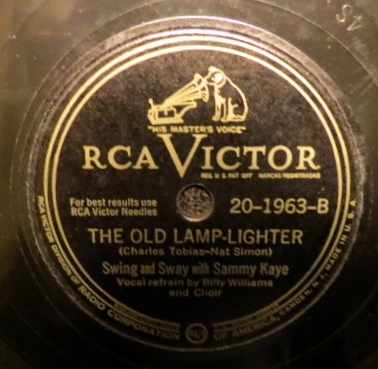
IMG_4579When we were children, our family would drive over the Ben Franklin Bridge to vacation at the Jersey Shore, and I remember we would look out the car window searching for the dog on top of “Dad’s building” where he worked. The puppy sitting in front of the gramophone was the famous RCA, or Radio Corporation of America, trademark, and the image appeared on all of their records. The Nipper Building, the nickname for what was once labeled as Building 17 of RCA’s Camden Plant, was built during the second decade of the twentieth century to house the Victrola cabinet factory. In 1916 the company installed on the tower four stained glass windows depicting the dog and gramophone. The RCA Corporation bought the building in 1929, using the Victrola names and logos on their own line of products into the 1970s.

My Father’s Commute

For over 25 years my father commuted from the Western suburbs of Philadelphia by way the Media trolley, the Market Street El, and the PATCO High-speed Line, which crosses the bridge, to his workplace at the Camden plant, just a few blocks from the bridge exit. RCA was an electronics company and one of the leaders of television technology from the 1930s and right into the next three decades. The plant manufactured broadcast equipment as well as television sets. The engineers at the Camden plant were responsible for building the first radio transmission from the moon of Neil Armstrong’s famous line, “One small step.”

John Malinoski RCA

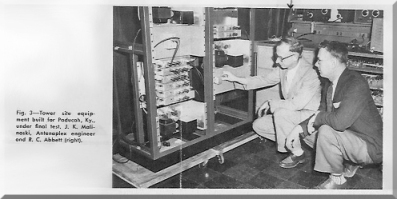
I wished that I could go back in time and ask Dad to take pictures of the bridge, plant and river because the area looked entirely different back then as factories, smokestacks, utility buildings and railroad lines occupied the landscape. For over two decades Dad worked for RCA as an electronic engineer, and I have only one picture that documents his work at the plant.

Our family didn’t realize the larger implications of my father’s transfer from Camden to Massachusetts in 1968. RCA began to reduce and sell off most of their broadcast products, finally going out of business in 1986. Buildings along the waterfront area were torn down as the area became abandoned and neglected. Building 17 also fell into disrepair and almost met with the wrecking ball, saved in 2001, when the New Jersey Economic Authority awarded a grant to preserve the structure.

RCA Building

The Nipper Building is now listed on the National Register of Historic Places. I don’t believe my father ever suspected that someday, the well-worn factory where he worked, would be considered a national treasure, but my sister and I always thought there was something special about that dog atop the tower. Forty years later, the iconic image guards the memory of my father and thousands other workers, whose electronic inventions pioneered broadcasting technologies.

The bridge had guided me back through our family history that I had almost forgot.

Nipper

Links of Interest

Historic Camden County
RCA TV Equipment Section of the Broadcast Archive
Eyes of a Generation
Eight Blocks in Camden that Made History

“Rock-‘n-Roll is Here to Stay”

Waxing Nostalgia: Teen Dance Scene 1964

For some time I have thought about dancing again as I’ve missed my ice skating dance routines ever since my hip replacement. Reflections about dancing brought me back to the time when my girlfriends and I went to the teen mixers at Holy Cross Roman Catholic Church in Springfield, a suburb just outside of Philadelphia. I couldn’t find any references to the dances on the web, but in the mid-1960s, Holy Cross was the place to be on a Saturday night.

Most of the teens who attended the dances came from the working class communities in the adjacent neighborhoods, and most were Catholic, of course. We attended the public school so it was a bit of a leap to attend a dance outside of our school where we wouldn’t know anyone. Some of our friend’s parents didn’t like the idea of their daughters going to a Catholic dance, but somehow we convinced them it would be ok. Secretly, we always thought that Catholic boys were “fast” but not necessarily that was bad, just we had to be aware. I can’t remember that myth ever playing out. We were somewhat protected in our suburban bubble. My sister remembers her shocked reaction when she saw smoking going on around the corner of the church.

Scan 2

The Church kept a strict dress code. Boys had to wear coats and ties and for girls, skirts or dresses. We would spend all day getting ready: washing our hair in the morning and using those humongous plastic rollers so that our hair would have puff rather than curl. We would sit under a hair dryer bonnet for hours. More daring girls would wear heavy eye makeup and challenge the limits on how short their skirts could be. It was a fine line, and the authorities would send you home, if you crossed it. Looking back, I believe the dress code established a certain decorum, even if we complained at the time.

We would join long lines outside the gym to pay our 75 cents to get in, passing by the three or four priests that lined up near the entrance. Everybody danced on the crowded floor; we didn’t have to worry about being a wall flower. When dancing, the boys would cut in front of us, nudging each other out-of-the-way. We had bragging rights depending on the number of boys that would cut in. The temperature in the room would rise through the night, but the boys still had to keep their jackets on.

Versions of the Bristol Stomp provided the basic dance steps, and dancers would hit the wooden floor with a collective stomp on the beat. That unison had to be a genre of tribal dancing, and while we danced with a partner, it was really a group dance–and that made it exciting!

The kids in Bristol are sharp as a pistol,
When they do the Bristol Stomp. Whoa-oh.
Really somethin’ when the joint is jumpin’,
Ah-ah-ah, ah. When they do the Bristol Stomp.

Kal Mann & Dave Appell

After every dance number, we would escape back to our girl pods and share our analysis. “Wow, that was a cute guy you were dancing with.” “He asked for my number!” “Look, he’s wearing a Beatle jacket.” “Did you see that split?”  Boys were considered hot if they did a split; and if a guy had a Beatle haircut, he racked up more status points.

The DJ usually played Doo-Wop music for the slow dances: See the Pyramids Across the Nile, In the Still of the Night, Till Then, You Belong to Me. I remember melting every time the songs played.

Back to the Future: Learning to Dance all Over Again

I looked around the web to find a local dance studio that might offer a few lessons in rock just so I could get dancing again. Ironically, not far from Holy Cross Church, I came across Don’s Dance World, and he was setting up a small adult class in jitterbug. When the class started, what was strange was learning steps to what I just kinda did without thinking when I was a teen. Now, I had to think about it! Don had us repeat the steps many times, switching partners often. He also recited little mantras to help remember the steps:

Sweet ta heart ta back-step
Guy a-turn-a back-step
Girl a-turn-a back-step

Many thanks to Joan, Mike, Robyn, John and Don for their part in the video. At some level, I channeled back to those steamy nights at Holy Cross.

Rock and roll will always be.
I dig it to the end.
It’ll go down in history,
Just you watch, my friend.
Rock and roll will always be.
It’ll go down in history.

David White

Lone Ranger and Tonto: A Nostalgic View and Modern Critique

Growing Up Viewing the “Wild West” while Living in the Philly Suburbs

Vintage-TV “Return to the thrilling days of yesteryear”

Everything we knew about the West we learned from Hollywood’s recreation of the American frontier on television, and we thoroughly absorbed the historical misinformation of the people and culture of that time. By the late 1950s, over thirty westerns, such as Gunsmoke, Have Gun Will Travel, Wagon Train, Sugarfoot, and Maverick, blazed across the screen. The melodies of the theme songs still replay in my memories. Years later, we learned that what we thought was real about the West was, in fact, a myth. As children, we certainly didn’t recognize stereotyping, and we were pretty much oblivious to standardized characters and plot predictability. Looking back, I still reflect with a certain amount of nostalgia just because the television western was a part of my childhood experience.

The Lone Ranger became one of our favorite programs. The TV series began in 1949, and new episodes continued through 1957. I remember watching the introductory episode in reruns many times, which unfolded the story of Tonto finding the injured Texas lawman and his transformation into the Lone Ranger. I was not alone in this infatuation, as almost every child in America knew who Kemosobe was. The Lone Ranger and Tonto stood as heroic figures in the lawless frontier. Later I would learn that Jay Silverheels, who played Tonto, resented that he had to speak in a scripted pigeon. As a child, I thought of Tonto as an equal partner with the Lone Ranger, which is surprising given that the Lone Ranger possessed all the hero accouterments: mask, silver bullets, white hat, and horse. To me, Tonto acted as a trustworthy and resourceful partner with the Lone Ranger.

Cowboys 2 Hands Up!

Westerns influenced our childhood games and apparel. The boys in our neighborhood played with toy cap guns. Several regularly wore their cap pistols in holsters and donned cowboy hats. I didn’t like cap guns because my fingers usually got pinched when the hammer mechanism sprung closed to make the “pop” sound. While the boys aimed their guns at each other in mock battles, for us girls, the guns were merely a fashion accessory, part of our cowgirl outfits. I’ve seen many pictures of our friends and relatives from that era, and not many escaped without being photographed in cowboy-girl attire. Our Sally Star dolls even came with holsters and guns, but we never played “shootouts” with them.

How did I interpret gun violence on television as a child? Well, I don’t remember either relatives or teachers offering any analysis of the programs or discussions of Western history or violence. Adults purchased the cowboy attire and the toy guns, so I think we assumed these had some legitimacy. At least on the Lone Ranger show, most of the villains never seemed worse for wear for being shot; Hollywood sanitized the effects of gun wounds with an arm in a sling as the typical portrayal of an injury. I think even as a child I realized that TV westerns were pretend–just like our plastic guns.

PICT0001 The gun is just part of the outfit.

Retrospective: Forty Years Later

The Good

Revisiting some of the episodes offered insight into a comparison of what I remembered from my childhood and the real program content. Now the benefit of scholarly historical analysis uncovers the stereotypical Hollywood interpretation of the Old West and portrayal of Native Americans. In his essay, “I hated Tonto then and I hate him now,” Sherman Alexie writes his views from a Native American perspective about his complicated relationship with Indians in the media.

Upon viewing some of the episodes, what immediately struck me was the Lone Ranger’s diction and demeanor. Clayton Moore, the actor who played the Lone Ranger, practiced duplicating the radio voice of the Lone Ranger; his enunciation was impeccable but sometimes comical. “Howdy” came off as a pronouncement rather than a greeting. However, it seemed easy to forgive that overly formal manner as contrasted with so much of the gruff and coarse discourse we get today on television; the Lone Ranger was refreshingly polite and well-mannered. The program had several other redeeming qualities.  This conversation in the first episode revealed an essential tenant of Long Ranger stories: he never shoots to kill but rather only to disarm his opponent, as painlessly as possible.

Tonto: Here gun to kill bad men.
LR: I’m not going to do any killing.
Tonto: You not defend yourself?
LR: I’ll shoot if I have to, but I’ll shoot to wound, not to kill. If a man must die, it is up to the law to decide that not the person behind the six-shooter.
Tonto: That right, Kemosabe.

The Lone Ranger decides to use only silver bullets as a reminder that life is precious. Along those lines, the Lone Ranger usually comes up with a thoughtful plan for dealing with the outlaws. He cautions against rash actions and his plans include deliberately reducing violence.

During the series, few story characters trusted the Lone Ranger, because he wore a mask, or Tonto, just because he was an Indian. The Lone Ranger said, “You’ll have to trust me.” That trust contrasted with some of those characters who held respectable positions but who were not always trustworthy, whether doctors, judges, or sheriffs. I’m not sure this is the result of watching the program, but I usually don’t ascribe trust to those in power just because of their position or status.

lone-ranger-and-tonto

The Bad

The Lone Ranger stories could be characterized as light entertainment that often relied on clichés, such as manifest destiny, the 19th-century belief widely held by Americans that the United States, destined to expand across the continent, would bring democracy and rule of law to the world.  Manifest destiny rationalized violence, as justifiable because of always being on the “right” side; the gun then became a primary symbol of moral violence. Unfortunately, the Lone Ranger was just another vigilante. Shooting to maim was legitimated because neither the legal process nor morality could prevent the violence. The superhero guaranteed and assured the audience that the outlaw would meet his deserved demise. Rather than the legal process, however, violence became the solution to the criminal problem.

And the Ugly

While representations of violence in the media offer many complexities not easily understood, my theory is that children take on the beliefs of their parents, who are the mediating factors, and why it is difficult to arrive at an overreaching theory on how the media influences each child.  I wrote about this issue in this post. It seems that generations of young people have accepted the mandate to solve conflicts through defensive gun violence and ignore the concept of the rule of law and reason in their justification of violence. If parents promote vengeance philosophy or celebrate power through weapons, the impact of the media reinforces these views. Although I don’t recall my parents offering any commentary about the Westerns, they held firm beliefs against fighting and aggression, which I believe was the greatest influence on my thinking about gun violence. Most of what I watched on television years ago held little sway over my views today. One of my main arguments against the possession of guns is: how is justice served if the shooter is the jury, judge, and executioner? I guess that’s where the Lone Ranger and I would agree.

Followup:

Lone Ranger on Television: Reflections on My Childhood

Little Orphan Annie, the Poem Rewritten for the Political Climate Today

Mary Alice Smith, Riley’s inspiration for the poem. Wikipedia

In an earlier post, I described our family’s celebration of Halloween and how my Mother,  born in Scotland, followed the Celtic Halloween traditions. Our grade school classes also had Halloween celebrations–everyone would dress in costumes and parade around the school grounds, followed by parties in the classrooms. Homeroom mothers would serve cider along with orange and chocolate cupcakes.

One year my Mother came up with the idea that I should dress up as “Little Orphan Annie” – not the comic book character, but from the poem by James Whitcomb Riley. Riley based his poem on a real person, Alice Smith, who became orphaned when her father died in the Civil War. Allie, as she was known, lived with the Riley family, and she would tell stories to the younger children after finishing chores at the end of the day.

For my orphan Annie costume. I wore a dress with an apron and black stockings and carried a dust cloth and broom. I memorized the poem for a classroom presentation; Mom coached me on the proper inflection at the end of each stanza, “and the goblins will get ya if ya don’t watch out!”  Thinking about the poem, I recalled these lines . . .

and cherish them that loves ya, and dry the orphans tears
and help the poor and needy ones that cluster all about,
or the goblins will get ya if ya don’t watch out!!!

I became inspired to rewrite the poem for today’s current political climate, just before the 2012 election.

Over the past few months, I have received forwarded emails, not about a particular political issue or articulated argument advocating one position or another, but rather content focusing on rumors and lies with obvious prejudicial biases. In rewriting the poem, I included the lines above, written over a hundred years ago, as they apply today as well.

The Ghost of Little Orphan Annie on Election Eve

The ghost of orphan Annie has somethin’ strong to say,
Things you might’ve heard before but may have brushed away.
About payin’ those taxes, is that so very bad?
Or are ya worryin’ and fretin’ and makin’ yourself sad?
For all the roads an’ bridges, schools, an’ parks an’ like
Just let them go to dust?  Well, that would be a fright.
If you’ re complainin’ then finishin’ with a shout
The goblins will get ya if ya don’t watch out!

There’s ways to pull together as Americans will do
But a bake sale to cure a kid with cancer, mumps or flu?
Or how about a doctor for the child ill next door?
Or are ya a listenin’ to that politician’s unrelenting roar?
Now payin’ fair share, that’s not a scary scheme.
Those with more wealth could help, or so it would seem.
So let’s all pitch in together, please, don’t be a lout,
Or  the goblins will get ya if ya don’t watch out!!

Are ya balkin’ to give to causes that benefit us all?
Or is money is better spent on merchants at the mall?
With the social security Grandma can live her own
Rather than in your basement without a telephone.
And those that will follow you, fond an’ dear,
Take care of them, please, an’ dry the orphan’s tear
An’ help the poor an’ needy ones that cluster all about,
Or the goblins will get ya if ya don’t watch out!!!

So who are the goblins, do they hide in the night?
They’re just right in front of ya, in plain sight!
They tell ya that science is not on your side.
They tell ya not to worry, take your car for ride.
They point to your working pal as stealing your dough.
When its unregulated Wall Street that’s really the foe.
They make up a story so you’ll hate those abroad,
Those many poor souls, also victims of fraud.
Think: is it your anger what this is all about?
Then the goblins have got ya, ya didn’t watch out!!!!

Halloween Pumpkin Carving at its Best

So why do we head out into the chilled night air to look at pumpkins?

From ghoulies and ghosties
And long-leggedy beasties
And things that go bump in the night
Good Lord, deliver us!
               Scottish Prayer

Halloween has always been my favorite holiday. Growing up, I thought it was everyone’s favorite because our family made the day a special celebration. I attribute that fondness for the holiday to my Mother, who was born in Scotland and brought with her the spirit of Halloween with stories of ghosties and ghoulies. My neighborhood friend, Joan, reminded me that Mom would peel apples for us, taking care to not break the peel. Each of us then tossed the peel behind our backs to see if  ghostie would grant our wish. Halloween originated in Scotland dating back when the ancient Celts celebrated Samhain, marking the end of summer and the beginning of the dark half of the year. The Celts celebrated the day by wearing masks, called “guising” or going into disguise, to scare away evil spirits. Halloween night seemed to be mystical experience–dressing in costumes, wandering about in the cool evening air, and thinking about the specter of strange and otherworldly happenings.

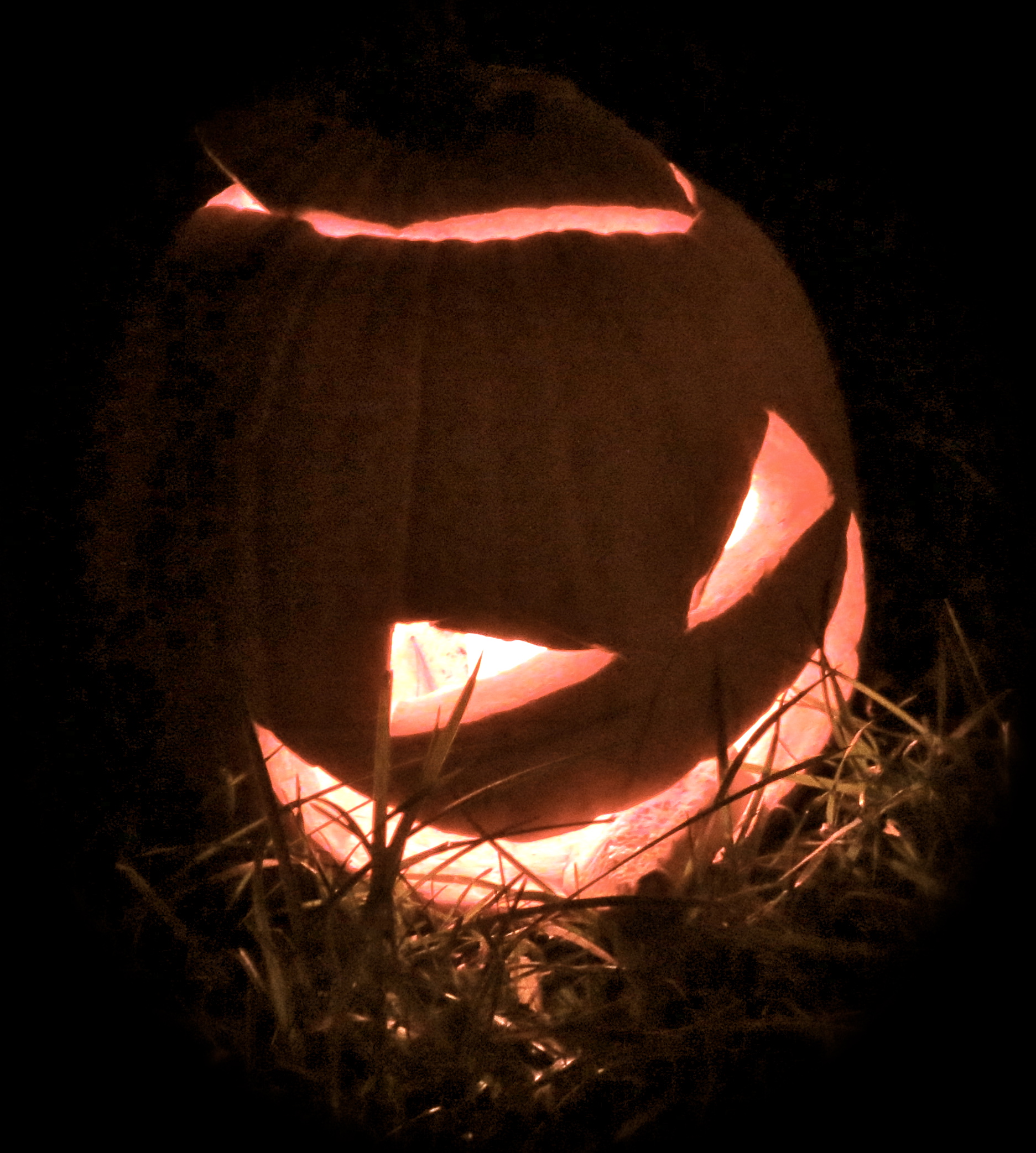
When Fall came around, our family usually headed out to the country to buy gourds, indian corn and pumpkins. We carved our pumpkins into jack ‘o lanterns; the tradition arises from the strange occurrence of light flickering over peat bogs. Originally turnip lanterns provided the Halloween decorations in Ireland and the Scottish Highlands.

Despite all the talk of witches, fairies, ghosts, skeletons, devils and apparition of all sorts I knew that these references were merely whimsical. Mom was firmly planted in reality and folk beliefs were just stories. Mom clearly identified superstitions, including most religious customs, and separated fact from fiction. We had so much fun trick-or-treating around the neighborhood with our friends. Supposedly, the idea was to threaten a trick if we didn’t receive a treat, but that scenario was never part of our tradition.
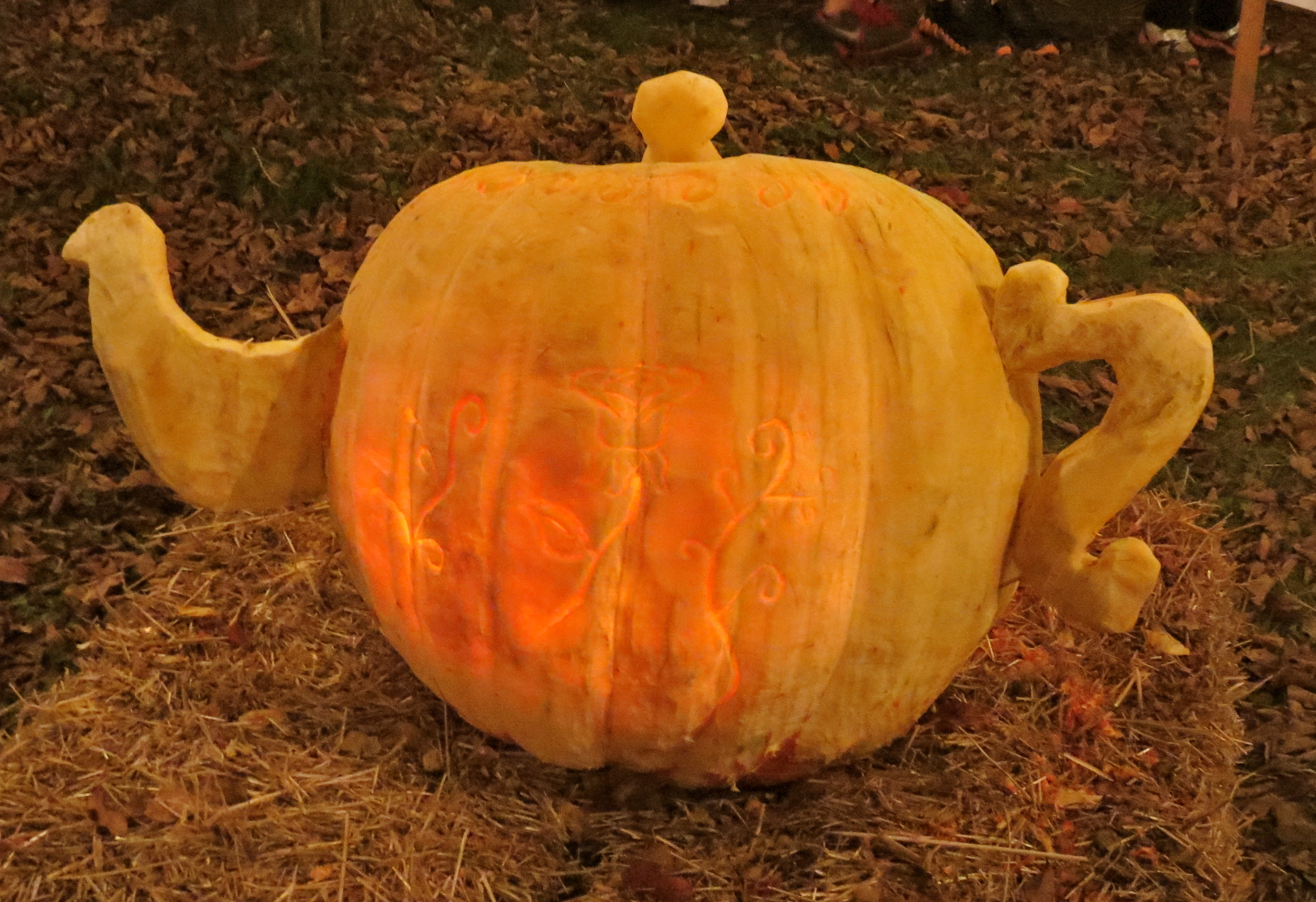
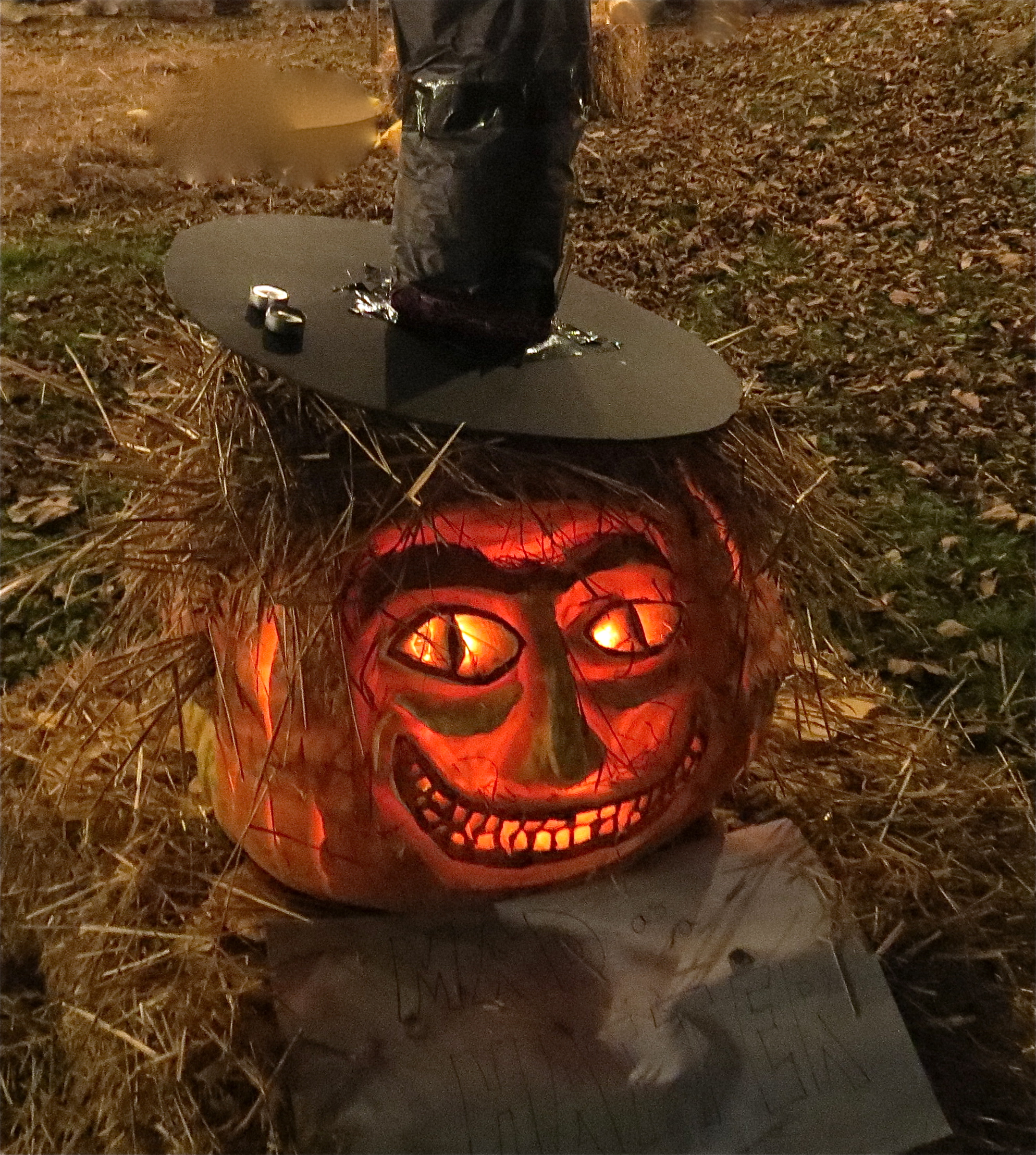
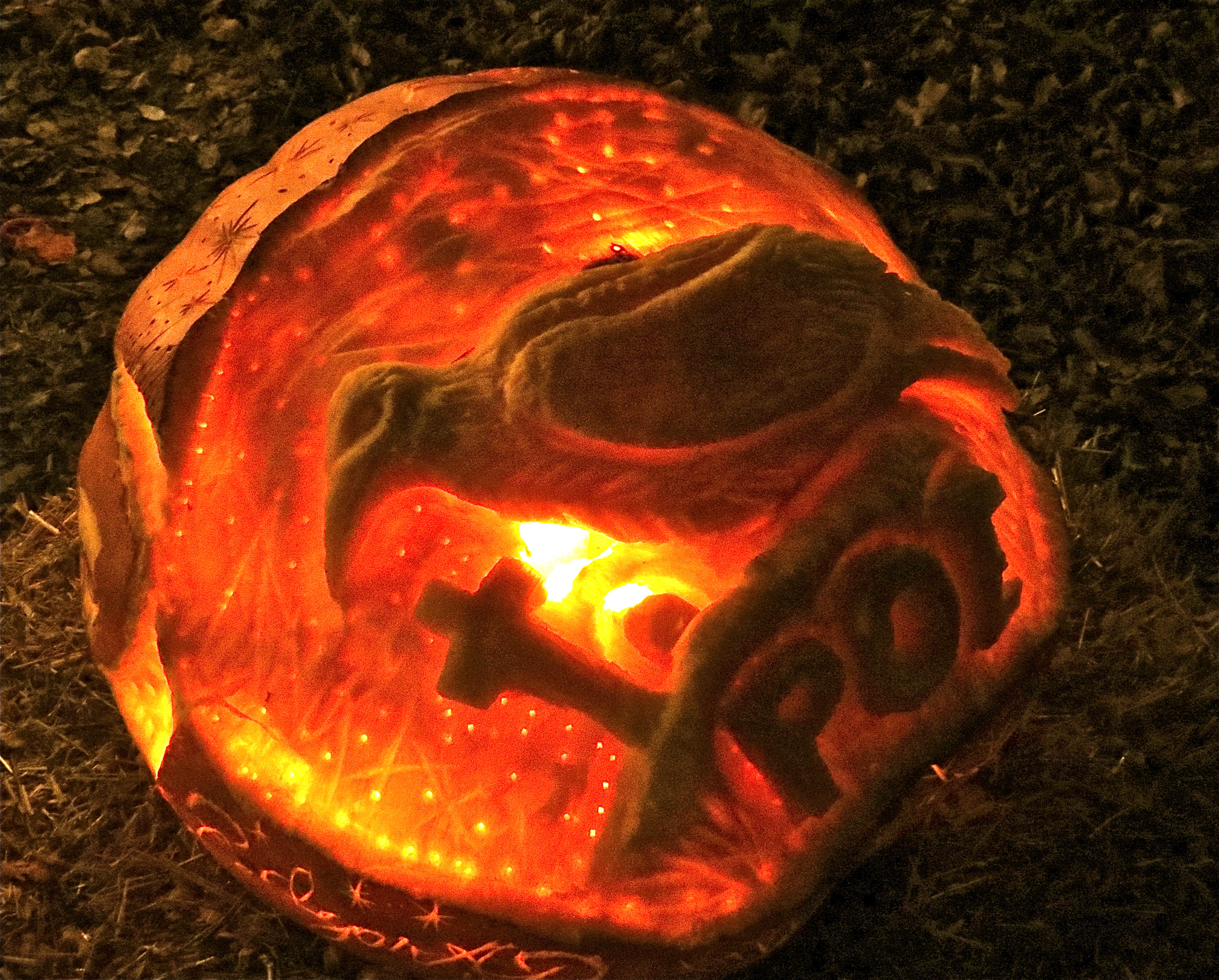
Harvest moons, apples, hayrides, anything to do with the season still resonates with the whimsy of my childhood so it seemed only natural to drive out to Chadds Ford to see the Historical Society’s annual pumpkin carving contest this past weekend. The Great Pumpkin Carve, a Chadds Ford tradition, began in the 1970s and spread from a few porch displays at the Chads Ford Inn to covering the entire lawn. All the pumpkins used in the contest are native grown, some weighing as much as 400 pounds.
What I imagined as a few pumpkins displayed in field turned out to be an explosion of activity. It seemed as if everyone in the county turned out to view the works of the pumpkin artists! Nobody could be disappointed.  Below just a few of the displays . . . .

I’m a little pumpkin, short and stout . . .

Ouch!

An entire story on the surface of a pumpkin . .

Mad hatter, no less

Nevermore

Calling wolf

Friends, cider, pumpkins and enjoying the moonlit night . . . it’s Halloween!

Appreciating the Needlework of our Grandmothers: Part II

Several months ago I wrote a post for International Women’s Day, Appreciating the Needlework of Our Grandmothers, in which I described how I sorted, then displayed, my Grandmother’s needlework and quilts. Her fabric art had been left in an attic trunk; with renewed appreciation, I researched different pieces in the collection.

Kay

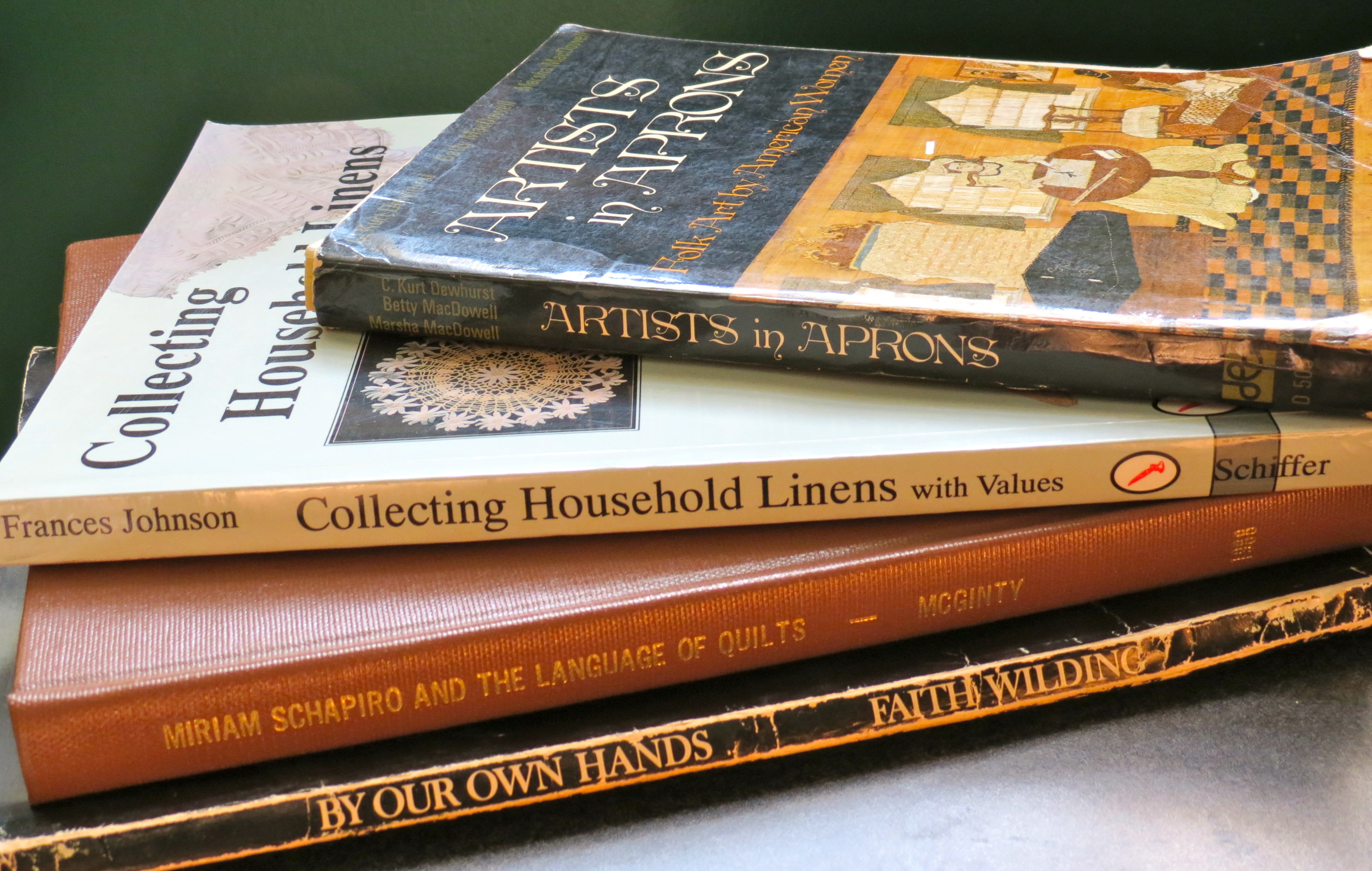
In this post, I’ve included several more photographs of my Grandmother’s quilts and added history on the subject. My friend, Kay McGinty, lent me several books on quilts and needlework. For her graduate work, Kay completed a thesis entitled, “Miriam Schapiro and the Language of Quilts,” which offered an informative study of Shapiro’s artistic creations. Schapiro, a leader in the feminist art movement, used elements of quilting in her creations and brought quilting into the “realm of high art.” Using the quilt as a model, Schapiro incorporated quilting patterns and designs into her collages.

Brooklyn Museum: Anonymous was a Woman

Anonymous was a Woman
Miriam Shapiro
Acrylic and Collage on Paper
Brooklyn Museum

The early 1970s saw a flowering of popularity for quilting as art historians began to appreciate quilts as art. Also contributing to the interest, artists began to focus on American crafts, and the feminist movement brought attention to the culture of women’s lives. Artists began to use elements from the heritage of quilt art that women had been practicing for over two hundred years.

Years ago, my father-in-law asked if I would like to have the sewing machine that belonged to his wife. The veneer top had been terribly warped; I was taking a woodworking course at the time and decided to rebuilt the top on the treadle foot cabinet.

1910 Red Eye Treadle Singer 66

Although women mostly quilted by hand, the sewing machine could also be used. This machine, over a hundred years old, can still handle most heavy-duty sewing. Internet sites include those that support human-powered sewing machines; this page displays treadle and vintage sewing machines.

A uniquely American institution, the quilting bee provided the opportunity for women to work collaboratively on the last steps of quilting, the completion of the top of the quilt. The time spent during a bee became an opportunity to share news, discuss politics and learn new skills. Susan B. Anthony spoke at a quilting bee in her first speech advocating for the right to vote.

My Grandmother created this basket quilt in 1936; the basket pattern was popular in the Depression Era. Reflecting the romanticism of the Colonial Revival, baskets were symbolic of the Colonial period.

My Grandmother used bright pastels and a geometric print on this next quilt, representative of another popular pattern during the Depression. Done by hand, this is a particularly labor-intensive pattern referred to as Grandmother’s Flower Garden. In paging through the book, Artists in Aprons, I came across a photograph of quilters in Detroit, Michigan. My Grandmother lived in Royal Oak, just outside of Detroit, where in 1938 over 18,000 women attended a quilt show at Wayne State University. Today quilting is a $3.6 billion industry.

The debate continues on what is art and what is craft–what seem to be arbitrary designations. A quilt made for exhibition falls into the category of art while authorities designate a quilt made for a bed as craft. Art created for the home or for function cannot be peeled from the realm of artistic creation. To do so would be to discredit the art women create, many times in extreme hardship or because of limited artistic opportunities. Gathering little pieces of cloth, sometimes from rags, women found a way to express artistic form in quilting and to make that art part of  their home. I never knew my Grandmother, but I can feel her creative presence in her quilts.

Quilting Sites of Interest

Why Quilts Matter

The Quiltmaker

Womenfolk: The Art of Quilting

Quilt History: Layer by Layer

Chiekoville

Coastal North Carolina: Witness to Pirate Invasion

Beaufort: Legacy of Pirates along the North Carolina Coast

Schooner Wolf

Yo Ho Ho & a Bottle of Rum

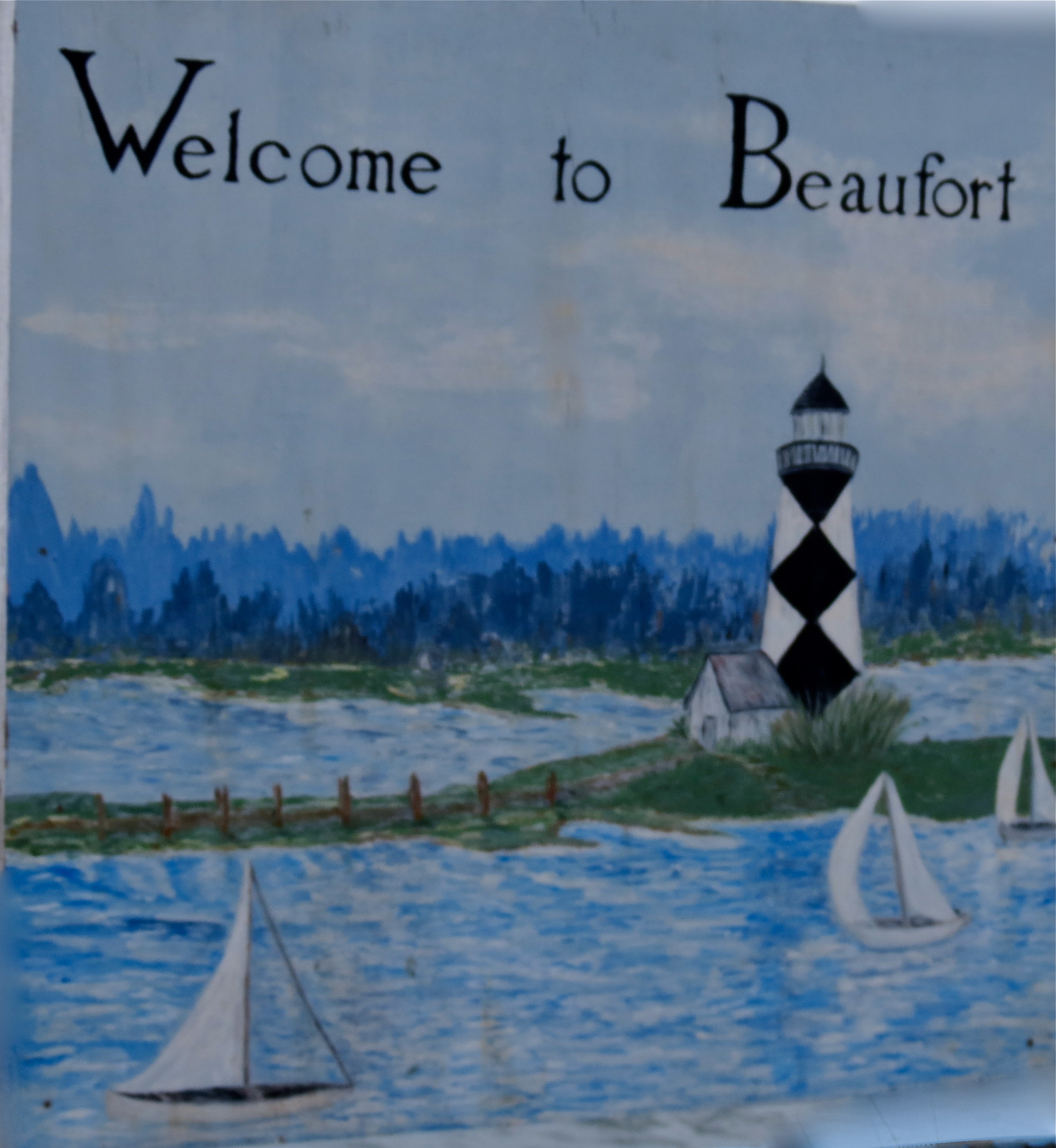
As we arrived in Beaufort, we found the town overrun with people streaming down toward the wharf. After scouring the neighborhood streets for a parking place, we headed the way of the crowds toward the waterfront. Some were dressed in colonial costumes–this began to look like fun!

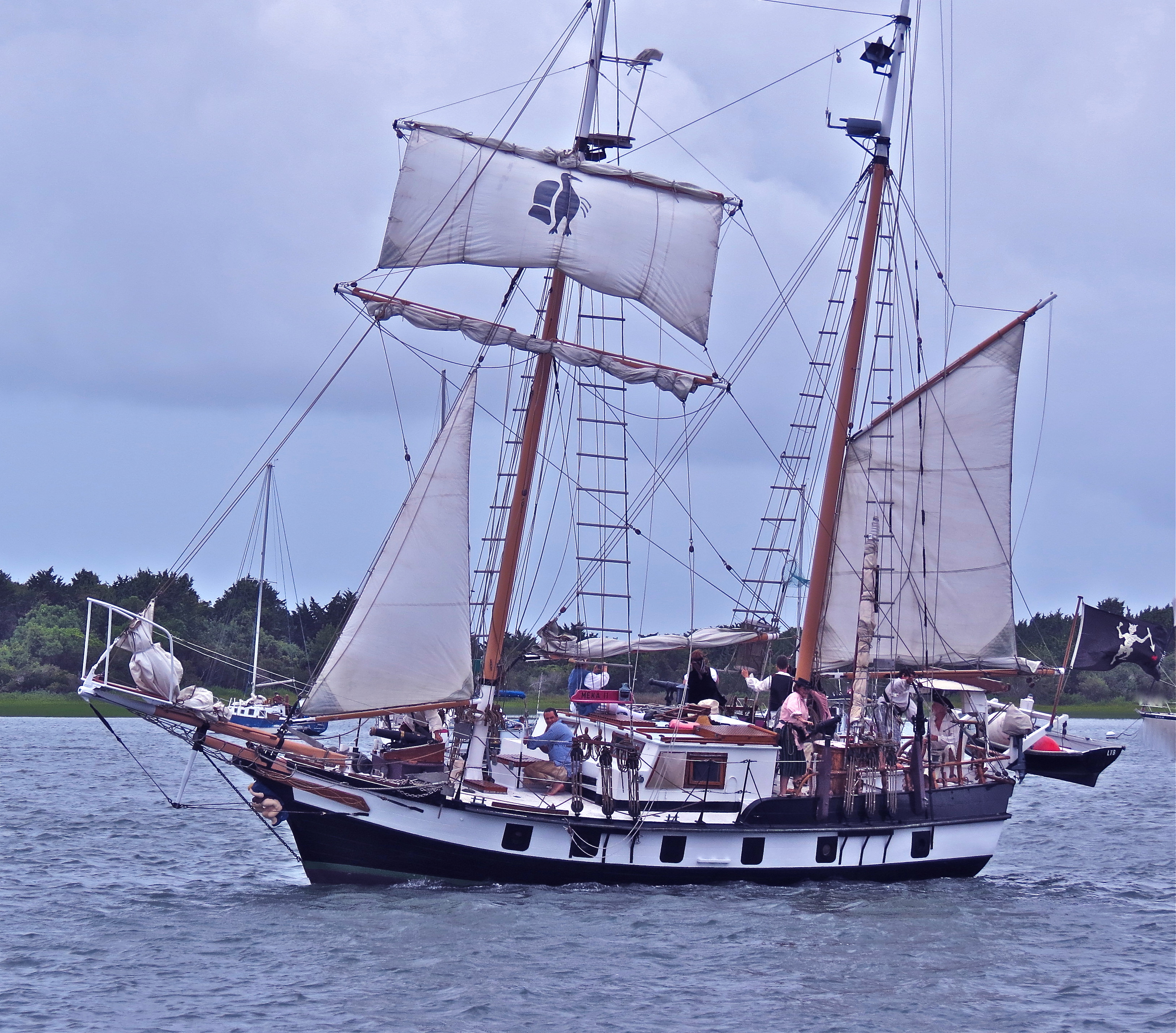
Turns out, we arrived just in time for a pirate invasion! Folks lined the piers and watched as the events unfolded on the river. A classic topsail schooner led the attack by sea, her pirate crew taking aim at the shoreline blasting her cannons. Muskets fired back in defense. Pirates in longboats plowed the water, and buccaneers on land brandished swords. Townsfolk cheered as the pirates clashed with the military guard.

We just happened on Beaufort’s Annual Pirate Invasion: It Takes a Village to Pillage event, the town’s recreating of an actual pirate invasion in 1747. The story goes that Spanish privateers sailed into the harbor and stole several ships, easy pickings when only a few men guarded the coast. Not satisfied, the pirates returned several months later to take the town! About fifty militiamen were not enough to protect the village, so citizens high-tailed it out of the area. After collecting more recruits, however, the militia counterattacked, driving the pirates out for good this time.

Blackbeard supposedly had been a frequent visitor to Beaufort around 1718. The governor of Virginia, tired of piracy along the coast, sent two sloops on a mission to capture Blackbeard; the governor’s ships eventually tracked down the pirate, and an intense sea battle followed in which Blackbeard was killed. Three hundred years later divers discovered the wreckage of his ship, Queen Anne’s Revenge, in Beaufort Inlet.

Capture of Blackbeard

The weekend featured all sorts of pirate activities from sword dancing, to pirate cruises, and costume contests.  The trial and supposed hanging of the pirates highlighted the afternoon. With so many events, I would come back and enjoy the entire weekend! 


More about our stay in Beaufort as well as our road trip through the towns of coastal North Carolina at the link.


A Family Story through a Rusted Bucket

My sister and I have been on a pilgrimage, searching for clues about our ancestors who homesteaded on the Upper Peninsula of Michigan just before the turn of the century. Jozefa and Herman, who emigrated from Warsaw and settled in a small Polish community, grew potatoes in the swampy, sandy soil. They experienced long and cold winters, where they measured snowfalls in feet and temperatures hovered well below zero. My grandfather, George, left the farm to work in the automobile industry in Detroit.

Although the farm has been abandoned for over 70 years, town folk still refer to the homestead under our family name and directed us to drive down a dirt road to find their house. We scanned the forest on either side of the road until we spy a rooftop peeking out above the tree line. I grabbed my backpack and camera, and we began pushing through the tangled underbrush. Thorny bushes and trees with low branches poked at us as we make our way toward the house. Thin trees encapsulate the home, but we climb through a space where the back door remains slightly ajar.

Paint peels away from the walls, but the floors remain intact. I can see the opening to the loft where my father told me he slept when he came to visit. Solid walls stand erect, the tin roof protecting the wooden interior. We explored all corners of the empty two rooms, and then just sit quietly on the hollow window frames.

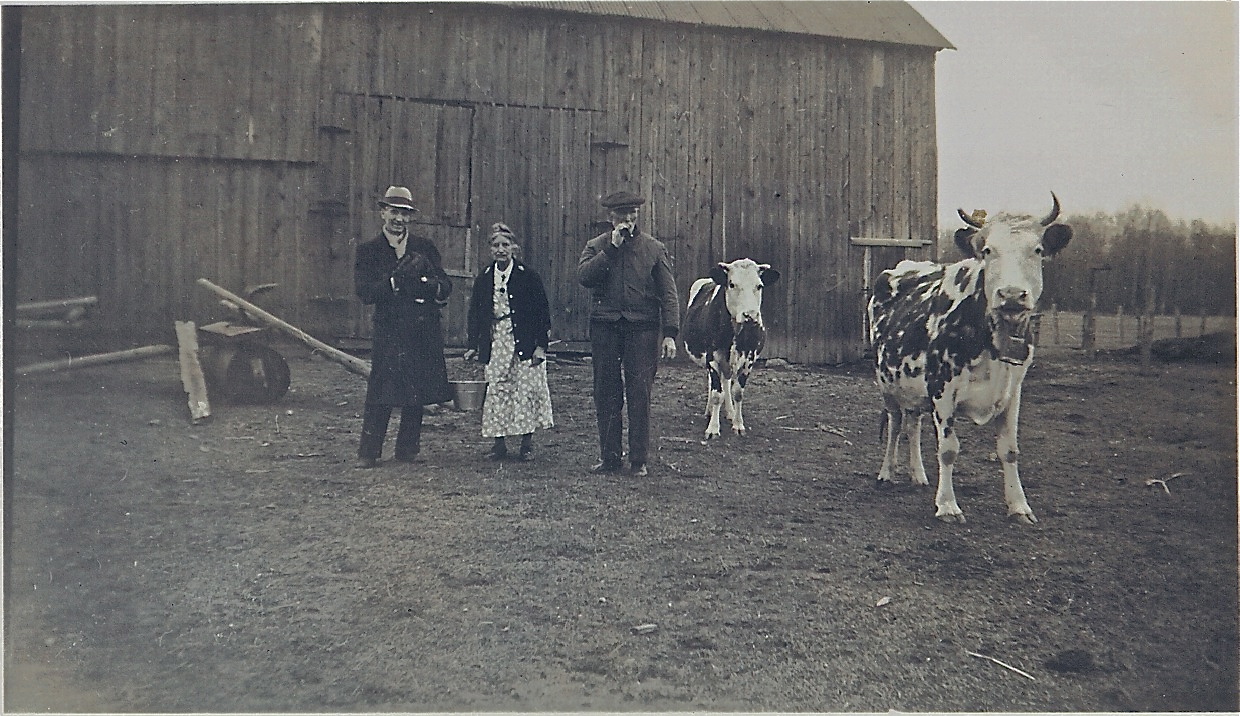
We leave the house to explore the surrounding fields and come across a pile of old timbers and cast-off pieces of metal, all that was left of the barn. Under the brush, we pulled out the pieces of a rusted bucket. As I look at the bucket, I remembered one of the undated photographs taken of our great-grandparents’ barn. My laptop, which I carry in my backpack, holds the archives of our family history, so I begin searching for the photograph. Time evaporates as I gaze at the rusted bucket and then at the photograph of  Jozefa holding the pail.

~ ~ ~ ~ ~ ~ ~ ~

Grandfather, standing to Jozefa’s left in the picture, traveled almost 400 miles to visit his folks on this day. I questioned why did he make such a long trip at this time? George appeared quite dapper in his fedora and long black coat, and I noticed that he was smiling coyly at the camera. I searched back in family records again and found that my grandmother, Catherine, had died in 1936. Several years later George remarried. Was that his new bride taking the picture?

This was the beginning of a new life for my grandfather, but Jozefa would have only a few years left to care for her animals and farm. I thought about her small hand holding the handle of the bucket.

Protected: Memorial for Corvin

This content is password-protected. To view it, please enter the password below.

Tag Cloud