Almost every civilization, including our democratic society, has constructed walls, mostly for keeping the “other” out. Sometimes the “other” is an enemy, where conquering, exploiting and enslaving citizens becomes the objective. In other cases, walls are built to keep out those whom society deems as undesirable.
A wall never works. Technology eventually catches up and produces mechanisms to scale the ramparts. Past civilizations continued to build higher and stronger fortresses, but eventually these walls were breached and societies fall, as opponents becomes hell-bent in destroying the barrier. Walls carve a separation that perpetuates the wounds on both sides, and the effects of the wall continue to influence people’s lives in terrifying ways.
Our ancestors have been on both sides of the wall, as conquer and vanquished. Will we ever be able to deconstruct the barriers in our minds to realize peaceful coexistence with our neighbors and put a stop to our perpetual compulsion of building and destroying walls?
Before I built a wall I’d ask to know What I was walling in or walling out, And to whom I was like to give offence. –Robert Frost, Mending Wall
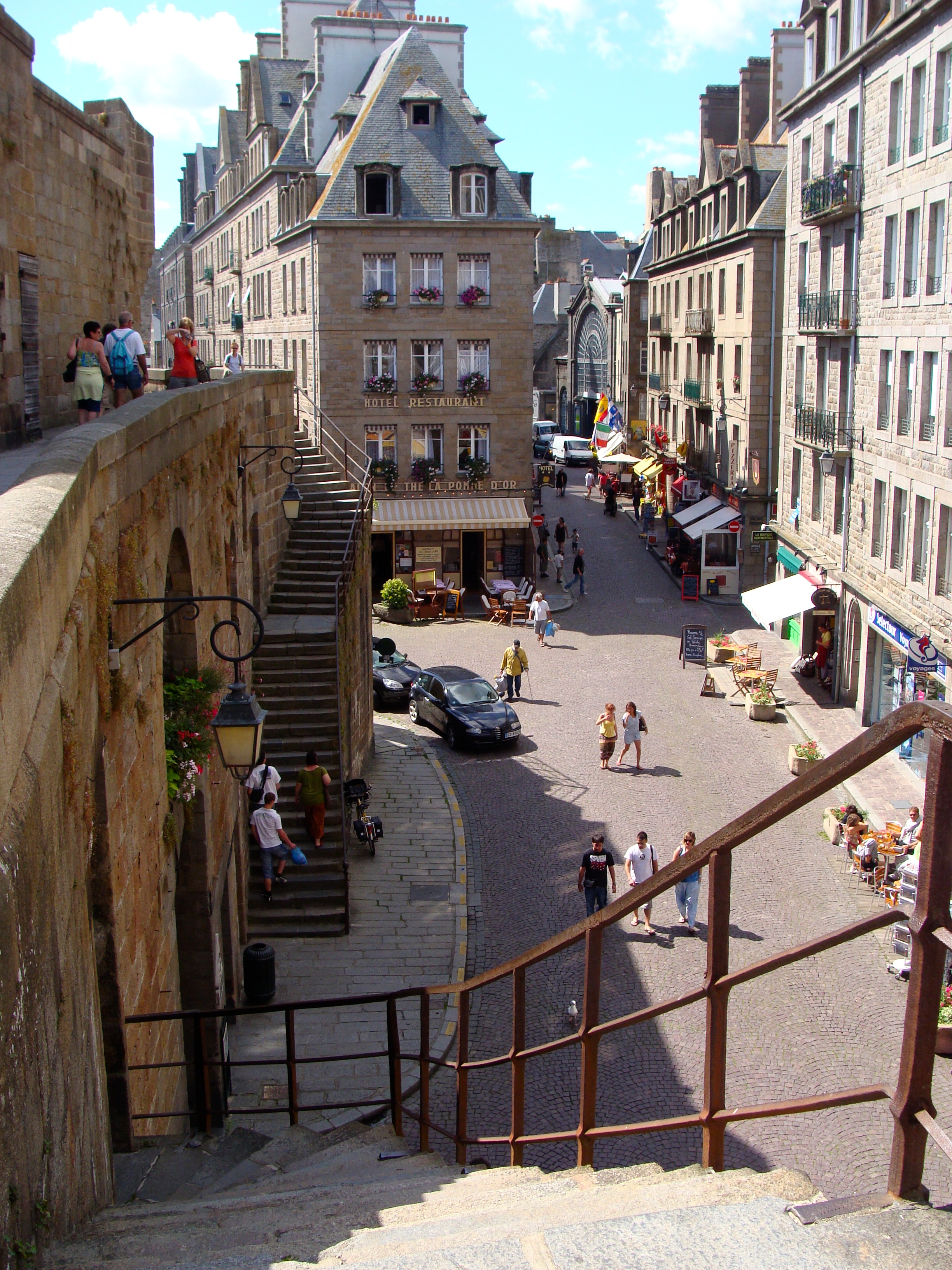
St. Malo, walled city in Brittany, France. Built in the 12thC, rebuilt in the 17thC, destroyed during WWII, and again rebuilt by 1960.
“The sky sees your face.” –Alexandra Kerr S. 2/7/15
Yes, the sky sees your face the wind whispers in your ear the rain hears your splashes the snow kisses your hand the grass tickles your toes the moon sparkles in your eyes the sun warms your skin. Yes, the sky sees your face.
* * * * * * * *
Alexandra has continued with her memorable quotes, collected by Daddy and Mommy:
May 24, 2016 Alex: Mommy, I’m made out of elements Oh really? What elements? Alex: FIRE ELEMENTS! My skin is the elements. The fire elemental are right next to my heart! What do you do with your fire elements? Alex: I only play with the fire elements right next to my heart & they look like fire and if you were in my body than you could see it but only if you are mini-sized. But don’t touch them or you will be burned into a fire monster.
“My aunty Kae is a nice aunty, I flew on a plane to see her and she took me to art class aaaannnddd gave me food to survive. I threw up in her car because my Nanna drove to much.”–Alex
Comments
Dear Alex, we are saving the date for you and Valeta to return to Pennsylvania in June. Can’t wait to see you both! There will be art classes again and dancing wearing our tutus. I promise we will drive slowly so no more worries about car sickness! How about another ride on the merry-go-round? Love, Auntie K
Alex: What happens if this chip breaks? Me: I don’t know, you will have a broken chip. Alex: Will the whole world break? Me: I don’t… Alex breaks the chip Me: think so.
She took out another and said “does this chip hold reality together?” before breaking it.
I look on the bright side when I give you hugs. –Alex
“when I go to Kindergarten I’m going to miss being normal.”
Alex started school today, and that is a big change for her… but it is also a big change for me, a milestone in her life and a threshold over which once crossed there is no going returning. She went out that door, got on that bus, and entered into a whole new world of experiences. It will change her, and in that change she will grow into someone new, someone wonderful. Of no less, and no greater beauty than the amazing person she is today. Yet the person she is today will be lost to me. The girl who holds my hand tomorrow isn’t the same person who held my hand as she toddles across the floor, isn’t the same person as the one who looked up at me with those eyes so blue on her very first day. She is the sum of those people, just as the young lady she will become is going to be the sum of the person she is today (and every person she is between now and then). But then am I not a different man than I was when I first held her hand (an eternity ago to her, an instant to me). That man is still here, part of the sum of experiences that makes up my life… just as the little boy who once held a hand (an eternity ago for me, perhaps a moment ago for others).
Time changes us, it brings us new experiences that shape who we are like the waves on a beach shape the sand. Even if we go back to the same place, be it days or even years later, we can never return to that same beach we once walked on. Nor are we the same people as the ones who once walked on that beach.
Tonight, after the excitement had calmed down she laid her head down on my shoulder and said “I can hear you breathing daddy” then drifted off to sleep. Tonight I laid there for a bit longer than I otherwise would… there being laundry to do and a dishwasher to run, lines on the endless list of things that need to be done. I laid there with the window open and lightning flickering in the distance.
Just for a moment, just one moment more.
* * * * * * *
Alex: Sometimes I run so fast on the ground it catches on fire
It’s OK, I’m an ice dragon and ice dragons breath ice like a refrigerator for ice. –Alex
I look on the bright side when I give you hugs. –Alex
Alex: hi Daddy Me: hi Snuggles, what’s going on in your world today? Alex: Sunshine and RAINBOWS!
September 2018 “we are never alone, because there are always spiders nearby. They live behind the toilet.” –Alex
December 15, 2018
“What happens if your brain is trying to make sense, but it ends up not making any sense?”
January 2019
“Every day is the newest day ever.” -Alex
Alex: When I go to Art Camp its a long way away… you leave from here in North America and you land in Philadelphia. Me: Philadelphia is in North America sweetie Alex: 😲
Never go over the rainbow, if you do there is a monster there waiting to nibble you up! –Alex
What’s the big deal about a chair? Actually, this chair is so big, about four times larger than a typical chair, and it’s a work of art that has taken on a life of its own. Jake Beckman, a student at Swarthmore College, conceived and built the original chair, which found a place among the other standard-sized Adirondack chairs that dot the stretch of lawn in front of the main hall on campus. Even The Colbert Report featured a segment about the famous chair.
Several years ago the original chair fell apart and was discreetly removed from the lawn. However, the campus community, becoming attached to the Big Chair, clamored to bring the chair back. Jake agreed to return to rebuild the structure, and the chair resumed its place with the others.
I guess I wasn’t the only one beginning to think metaphorically about the Big Chair. Some unnamed inventives would come by during the night leaving the chairs in different arrangements, such as the Big Chair leading a line of the other chairs or the Big Chair in the middle of a circle. One morning the Big Chair stood upright while a semicircle of normal chairs tipped down in front of the Big Chair.
Now I was thinking hard. The chairs assumed the metaphor for power dynamics . . . and not just at Swarthmore! I thought about “Big Chair” people, folks that tell us what to do or think: politicians, pundits, advertisers, bosses, CEOs, presidents, board of directors . . . and I’m sure you can think of many more. Do we perceive these folks as big in influence, power, authority, and wealth and get drawn into a mindset that binds us to a deferential attitude? Many normal chairs sit on the lawn–there is strength in numbers when we act collectively. And normal-sized chairs serve a real function. We wouldn’t make 25 more Big Chairs!
On reflection, perhaps we do need the Big Chair–reminding us to keep the right perspective.
Serenity comes upon us when the vastness of our planet rises before us. We see ourselves as part of the miracle we call earth. It’s as if the universe is sending us a message that we belong to this place and time. When we stand alone by the seaside, we are not lonely. The moment stretches into an imaginary eternity as the waves return to the shore and the clouds pass away. We are alive, and we experience this transcendent gift in a moment of serenity.
The farmland, forests and fields of the Pennypacker Mills County Park provided the setting for the Civil War Reunion. The park lies 15 miles north of Valley Forge National Park and just across the Perkiomen Creek from the town of Schwenksville. “Perkiomen” is a word from the Lenape, a tribe of Native Americans who settled in the area, that means “muddy waters” and “where the cranberries grow.” As I walked down to the creek, tall grasses waved in the gentle breeze casting an incense over the landscape. Purple, white and yellow wildflowers peeked out from under the canopy of grasses. I stood on the bank of the creek as the melody, “Wade in the Water,” a song associated with the Underground Railroad, played in my mind.
The Perkiomen Creek and Underground Railroad share a connection. In a famous case, a slave named Rachel had to flee from West Chester when her owner, who lived in Maryland, showed up in town with a warrant for her arrest. Fleeing from her pursuers, Rachel jumped a seven feet high fence, escaping once again. After hiding in an attic, her friends smuggled her out of town to Phoenixville, crossing the Schuylkill River and then the Perkiomen Creek at Tyson’s Mill in the middle of the night. (The Underground Railroad in our Area)
The centerpiece of the park is a colonial revival mansion built around 1720 and owned by the Pennypacker family for eight generations. Pennsylvania governor Samuel Pennypacker, who served the state between 1903 to 1907, lived in the house and collected many of the antiques that are displayed throughout the rooms of the mansion.
Having filmed two other Civil War reenactments, skirmishes on the Wilmington Railroad and at Rising Sun, Maryland, I looked forward to a new adventure on the rolling hills of Montgomery County. Although no Civil War battles were fought here, in 1863 Samuel Pennypacker enlisted in the 26th Pennsylvania Volunteer Militia and confronted Confederate forces at a skirmish north of Gettysburg at Witmer Farm.
American Civil War: History and Recreation
Other than a few history classes in college, I hadn’t studied much about the Civil War. In order to learn more, I’ve watched the recent PBS series, Civil War: The Untold Story, the central theme, which some view as controversial, establishing that the Civil War was fought over slavery and not the issue of states’ rights. Producer-director Chris Wheeler stated that the film brought hate mail from groups on the radical right. The film also included the relatively unknown history of the contributions of African-Americans to the conflict. I admired the filming of the battle scenes. What Wheeler and I have in common is that we both photographed reenactors, who are dedicated to accurate portrayals of the Civil War.
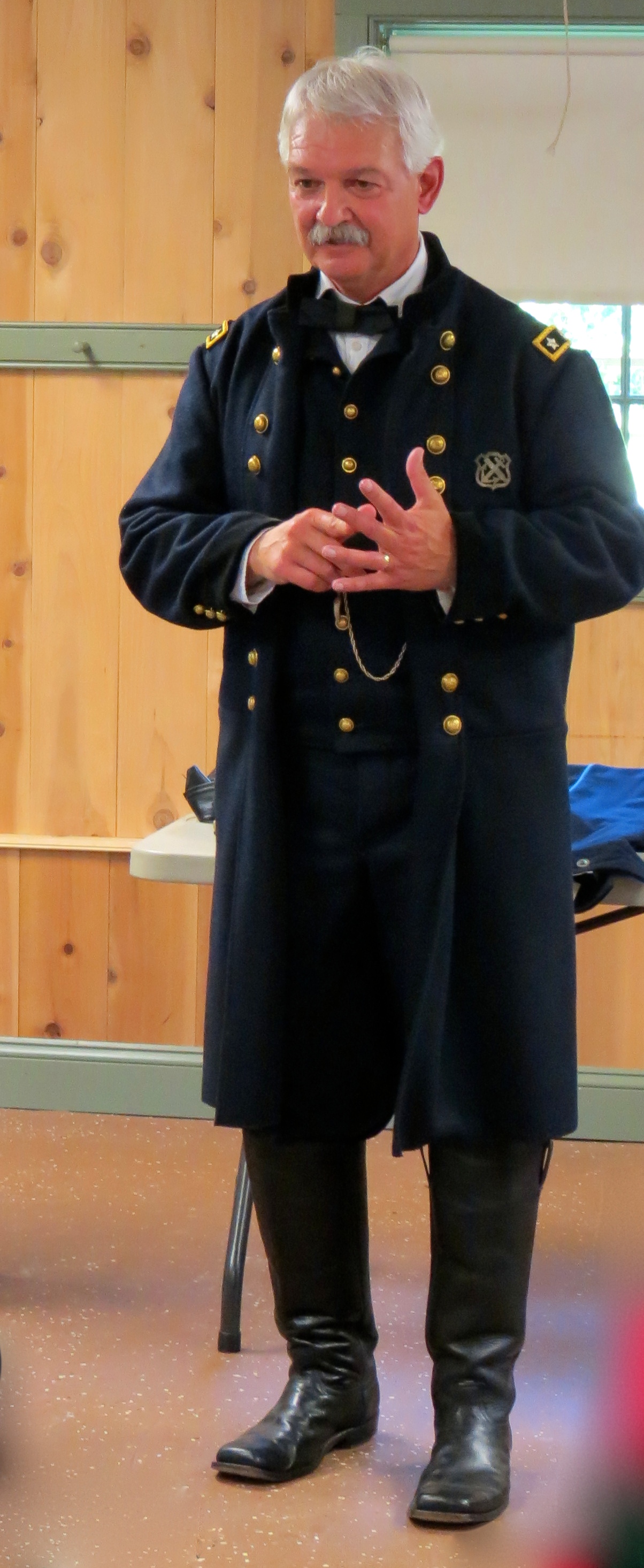
General John F. Hartranft
General John F. Hartranft (a.k.a, Mark D. Grim, Jr.), a native of Montgomery County who fought in both the Eastern and Western battles, presented a lecture on his experiences during the war and as provost-marshal during the trial of those accused of assassinating Abraham Lincoln. The General stated that when Lincoln announced the Emancipation Proclamation, Union soldiers became confused as to the reason they were fighting. They understood the cause as preservation of the union and not for the freedom of the slaves. General Hartranft reaffirmed to the soldiers that preserving the union was the purpose of their sacrifice. As strongly as I believe that the preservation of the union was important, seems like freeing an oppressed population would be a more compelling reason to take up arms.
The event planners filled the weekend with activities and demonstrations including musical performances, battle reenactments, children’s events, speakers and sutlers displaying their wares. I took advantage of an early start on the day and attended every event on their schedule.
Mansion Tours
Visitors could walk through the house, where guides in each area presented a history of the rooms. The house was not electrified until after the Pennypackers left, but in 1900 much of the building was updated and renovated. Many of the original furnishings, books and paintings remained with house and in remarkable condition.
Included in the slide show below, is a portrait of Governor Pennypacker, whose veto in 1906 blocked what would have been the first compulsory sterilization law in the United States. Pennypacker stated:
“It is plain that the safest and most effective method of preventing procreation would be to cut the heads off the inmates, and such authority is given by the bill to this staff of scientific experts…Scientists like all men whose experiences have been limited to one pursuit…sometimes need to be restrained. Men of high scientific attainments are prone…to lose sight of broad principles outside of their domain…To permit such an operation would be to inflict cruelty upon a helpless class…which the state has undertaken to protect…” Wikipedia
This slideshow requires JavaScript.
Songs & Stories of the Civil War
Dressed in a Confederate soldier’s uniform, Matthew Dodd played banjo and guitar, singing songs of the Civil War era, as well as telling stories. He plays “Dixie” in the video at the end of this post.
Civilian Street Demonstrations and Families
Union Patriotic League, an organization that represents domestic life during the Civil War era, often accompanies the reenactors, displaying their specialized interests, whether basket weaving, cooking or sewing. They created charming vignettes inside their tents, with rugs, quilts, flowers and lamps. In the real Civil War encampments, women and children rarely accompanied the soldiers, so these tents are representative of domestic life at that time and not actually recreating camp life. Photographs that follow are from the both the Union Patriotic League and Civil War reenactor camp sites.
This slideshow requires JavaScript.
Confederate Artillery Demonstration
John Houch presented a history lesson to the gathered crowd, who came to watch the firing of the cannons. John mentioned that in the filming of Gettysburg, the director borrowed 50 cannons from reenactors. In addition to the seasoned adults, children and teens also took part in the demonstration. The Confederates represented the 37th Regiment, North Carolina Troops, Company A.
This slideshow requires JavaScript.
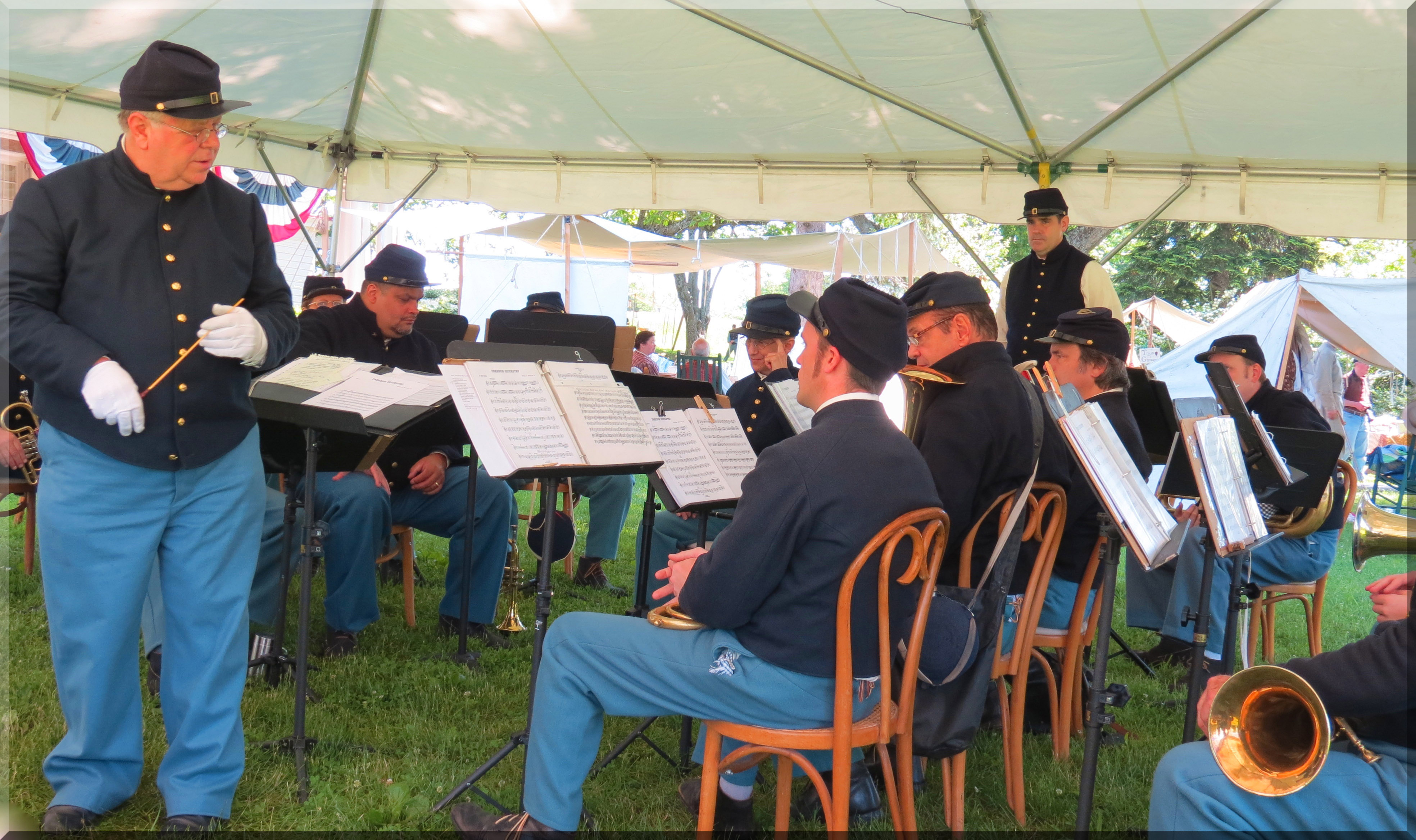
Becks Philadelphia Brass Band
The Becks Philadelphia Brigade Band, a Civil War/Victorian-era brass band, performed military and social music of the Civil War period through the late 1800s. Authentically uniformed, the band played both reproduction and period instruments including a piccolo, Eb cornet, Bb cornet, Eb alto horn, tenor horn, baritone horn, bass and percussion. Today’s band serves as representatives of the brass band of the 2nd Division, 2nd Corps, 2nd Brigade of the Union Army of the Potomac in 1863.
Battlefield Enactment
Like the little girl whirling in circles, controversies swirl around the authenticity and ethical debates on battle enactments. For someone who would melt down every bullet and bomb ever produced, I have had to ask myself what is the attraction to watching battles, which in reality brought untold suffering and grief? Can someone so committed to peace derive an uplifting message from living history enactments?
My argument is in support of the reenactors. They have been extraordinarily kind in sharing information they have learned and generous with their time in making an honest effort at historical representation. Reenactors have every right to role play, as any movie director or documentarian has to present their view. These are regular folks who are portraying regular folks. Just like critics analyze films and television, visitors and observers may also critique these enactments. Just being present, reenactors encourage discussion, debate and further research. Historical reenacting, as well as for those of us making videos, carries the responsibility to authenticity and an understanding of the implications how the history of the Civil War might be presented.
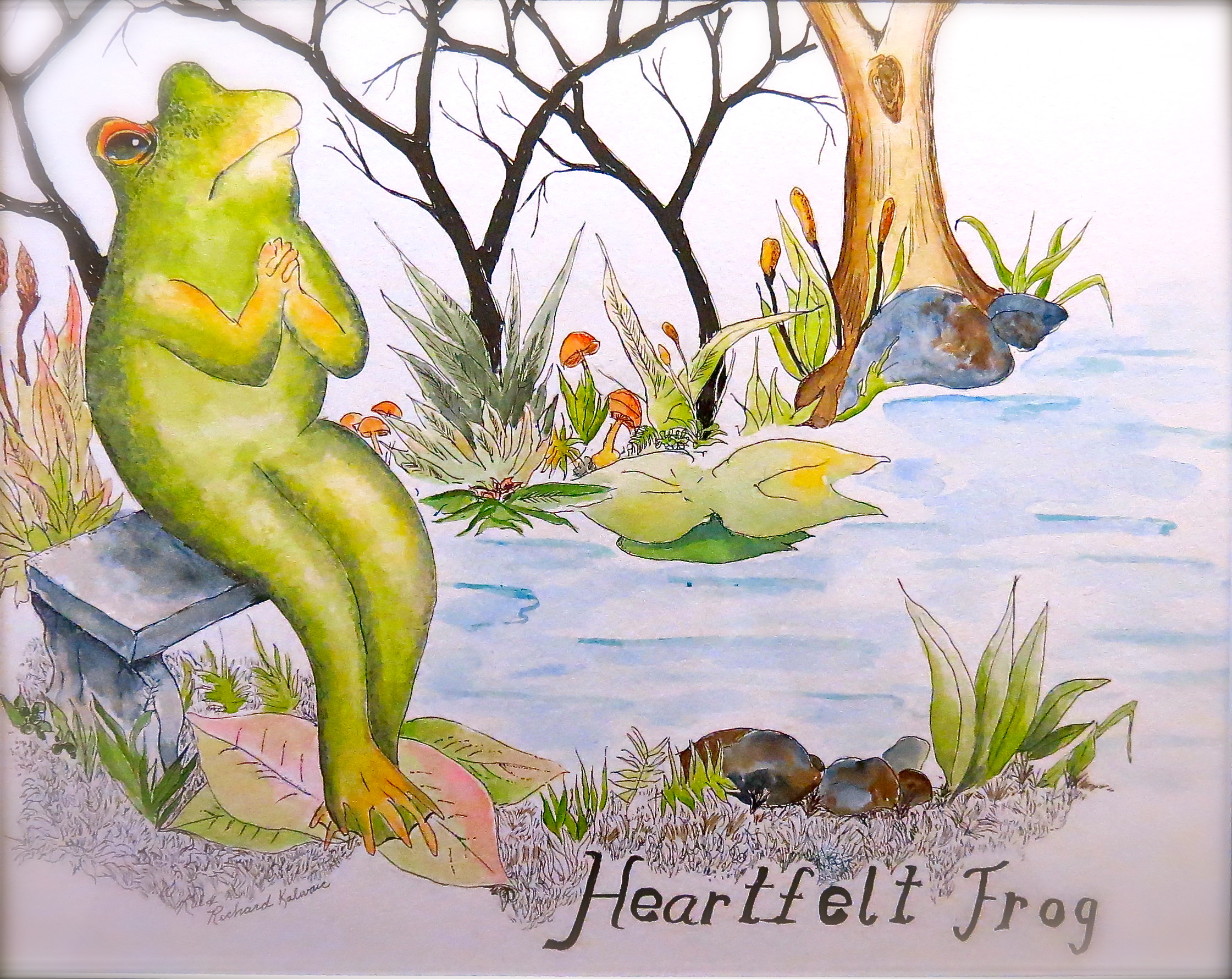
T’was a stormy spring morn at woodland pond
When the Ravens flew from their treetop home,
And found their friend, Froggy, along lily pads
At water’s edge, gazing at the bubbly foam.
“Dear Froggy,” they cawed, “Please hold our magic wand,
As we search far and wide to look for our food.
Our little birdlets are still too young to fly,
We must find something to eat for our growing brood.”
The frog agreed he would guard the wand
And promised to keep it from all danger.
Froggy placed the wand on the lily pad
And vowed to protect it from all strangers.
As lightning bugs danced in the misty air
Froggie gazed on their fleeting reflections,
Dark clouds brought a burst of stormy showers
The wand slipped away, without detection.
Froggy surveyed the nearby lily pad,
But the shiny wand was now gone.
As rain drops slipped off the leaves, He cried,
Oh, no! it’s lost at the bottom of the pond!
He sat on the shore for a very long time
But he knew that he mustn’t stay fraught.
Froggie had let down his Raven friends.
He grasped his heart, “I’m so sorry,” he thought.
Froggie peered through the muddied water
And held his breath and swam down deep.
He searched through the muddy goo
Finding only twigs, he piled them in a heap.
In the distance Froggie heard the Raven’s call
But he knew that he must not stop.
With one more deep breath, dove down again
Found the wand! and swam to the waters’ top.
The Ravens flew to their friend, Froggy,
Now tightly holding their magic wand.
The Ravens could see what the Froggie had done
Then called to frog, “Please come out of the pond.”
Froggie was sad, as he had lost their wand
But the Ravens comforted him and said,
“You worked so hard to find what was lost.
Come and join us now and share our bread.”
The end of the story can now be told.
As friends they remained in their woodland haven.
For a heartfelt response means more than gold
For this we’ll remember–the Froggie and the Ravens.
Travel has sharpened my awareness of the passage of time, whether observing the erosive forces on the Grand Canyon or the sea carving inlets on the coast of Ireland.
Recording family history has also expanded my perceptions of time: how families have lived out their days in cycles of births, marriages, and passings. Sometimes I cannot tell whether I am in their time or my own as these dimensions seem to meld together.
Whether we wake or we sleep,
Whether we carol or weep,
The Sun with his Planets in chime,
Marketh the going of Time.
~Edward Fitzgerald
For Women who have Resolved to Work for the Common Good of Humanity.
Emergence
The world enclosed and darkened inside my head Not even dreams materialized as I lie in bed Discord delivered echoing despair And yet . . . guided me to your sheltered lair.
I found you, though you were there all along You entered into my soul as an enchanting song With leonine magnificence, so noble, so sublime Intrepid lover of art, beauty, truth and rhyme.
This miracle then cleansed my mind Reborn to a new life refined. I laughed and learned to forgive. My heart opened–I began to live.
And yet what you are is an illusion in time. This noble ideal can only exist in my mind. Never to feel your warmth that a Lover knows Or touch the fabric of your roughened clothes.
But how to create harmony again from sighs. To feel the exhilaration of the highs And experience truth from melodious lows. Not to be played out as a duet but as a solo.
Embraced by the power of this measure Hearing music of souls joined together Triumphs in splendor as shimmering sounds With knowledge and passion that knows no bounds.
I arise from this dream and rebirth Resolved to become a heroine on earth.
When I was in sixth grade, some of the boys in my class were mean, rough and nasty. One of our former teachers said of our class that they were the worst she had ever taught. The boys were disruptive and opportunistic, seeming to find ways to cause trouble without getting caught. The boys cursed at one another and at the girls. Giving the finger was part of their repertoire but well-hidden from teacher’s eyes.
In past years, I had been injured during rough-housing. In third grade, a boy pushed me off a wall, and I chipped my tooth. A year later, I almost lost my eye when boys were taunting us by lifting our dresses up. I bent down to push my dress down and my head went into a pencil in the boy’s pocket. My Mother always warned me to just stay away from them, which was the strategy I tried to practice through grade school.
Wikipedia
Our sixth grade teacher, Mrs. Boyer, was a great teacher and a sweet person. She seemed to manage the class, often by telling stories of her life or reading to us. She would say, “I’m not sure we have time for Winnie the Pooh today.” The class would immediately go into begging mode, “Please read Winnie the Pooh.” As I looked around the room, I would see even the most hardened boy pleading for a story about the bear. During story time, the class would settle and the students would fold their arms on their desks, listening intently. I remember asking myself how could a story quiet such restless anger.
When Mrs. Boyer read the stories, I could easily visulize the Hundred Acre Wood, and we’d look at the map on the inside cover of the book as if it were a geography lesson. Pooh was the most endearing character, almost the alter ego of the classroom boys. Pooh was never mean-spirited, and he was always kind to his woodland friends.
Although the bear supposedly was of “very little brain,” Pooh was hopeful and comforting.
“Rivers know this: there is no hurry. We shall get there someday.”
“Promise me you’ll never forget me because if I thought you would, I’d never leave.”
Of course, school is a place where your self worth is constantly on the line with test taking. In contrast to the academic demands of school, Pooh offers an alternate view of cleverness:
“Rabbit’s clever,” said Pooh thoughtfully. “Yes,” said Piglet, “Rabbit’s clever.” “And he has Brain.” “Yes,” said Piglet, “Rabbit has Brain.” There was a long silence. “I suppose,” said Pooh, “that that’s why he never understands anything.”
Good-bye to Elementary School
The next year our elementary school class went off to a large junior high school, and I had little contact with the boys in my class after that. In general I don’t remember that the classroom dynamic in junior high being as hostile as it was back in elementary school. Maybe the boys matured or began concentrating on the grind toward college. I wondered whether in transitioning into junior high, Winnie the Pooh offered emotional support that eventually altered world views, even if slightly.
My favorite PBS show from the BBC this season is not Downton Abbey, but rather Lark Rise to Candleford, a costume drama set near the end of the 19th century in the Oxfordshire hamlet of Lark Rise and neighboring town of Candleford. The BBC adapted the series from a trilogy of semi-autobiographic novels written by Flora Thompson, published between 1939 and 1943. What sets Lark Rise apart from other costume dramas, where sometimes the characters come across as self-centered and petty, the folks of Lark Rise seem genuine as they struggle to find the right path, even if their best attentions sometimes fall short. The program shows human frailty tenderly as the characters search for answers to their challenges in difficult times.
Because I am a big fan of EastEnders, the popular, gritty British soap opera, I laughed when I read this review of Lark Rise in The Guardian, “A rural Victorian EastEnders with telegram deliveries instead of murders.” Whereas EastEnders offers an intriguing and somewhat addicting storyline in an unending series of hopelessly agitated characters, unable to find one modicum of mindfulness in response to each other’s failings, Lark Rise characters offer philosophical insights to the latest crisis. Those insights often happen through the humblest character.
Shall We Assist?
In this recent episode, Season 4, Episode 1, the townsfolk accused Dorcas Lane, main character and post mistress, as meddling in everyone’s business, causing untold distress. Dorcas, who consistently affirms that she only has one weakness, whether it is banbury cakes, feather pillows or baths, decides that this weakness of meddling must be addressed, and she vows to no longer interfere in her neighbor’s lives. The problem she almost immediately faces is whether to step into a situation in which she could be genuinely helpful. Standing on the edge of disaster seems cowardly but backing off from her commitment also seems like a half-hearted effort to check her interference. I won’t give away how the rest of the story unfolds, but this theme gave me pause.
What factors do we measure when to step into a situation. Of course, if someone asks us to help, we can without hesitation. What about if someone cannot see their situation objectively, overcome with emotion? After careful thought, can we offer assistance in form of advice, money or help? How do we assess how any of our generous offers might affect outcomes? We might ask ourselves if somehow this offering of advice plays into our own ego. Are we giving advice to sound important or because we feel we have the authority to do so? Are we responding to a dangerous situation that needs immediate attention? It takes courage to speak up in unjust situations where our input may not be welcome.
Offering advice is a difficult negotiation with only a few guidelines. Like Dorcas, best not to make hard and fast rules but rather carefully evaluate the factors in each situation. We may not always get it right, but a thoughtful response might offer folks in our times some comfort and help.











 Psalmboxkey's Blog
Written
on 03/13/2015