Humble Contributions to the Peoples' History

Archive for March, 2013

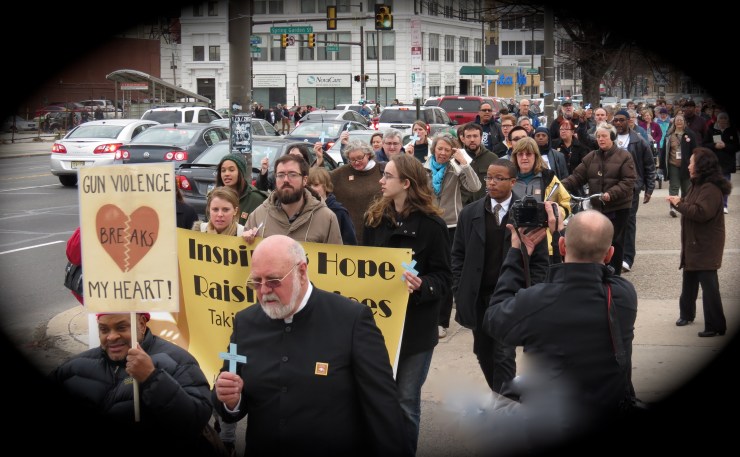
Philadelphia Performance Protest against Gun Violence

On March 29, Heeding God’s Call, held their Fifth Annual Good Friday Procession and Vigil to protest the continued gun violence in the city. Nearly 200 worshippers gathered late in the afternoon at St. Paul’s Baptist Church, where worship services began, and then “en masse” marched to Benjamin Franklin High School on North Broad Street for  the vigil.

Healing Presence Choir2

The Tabernacle United Choir and Arch Street Methodist Choir joined the Healing Presence Singers under the backdrop of the Common Threads Mural, which is representative of hope for the future. Holly Phares directed the choirs during the ecumenical service that included guest speakers from several faith-based organizations and  families who have lost children to gun violence. By joining together, the worshipers affirmed that it is possible for citizens to fight for legislation and social policies that would help bring peace to our streets and homes.

Marching

According to CNN, Philadelphia has one of the worst homicide rates in the country, with more than 80% of these crimes committed with a gun.

A young, black man, has a greater chance of being shot and killed in Philadelphia than he would have if  he were a soldier serving in the conflicts in Afghanistan or Iraq,

An average day in US has 30 gun-related murders with another 162 wounded  based on the most recent figures from the Centers for Disease Control and Prevention. In addition, 53 people kill themselves with a gun each day. Our homicide rate of 4.7 murders per 100,000 people is one of the highest of all developed countries. Unfortunately, statistics of these daily tragedies mean little in the public consciousness and only when mass shootings occur, do citizens begin to take notice. This outrage that follows these shootings is followed by frustration as law-makers, indebted to the gun lobby, block even the most sensible gun restrictions, such as high-capacity magazines. If the Tucson shooter had only ten bullets, Christina Taylor Green would be with her family today.

At the rally in Philadelphia, parents of children who were killed by guns spoke of their loss.

While this was a peaceful demonstration, just a day before mothers in Indiana had to stand in defiance in front of a line of armed men carrying AR-15 semi-automatic weapons. The moms, advocating for restrictions on purchases of high-capacity magazines and legislation requiring background checks on gun sales, were protesting in front of the Indiana statehouse. An armed opponent admitted that his rifle was loaded. Some might argue that the Indiana protest was also peaceful, but the potential for violence, either because of accident, mental instability or provocation, undermines the tenants of democracy to live free from the threat of gun violence.

Numbers to reach US Senators at this link.

“Rock-‘n-Roll is Here to Stay”

Waxing Nostalgia: Teen Dance Scene 1964

For some time I have thought about dancing again as I’ve missed my ice skating dance routines ever since my hip replacement. Reflections about dancing brought me back to the time when my girlfriends and I went to the teen mixers at Holy Cross Roman Catholic Church in Springfield, a suburb just outside of Philadelphia. I couldn’t find any references to the dances on the web, but in the mid-1960s, Holy Cross was the place to be on a Saturday night.

Most of the teens who attended the dances came from the working class communities in the adjacent neighborhoods, and most were Catholic, of course. We attended the public school so it was a bit of a leap to attend a dance outside of our school where we wouldn’t know anyone. Some of our friend’s parents didn’t like the idea of their daughters going to a Catholic dance, but somehow we convinced them it would be ok. Secretly, we always thought that Catholic boys were “fast” but not necessarily that was bad, just we had to be aware. I can’t remember that myth ever playing out. We were somewhat protected in our suburban bubble. My sister remembers her shocked reaction when she saw smoking going on around the corner of the church.

Scan 2

The Church kept a strict dress code. Boys had to wear coats and ties and for girls, skirts or dresses. We would spend all day getting ready: washing our hair in the morning and using those humongous plastic rollers so that our hair would have puff rather than curl. We would sit under a hair dryer bonnet for hours. More daring girls would wear heavy eye makeup and challenge the limits on how short their skirts could be. It was a fine line, and the authorities would send you home, if you crossed it. Looking back, I believe the dress code established a certain decorum, even if we complained at the time.

We would join long lines outside the gym to pay our 75 cents to get in, passing by the three or four priests that lined up near the entrance. Everybody danced on the crowded floor; we didn’t have to worry about being a wall flower. When dancing, the boys would cut in front of us, nudging each other out-of-the-way. We had bragging rights depending on the number of boys that would cut in. The temperature in the room would rise through the night, but the boys still had to keep their jackets on.

Versions of the Bristol Stomp provided the basic dance steps, and dancers would hit the wooden floor with a collective stomp on the beat. That unison had to be a genre of tribal dancing, and while we danced with a partner, it was really a group dance–and that made it exciting!

The kids in Bristol are sharp as a pistol,
When they do the Bristol Stomp. Whoa-oh.
Really somethin’ when the joint is jumpin’,
Ah-ah-ah, ah. When they do the Bristol Stomp.

Kal Mann & Dave Appell

After every dance number, we would escape back to our girl pods and share our analysis. “Wow, that was a cute guy you were dancing with.” “He asked for my number!” “Look, he’s wearing a Beatle jacket.” “Did you see that split?”  Boys were considered hot if they did a split; and if a guy had a Beatle haircut, he racked up more status points.

The DJ usually played Doo-Wop music for the slow dances: See the Pyramids Across the Nile, In the Still of the Night, Till Then, You Belong to Me. I remember melting every time the songs played.

Back to the Future: Learning to Dance all Over Again

I looked around the web to find a local dance studio that might offer a few lessons in rock just so I could get dancing again. Ironically, not far from Holy Cross Church, I came across Don’s Dance World, and he was setting up a small adult class in jitterbug. When the class started, what was strange was learning steps to what I just kinda did without thinking when I was a teen. Now, I had to think about it! Don had us repeat the steps many times, switching partners often. He also recited little mantras to help remember the steps:

Sweet ta heart ta back-step
Guy a-turn-a back-step
Girl a-turn-a back-step

Many thanks to Joan, Mike, Robyn, John and Don for their part in the video. At some level, I channeled back to those steamy nights at Holy Cross.

Rock and roll will always be.
I dig it to the end.
It’ll go down in history,
Just you watch, my friend.
Rock and roll will always be.
It’ll go down in history.

David White

Mystique of the Ole Fashioned General Store

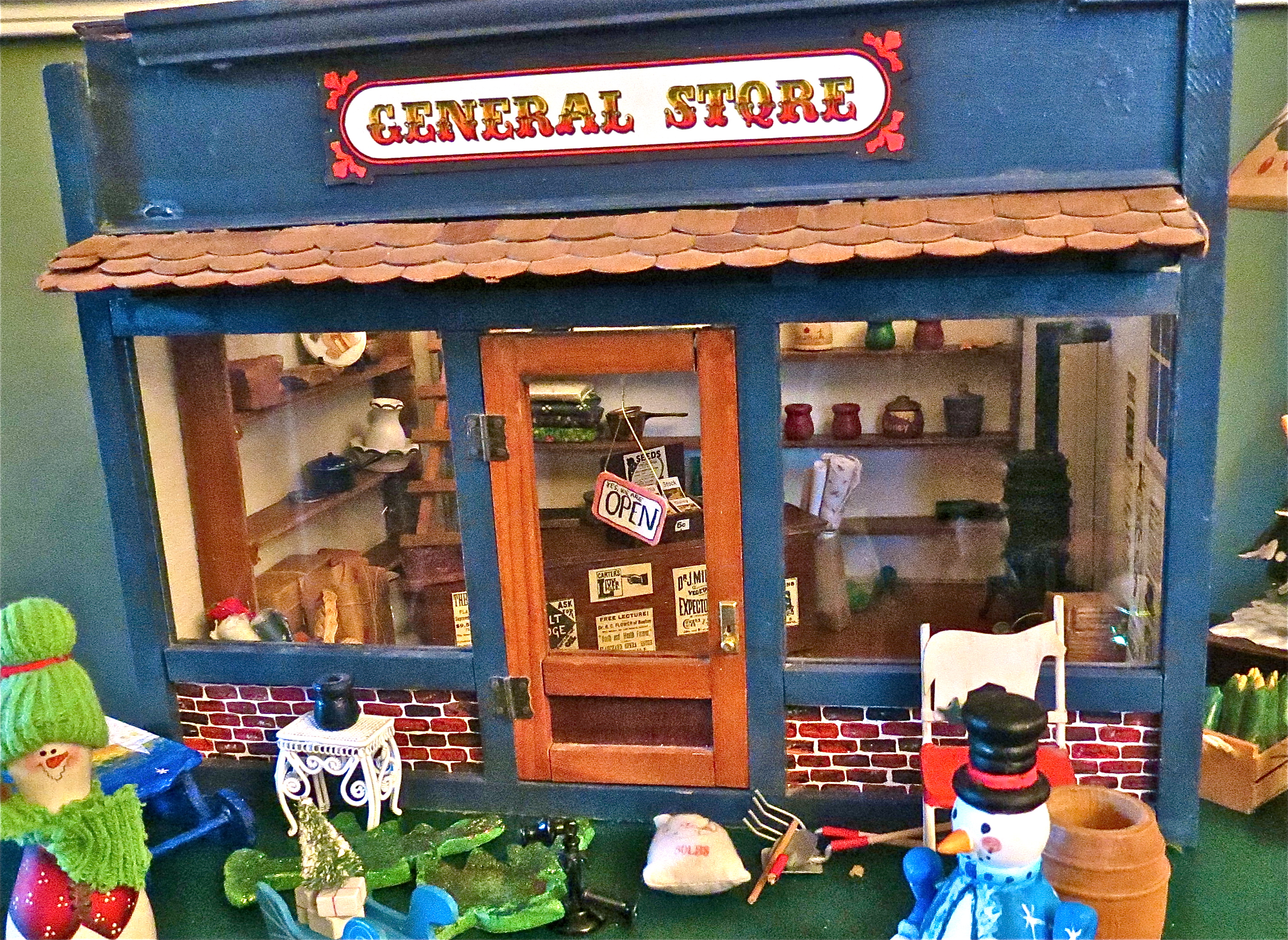
My attempt at a replica.

The old-fashioned general store has always been intriguing to me. As a child, one of my favorite shopping places was a building called “the Casino,” a large round wooden structure in Cape May, New Jersey. Every summer I looked forward to traveling to Cape May to just walk through the isles of the Casino to glance at the imports lining the shelves from around the world. I especially liked the little colorful cloth dolls holding baskets and brooms. The store offered a wide selection of  souvenirs, including metal buckets and shovels for playing in the sand.

Store Door

W.H. Snowden General Merchandise – Currituck, North Carolina
1895

Today a few general stores remain in operation. The aesthetic appeal begins right at the front door with a lightweight screen door, allowing fresh air into the space. Frequently merchandise spills out from the building, decorated with moldings even if the paint is peeling. Creaky wood floors and long wooden counters represent typical interiors. Wooden shelves and bins built into the walls extend from the floor to ceiling.

While general stores hold an abundance of merchandise, I don’t believe this is about conspicuous consumption, as an overwhelming number of goods are essential to the home and farm with elements of industry and efficiency . . . potato peelers, bolts of cloth, coffee grinders, iron skillets and lanterns.

Stove

Mitchell Hardware, New Burn, North Carolina

In the 19th and early 20th centuries general stores were central to small town communities. Selling everything from groceries, hardware items, shoes, pots and pans and other necessities, the store often anchored other small businesses that would line the town’s main street. That town center provided a community-oriented amenities such as sidewalks, parks and theaters. Within a short walk, shoppers could stop in at the library, bank and post office. Upon entering the store, the proprietor, sporting a long white apron, would stand behind a wooden counter and would greet you. Storekeepers had to keep informed on the pulse of the community so that they could order the right materials. Neighbors would meet up at the store and share news as they shopped. Many stores keep a pot belly stove going, and customers played bottle cap checkers near the warmth of the stove.

The Peck Basket General Store
Moyock, North Carolina

The store owner maximized the floor utilizing boxes and barrels to support merchandise. Generally, the proprietor purchased in bulk quantities. Then he would weigh the purchases on a large scale. Few items were pre-packaged, but canned goods occupied much of the grocery shelf space. Speciality items could be ordered, such as furniture, farm equipment and sewing machines. Deliveries arrived by horse-drawn wagon and later by train.

IMG_0963

Bins for nails; no pre-packaging
Mitchell Hardware, New Burn, North Carolina

Something from my childhood must have endeared me to the general store that still resonates with me today. Viewing little pieces of this former way of life, is tantalizing enough to make me wonder about what has been lost.

Post Ofice

Often times General Stores housed the Post Office.

Do the consequences of losing the small-town general store move beyond aesthetics?

Seeds

How do our shopping experiences around malls, big-box and strip stores compare with the country store of yore?  Today massive shiny lettering in bold colors shouts the store’s name. These industrial style buildings sit at the back of expansive concrete parking lots without hardly a tree or blade of grass in sight. Bland building facades are identical to every other strip mall. Steel doors, cavernous spaces, utilitarian shelving and harsh lighting all contribute to the lack of aesthetic appeal and warmth. With their stark interiors, they are but warehouses for merchandise.

Big-box retailers have reaped economic benefits from their bland design that demands little in aesthetic investment, and consumers may have found these businesses offer the best prices. But what have we lost in the conversion to bear-bones consumerism?  Some claim that these retailers boost city revenues, but have we sacrified small businesses at the altar of increased tax revenue and cheaper prices? Small business owners, often members of the community, support local enterprises and charities. Huge corporations have no loyalty to any one town or city.  Some research shows that it doesn’t always play out that this increased tax revenue brings in development.

How does the big-box store influence our social relationships? Do you run into your neighbors at the box store? Is there a place to stop and converse with friends? Does anyone smile at you?  Wal-Mart has even phased out the paid greeter, not that a paid employee saying “hi” necessarily made any difference. According to an article in Jezebel,

Because big box store are so anonymous and huge, there’s a sense that no one is watching. Social bonds are strongest when people feel like they’re being closely watched, so if the opposite is true, it might make people feel like they could do whatever they like without consequence.

As weird as this might sound, these big-box stores coincide with hate groups, according to a study conduced by faculty at Penn State and other universities. The number of Wal-Mart stores in an area correlated with the number of hate groups in that same area and more statistically significant than other factors, such as unemployment and crime.

What runs side by side of hate group? Gun sales. Approximately a third of all Wal-Mart store sell fire arms, including the “modern sporting rifles” or the type of semiautomatic rifle used in the killing of 26 adults and children at Sandy Hook Elementary School. Wal-Mart is the largest seller of firearms in the US. The Christian Science Monitor features an excellent article on the subject.

My original intention of writing this blog post was to describe the pleasing aesthetics of the old-fashioned country store. Analyzing the larger picture of what the demise of country store has meant for America reveals how their absence uncovers much more than just a change in aesthetics.

Checkers anyone?

DSC03540 - Version 2

Greek Antifascists bring their Message to Philadelphians

Was only 70 Years Ago . . .

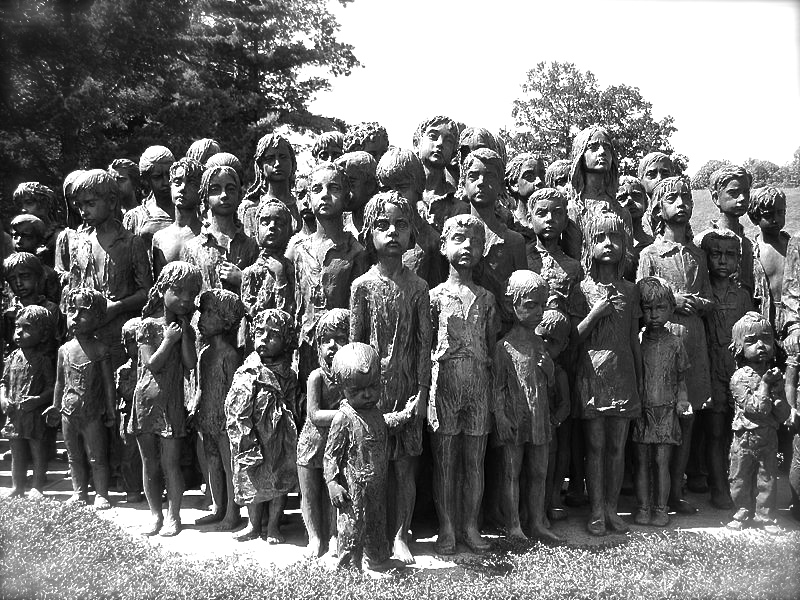
Memorial_lidice_children_(2007)-commons

Wiki Commons

My son, John, and his housemate, Jim, hosted two Antifascist activists from Greece, who were giving a presentation at the Lava Space in Philadelphia on Monday, March 11. John and Jim attend many activist events, and they always invite me to come. I decided to attend this event mostly because of an email I received just a few days ago from a member of my photography class who traveled to the Czech Republic on a family heritage trip. In that email he wrote that he had visited the town of Vrbove and walked the along the streets that were so familiar to his grandmother. He also made a pilgrimage to the town on Lidice, on the outskirts of Prague, to view the memorial there. I hadn’t heard of this town or the Lidice Memorial site so I checked out the details on the web. In 1942 the Nazis marched into Lidice and killed every male over the age of twelve and deported the women and children to the camps. They burned and leveled the village. The Nazis brought on further horrors which I cannot even bear to write about. The Nazis carried out this atrocity as revenge for the assassination of General Heydrich by unknown assailants. This chance intersection with the Lidice Memorial underscored the heroic efforts of the Greek Antifascists.

The Dysfunction of  Scapegoating

When elements of fascism raise the specter of blatant racism, blaming targets of their hate for the economic failures while undermining democracy through brute force and suppression, citizens must take note. The Antifascists remind us that we must be aware of fascist propaganda, which scapegoats on immigrants and multiculturalism, taking advantage of economic crises to fuel the fires of discontent in times of austerity. Without vigilance to these seeds of discontent, the horrors of Lidice could revisit the human race again.

Greece: A Case Study of an Economic Meltdown

Austerity measures in Greece, with the goal of  paying off astronomical debt, have created nationwide protests. Greece is suffering with unemployment at 27%. The Golden Dawn, described by both the media and scholars as fascist and neo-Nazi, won 7% of the seats in parliament and colluded with police to initiate violence against progressive activists and immigrants.

According to a 2012 article in The Guardian,

Golden Dawn is opening branches in towns all over Greece and regularly coming third in national opinion polls. Its black-shirted vigilantes have been beating up immigrants for more than three years, unmolested by the police; lately they’ve taken to attacking Greeks they suspect of being gay or on the left. MPs participate proudly in the violence.

IMG_2336

Introductions by Chris

The Greek Antifascist City Tour 2013

Philadelphia was one stop on their scheduled visits to over 25 cities in the US to increase awareness and to raise funds for legal help. Greek activists, Thanasis Xirotsopanos and Vangelis Nanos, spoke to folks at the Lava Space about fascism and resistance in their country. Sofia Papagiannak gave her presentation via the computer as she had to return to Greece. Video footage provided documentation of the Antifascist resistance to the Golden Dawn.

IMG_2339

Models of protest activism  ~ Thanasis and Vangelis ~ against the most heinous of political movements

Tag Cloud