Top Ten Snow Scenes
By Photographers, J. R. Blackwell, Jean Kerr Strosahl and Yours Truly
From our collection of trading cards 1964

Awe-struck best describes my reaction on seeing the Beatles for the first time on “The Jack Parr Show” during a wintry evening in January 1964. Parr had intended the short video as a humorous anecdote about a British rock band and their astonishing popularity. The clip from that show exists here on YouTube. The music instantly set the standard for originality, fresh and energetic with a rhythmic pulse. Their expressive singing conveyed true sentiment. I suppose some critics might argue that the song in that clip, “She Loves You,” is cliché, but a close examination reveals otherwise. The lyrics, written in the third person, resemble a conversation about love. These young men from Liverpool defended love and sang about fairness, and that was very romantic. They offer wisdom and reconciliation, “Pride can hurt you too. Apologize to her.” Their performance package was perfect. Growing up in the era of crew cuts, the lads’ longer hair had instant appeal–a break from the uniform haircut that almost all males had at the time. Criticized and mocked by the Establishment, the Beatles‘ hair cut was considered as radical as was their “yeah, yeah, yeah.” To us, they just looked fabulous; and we admired this rebellious response to the status quo.
The Beatles transformed two teenagers from the suburbs in style as well as in mind. Before the Beatles:

and after:

I immediately connected with British culture and their representation of working class youth: Liverpudlian accents, collarless fitted suits and urban lifestyle. The Cavran Club tucked in a cobbled ally of Liverpool, provided that gritty, smokey backdrop that served as their performance home and became my imagined refuge from the suburban pabulum that surrounded us. Their place in the world was so foreign from my life. They lived on the edge of the wharfs and warehouses and played music in ally way cellars, while I remained safely planted in the middle of a suburban protective cocoon. I studied the geography of their city, intrigued by the River Mercy, the docks and ferries. The Beatles, humorous and irreverent, seemed fearless. They would find themselves in trouble because of their candid and unaffected remarks; but for their fans, they became that much more endearing. We admired their forthright approach to life. Aware of their way in the world, more than anything I wanted to be part of that scene.
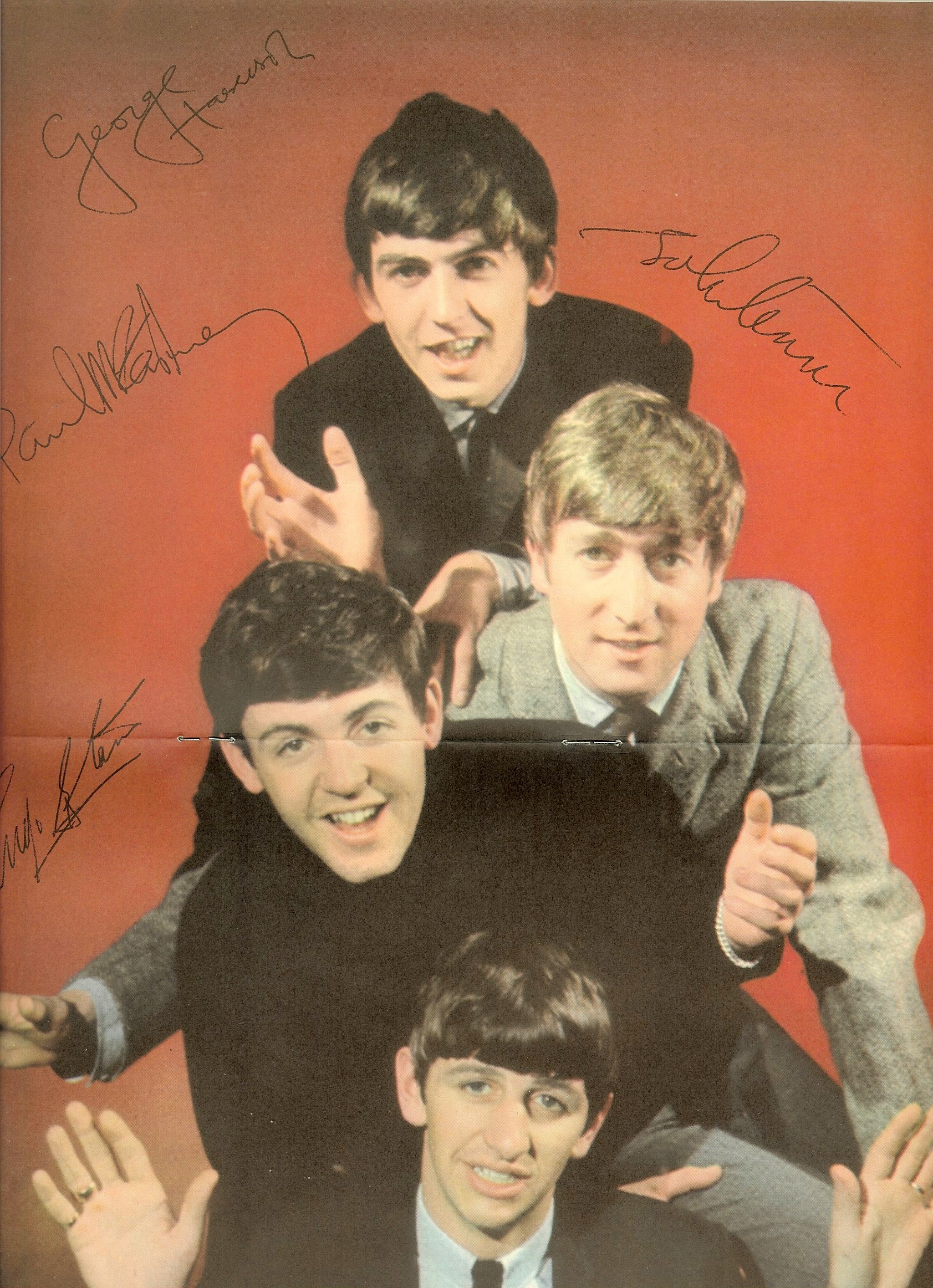
So we bought their albums, in addition to fan magazines, posters, trading cards, which offered a way of transporting ourselves into a time and place we could only experience vicariously.
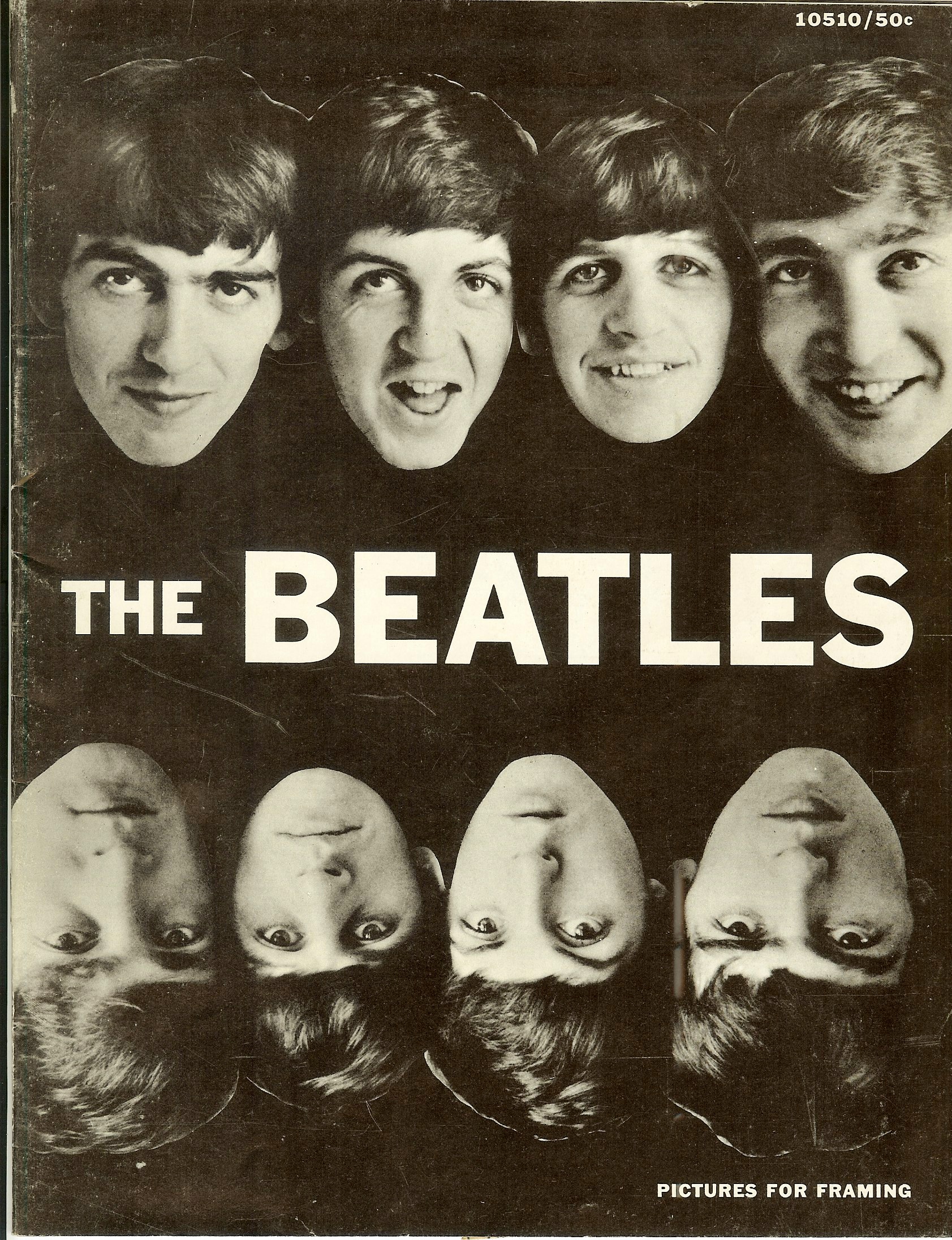

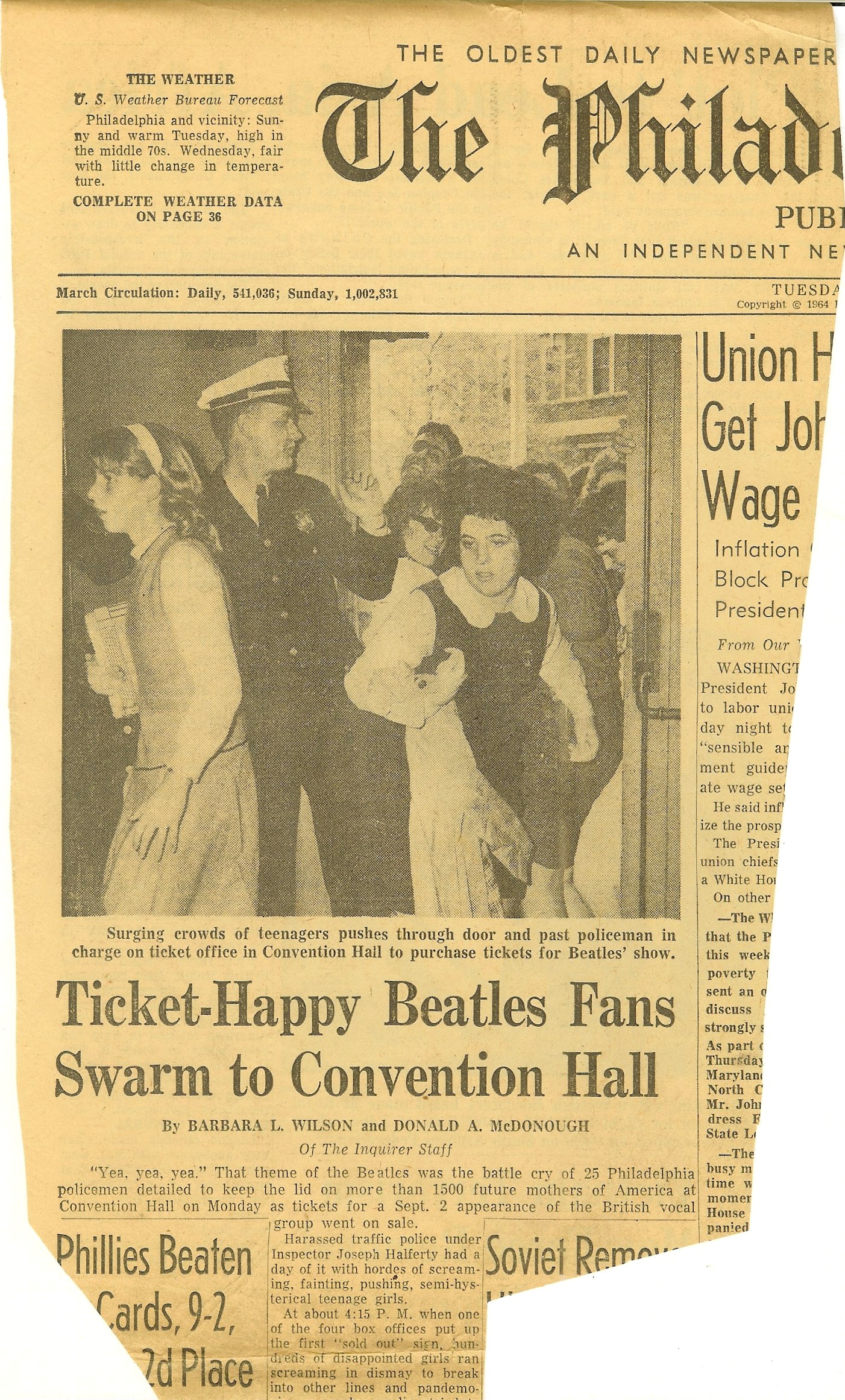
When the Beatles announced they would be performing in Philadelphia, we left school early and raced down to the Convention Center to buy tickets to their concert. We waited in line for hours, pushed and shoved as fans surged toward the doors. The police regulated the flow, but the crowds outside pushed against us as we waited our turn to pass through to the ticket booth. I finally squeezed through an opening, and just as I fell out of the crowd, a newspaper photographer snapped a picture, which turned up on the front page of the Philadelphia Bulletin the next day! I’m the one to the left looking somewhat dazed after being crunched by the surging crowds. About 12,000 tickets were sold that afternoon in just 85 minutes.
We were thrilled to attend the concert, and although we had seats in the back of the Convention Center, it didn’t matter because once the Beatles appeared on the stage, fans surged forward streaming down the aisles and through the chairs. The wooden folding chairs provided standing platforms, some girls standing on the back rim of the seat. We never heard a note of the singing–the screaming was so loud. Cameras flashed steadily during the entire concert. None of that mattered; we were with the Beatles.
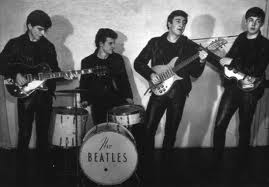
Peter Best, the drummer who preceded Ringo and played with the Beatles for two years, appeared on “I’ve Got a Secret,” a popular game show of the 1960s hosted by Garry Moore, on March 30, 1964. (YouTube clip here.) I was very much impressed with Peter as he had his own band but felt sorry that he had missed the opportunity to stay with the Beatles. I decided to write him a letter and began researching ways in which I might make contact. I phoned the “I’ve Got a Secret” show, and they suggested sending the letter to The Peter Best Four in care of Decca Records.
Two months went by when one day I was surprised to find my mother standing outside of my algebra classroom. I couldn’t imagine what had brought her there until she handed me the letter from the United Kingdom. Pete Best had written me back!

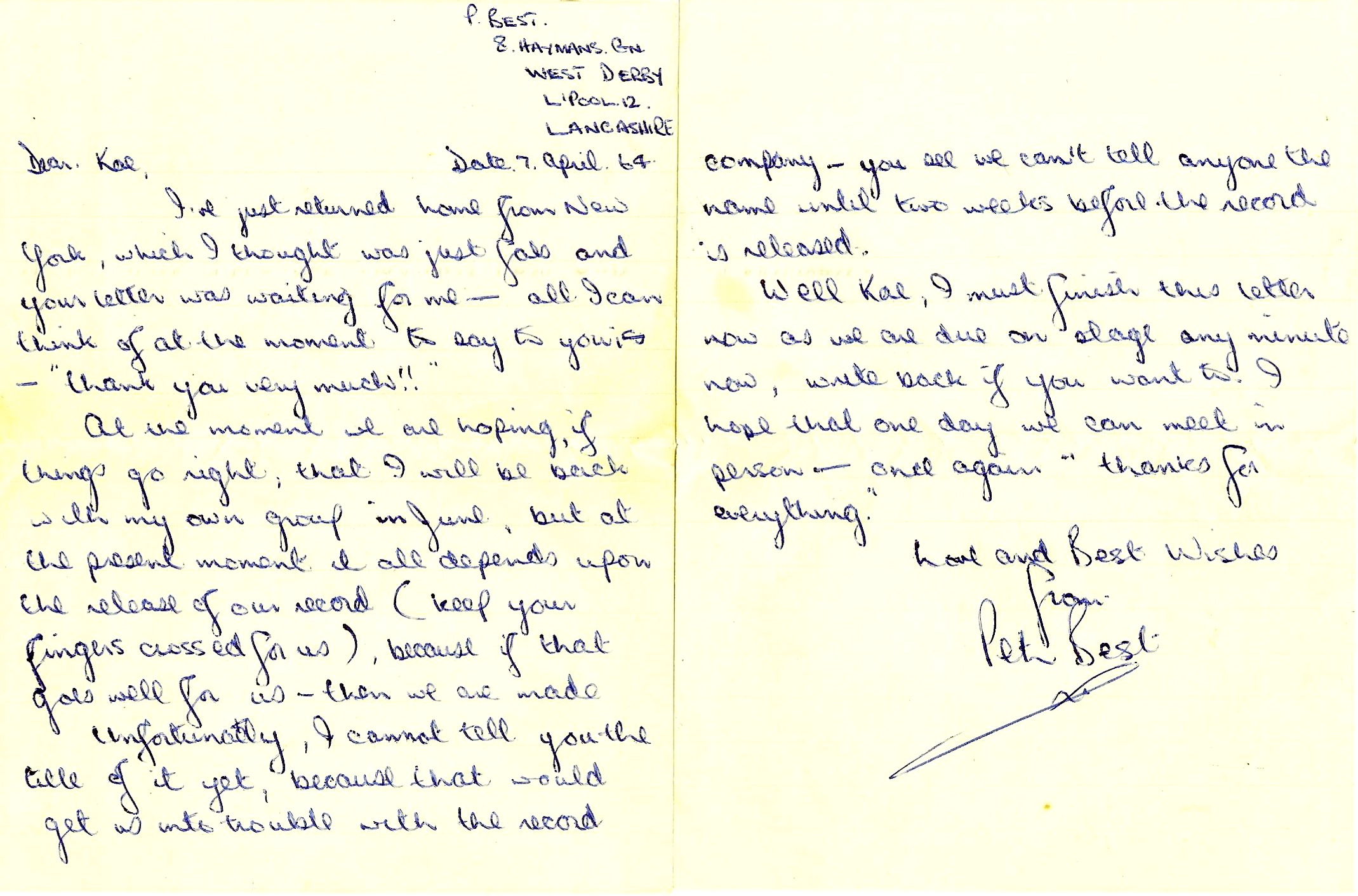
Our culture never had much respect for teenage girls for many reasons. We were “little women,” and society didn’t even respect mature women. In the early sixties, careers and opportunities for women were still limited to a few fields. My mother assigned my sister and me our occupations: teacher and nurse. Of course, screaming at rock stars didn’t help the status of teenagers in the eyes of the Establishment, but I now have an understanding of that enthusiasm that bubbled over: teenager girls were heralding what turned out to be one of the most influential bands in this history of music. The Beatles‘ music remains a powerful contribution to the musical canon, having sold over one billion albums throughout the world.
The Beatles profoundly influenced the culture, everything from movies and fashion to the introduction of eastern philosophy to the West. Some have speculated that pop culture changed the way Russian youth perceived the West, dissipating the propaganda of English/Americans as being the enemy. Individually, the Beatles contributed to progressive causes: George’s Concert of Bangladesh, John and Yoko’s peace campaign, Paul and Linda’s advocacy for animal rights.
Prophetic young women, teenage fans from those early years recognized that the Beatles brought hope, change and happiness through music, which is understandable and reasonable. Our unified voices, unfettered from society’s control, expressed an outpouring of jubilation and appreciation. Sophisticated behavior in the eyes of the patriarchal society, probably not, but heartfelt, truthful and joyful, most certainly. With a love like that you know you should be glad.

From Wikipedia
For those unfamiliar, steampunk combines elements of science fiction and fantasy overlaying elements of the Victorian era and industrialization, especially the influence of steam power. Steampunk literature features futuristic innovations as Victorians may have envisioned them. Fictional machinery that H. G. Wells or Jules Verne invented for their novels are models for steampunk. The steampunk genre presents a romantic idealization of the 19th century and an escape from modern realities. Steampunk culture values a more formal approach to manners and dress. So how does the punk fit into this retro-genteel world? Punk loosely references the cyberpunk style with anti-establishment sentiments. Various sub-cultures of punk have evolved since the late 1960s, but it seems the common thread of non-conformity weaves through most of followers’ ideology.
Steampunk fashion models after the imagery created in the genre’s literature. Victorian attire provides the basic starting place, and the clothing can mimic outfits of an explorer, officer, scientist, gazetteer or just something any one of Dickens’ characters might have worn. Suits and vests and military coats are favorite apparel items associated with the steampunk culture.

Steampunk enthusiasts modeling outfits
Especially note the gentleman’s hat, for this is where Victorian meets the technology. The hat, which is electrified, tells time! One of the most delightful aspects of steampunk is that wearer and the viewer both experience enjoyment over the inventions. Steampunk fashion undergoes constant change as fans naturally incorporate diversity in style, making each outfit unique.
Below are several examples of steampunk elements in wedding attire.


Jewelry mimics mechanization, and pieces feature chains, clocks, gears, keys or propellers. Sometimes, semi-precious stones are set in the piece. Steampunk jewelry has a salvaged look avoiding bright metals or colors. Copper, bronze, silver or brass better reflect an antique appearance.

Steampunk culture encourages everyone to find their own interpretation and invention. This philosophy holds for creating all sorts of inventions as accessories or props, which may or may not actually work. This is one aspects of steampunk where I find comfort:
Anyone who enjoys going against the authority and standards of society is going to enjoy the clothing that this type of society loves. There are no rules or guidelines whatsoever. http://www.buysteampunk.com/
Claiming to be the greatest steampunk festival in the world, Yesterday’s Tomorrows: Steampunk World’s Fair was held in Somerset, New Jersey, in May 2011. A lovely assortment of costumed people filled the rooms, and stores displayed everything from electrified gadgets to elegant jewelry. CBS News did a short piece on the Fair, and about 20 seconds into the video a report interviews a certain young woman above about her “supportive” apparel.


Before I ever hear the word steampunk, back in 1987 a new television series appeared on the scene that had all the elements of steampunk, Beauty and the Beast, starring Ron Perlman and Linda Hamilton. The clothing, setting and the intersection of fantasy with reality all connect the program to the steampunk genre. In this telling of the tale, New York City sets the stage for the drama with Catherine, the beauty, residing “where the wealthy and powerful rule” and the Beast living below the subways in a tunnel community.
 Many elements of the program offer evidence of the link to steampunk. The Beast’s clothing could best be described as Victorian–he did wear a cape, after all. Sometimes his outfits included a large metal or leather belt, a break from the straight Victorian look. His home in the tunnel world consisted of arched chambers of cinder blocks and cement, and pipes lined the walls. These stark industrial scenes contrasted with his room, lite by Tiffany-style lights and candles with books piled high, and where a huge semi-circular stained glass window served as a backdrop. Bronzed statues, old-world globes, and even a huge time piece contributed to the room’s ambiance. As Catherine leaves the tunnels the first time she experiences this new world, Vincent takes her hand as she jumps over a crevice filled with steam rising from below. In the first episode, “Once Upon a Time in New York City,” Vincent reads to Catherine from Charles Dickens’ Great Expectations, a popular 18th century novel.

And just like a theme in a Dickens’ story, Beauty and the Beast juxtaposes two social classes, as Vincent explains,
We’re below the city, below the subways. There is a whole world of tunnels and chambers that most people don’t even know exists. There are no maps to where we are. It’s a forgotten place. But it’s warm and it’s safe, and we have all the room we need. So we live here and we try to live as well as we can, and we try to take care of each other.
Vincent cares for Catherine, who is left for dead after thugs attack her. After her stay in the tunnels, Catherine transforms from a wealthy socialite and corporate lawyer to a position of assistant district attorney where she believes she can help people.
Steampunk as a genre is fantasy that has an effect on reality through fashion and culture. In the same way the fans of Beauty and the Beast transformed fantasy into reality. Although the program lasted for only a few seasons, the devoted fan following grew and remains the legacy of the program today. One of the projects the fans undertook was to sponsor a bench in Central Park near what was supposedly was one of the entrances that Vincent used to the tunnel world. I have a certificate from the Central Park Commission thanking me for my contribution. I made a pilgrimage there to find the bench. The inscription reads:
“Even the greatest darkness is nothing,
so long as we share the light.”
Beauty and the Beast (TV) 1987-1990
Dedicated by its devoted fans.
 Every year the fan community holds a cyber “Winterfest” that can be found here. Fans have created web sites, art, literature and hundreds of videos on YouTube.
The creators of the show must have had some sense of the magic that could be created by a time-space warp: folks living in another era right beneath the feet the power mongels. The audience enjoys the prolonged romantic courtship of Catherine and Vincent that allows the heroine to pursue her own goals and ambitions without the constraint of a social relationship and its complications in the modern world. Vincent guides both Catherine and the viewer through a labyrinthine of chambers and tunnels, away from the impersonal and greedy world to a community that offers companionship, warmth, and comfort in the form of a subterranean sanctuary with a bit of Victorian flare.


So whether it be finding an accessory from the Victorian age or watching favorite episodes of B&B, I’ve enjoyed the trip as a passenger on that steampunk train.

How Social Services Provide the Mechanism to Help our Fellow Citizens


 Psalmboxkey's Blog
Written
on 12/01/2011