Humble Contributions to the Peoples' History

Archive for November, 2011

Giving thanks on Thanksgiving? No thanks!

With one statement, I’ve probably offended almost everyone about this most sacred cow of American holidays but I’m going to put it on the table  nonetheless. I am contemplating the implications of the concept of thankfulness and what it means to me. For a moment, I’m suspending the idea about being grateful to a “higher power,” as often thankfulness extends upward. For now I’m focusing on generic thankfulness in non-religious way.

Recently someone explained to me that when living under a monarchy, citizens are supposed to feel infinitely grateful for all that the king has bestowed upon them, which reminded me of the song from the King and I where Anna considers confronting the king about the continual ingratiating behavior of his subjects:

Everybody has to grovel to the King.
All that bowing and kowtowing  . . .
To remind you of your royalty

Recently a student posted a reply to an article in a college news forum about the first general assembly held at their college, modeled after how the Occupy groups use general assembly as method of bringing greater voice to all participants. She remarked that complainers and discontents filled the assembly. She argued that students should realize how lucky they were and how grateful they should be for the privilege of attending their college.

When I was working on the living wage campaign at Swarthmore College, a comment we frequently heard was that employees should be grateful that they had jobs, let alone a job with a living wage.

The common thread through these instances has me pondering the question: is it wise to extend thankfulness to any person or institution?

The problem with being grateful is that it serves as a convenient excuse to keep the status quo. We get uncomfortable when change is threatened. Being thankful soothes and placates the mind to consider or act on greater possibilities. A mindset that allows us to accept our “losses” also cajoles us by thinking that surely someone out there is worse off than ourselves. If I say,  “I am so thankful for the food on this table,” the implication is . . .  compared with what? . . . little children in Darfur? So by the fates that have fallen on us, we are fed while others go hungry and so we are thankful that WE have food?

We could use a new tradition to replace thankfulness, as the danger lurks right beneath all that heartfelt sentiment that this is the best we can do now. Rather, we might consider giving each other encouragement in our endeavors. If Dad cooks a great Thanksgiving meal, mention specifically what you enjoyed or ask about the ingredients. When Mom receives help with the dishes, she doesn’t have to reply with “thank you.” She can just acknowledge how nice it is to have help or company in the kitchen.

We neither have to grovel for favors granted nor expect thanks but rather acknowledge that we can share moments of equality that we all contribute to each other’s well-being. Happiness, optimism and compassion replaces gratefulness. Love what you do rather than expecting praise and thanks, which act as false rewards. Acknowledge what we have done to make the world a better place and renew our commitments and responsibilities. On a day that we come together and share our food with family and friends we can enjoy Thanksgiving more fully because we’re not beholding to the customary and clichéd expressions of gratitude.

And if this philosophy works for you, no need to send me a thank you note.

Holiday Giving: Charity for US Children?

It’s Down to Having a Pencil and Pad of Paper

Yesterday the mail brought the usual Christmas catalogues, including one from World Vision Gift Catalog. The catalog reads that “85% of every gift goes to program helping children and families overcome poverty in nearly 100 countries.” Throughout the pages, smiling and sometimes sad faces of third-world children tug at prospective donor heartstrings. This organization specialized in donations of chickens, ducks, rabbits and other animals in addition mosquito netting and medicines.

One page in particular was disturbing:

Urgently needed

clothing, and more for 

kids in America

and

school supplies 

for U.S. classrooms

It’s not that I didn’t know this was the case, it was the context of being included with children in under-priviledged nations. The United States’ GDP is the largest in the world, signficantly larger than China, Japan, India and Germany, at at figure of

$14,720,000,000,000 

and we can’t support our children with school supplies and clothes?

Where is all that wealth going and why do our children have to depend on charity? The problem lies in wealth inequality.

In 2007 the richest 1% of the American population owned 34.6% of the country’s total wealth, and the next 19% owned 50.5%. Thus, the top 20% of Americans owned 85% of the country’s wealth and the bottom 80% of the population owned 15%.    Wikipedia

The richest Americans control most of the wealth and add on top of that their financial privilege of supporting candidates that further their own interests rather than the common good where every citizen benefits.  How can our $35 contribution to a political candidate match the thousands that someone with wealth can give to the candidate of their choice?

As long as the current distribution system and campaign financing remain as policy, looks as if we will have to rely on charity, pleading for money for even basic school supplies for America’s children. I guess that’s the great equalizer with developing nations, we can all grovel now.

Sunday Afternoon at Occupy Philly

November 13, 2011

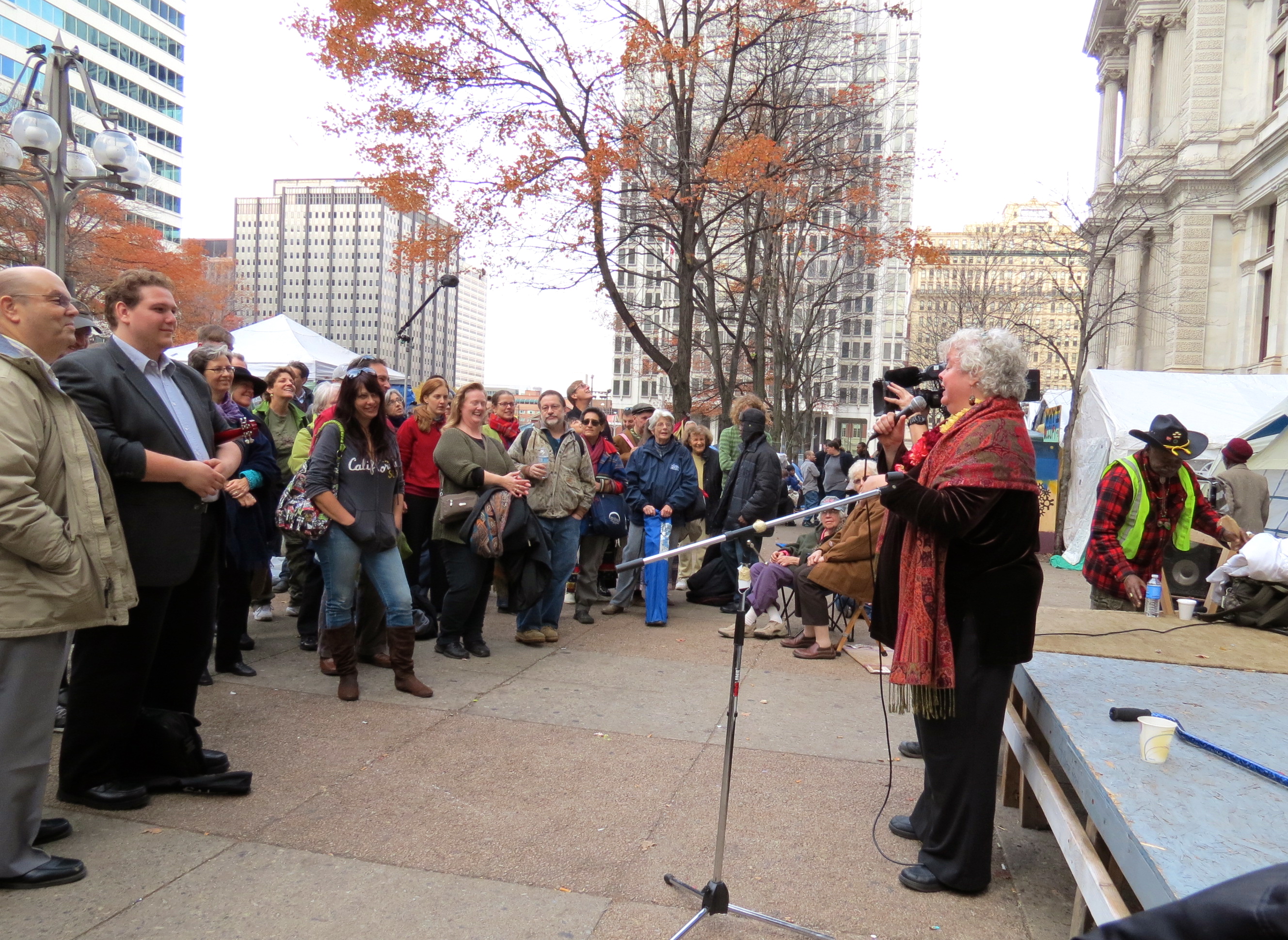
On a pleasant fall afternoon, Nada Alwali, journalist, writer and researcher from Bahrain, and Holly Phares, Choir Director at Tabernacle United, participated in the afternoon program at Occupy Philly.

Nada Alwadi ~ Inspiring Words to the Activists

Musical Interlude led by Holly Phares

Support Occupy Philly!

Women and the Arab Awakening

Discussion and Presentations at International House Philadelphia

Carole Parker Introduces Program

Sami Krait, International House Resident

On November 11, 2011, The International House of Philadelphia, a residential community for international students and sponsor of multicultural programs, featured two guest lecturers who spoke on “Women and the Arab Spring.” In the Spring of 2011 the international community was spellbound by the courageous actions of the people of the Middle East and their determination to bring democratic reforms to their nations. On a personal note, I was so inspired that I made a video as a tribute to all people through human history who have fought for their freedom against oppression. Video is here under FREEDOM.

Sahar Khamis

In her presentation Sahar Khamis, professor of Communications at the University of Maryland, spoke about how the “Arab Spring” was actually an “Arab Awakening” and how women played a significant role in the Egyptian protests. While acknowledging the important role of social media as a tool that allowed the democracy movements to proceed more quickly, the success of the protests could be attributed to prior organization and to the people willing to come together to demonstrate in solidarity for democratic reforms.

Nada Alwadi

Nada Alwadi, independent journalist, writer and researcher, spoke on “Women in Bahrain.” Nada introduced the heroines of the Bahraini protests. Citizens of their country who were just doing their jobs were imprisoned and tortured.  The Bahraini authorities targeted two unionists, Jaleela Al Salman, Vice President of the Bahrain Society of Teachers and Rula AlSafar, President of the Bahrain Nursing Society, both of whom spent months in jail and are scheduled to go to trial. Authorities also arrested Ayat al_Qurmezi for reciting her poem about injustices in Bahrain at one of the protests. Nahad al-Shirawi treated injured protestors. A photograph in a hospital room showed Nahad grieving over the loss of a patient. She was later arrested for “grief without a permit.”

This site has more information about women’s role in the uprisings, which continue until this day.

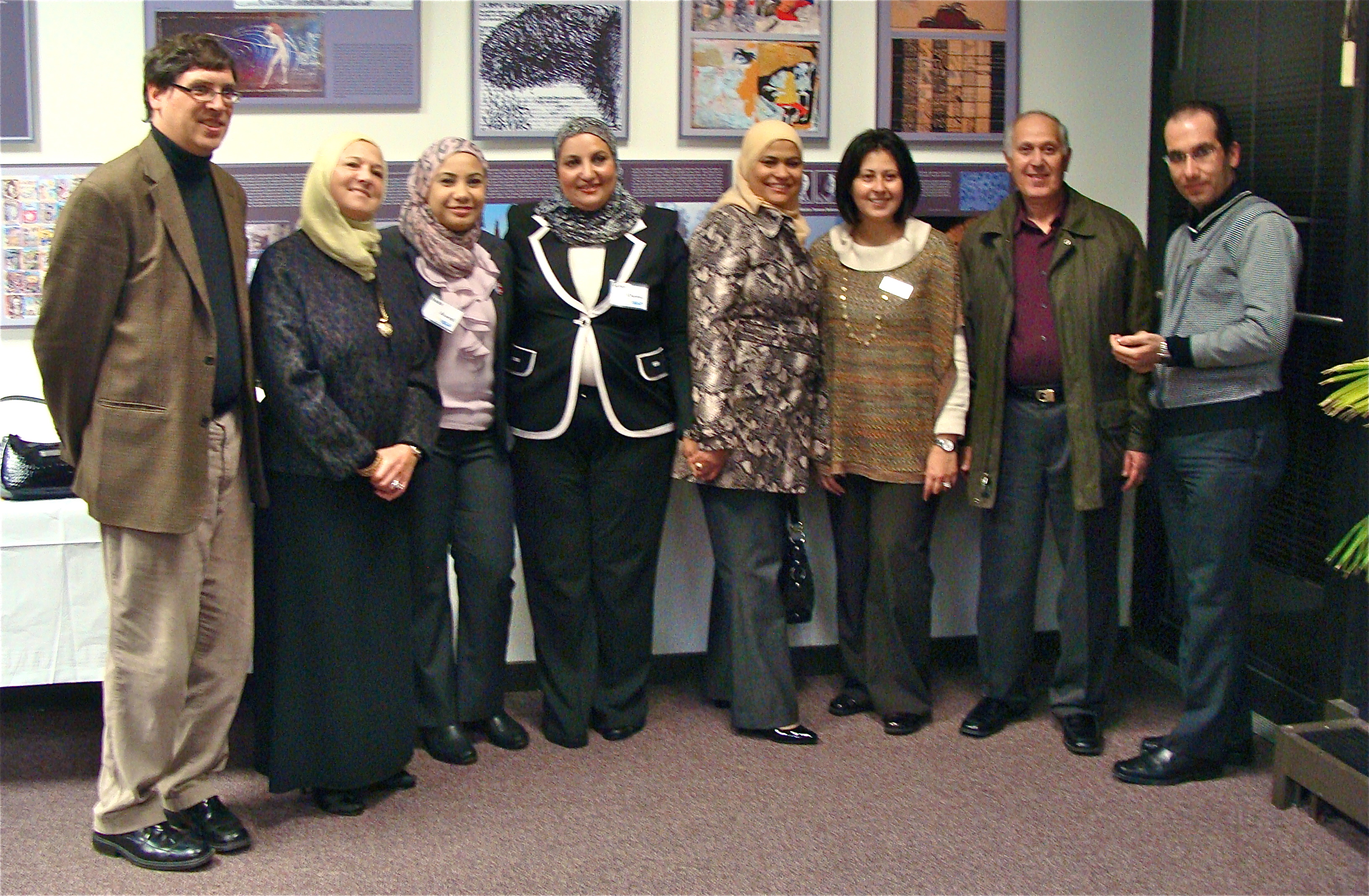
L-R Marwan Kreidy, Mrs. Baraka, Nada Alwadi, Sahar Khamis,/ /,Sally Baraka, Nabil Baraka, Sami Krait

Working for Democracy in Bahrain: John’s Interview with Journalist, Nada Alwadi

Nada Alwadi

Photo: J. R. Blackwell

John’s Thesis on Bahrain

Severals month ago my son, John, selected a topic for his master’s thesis, “Bahrain, Migrant Workers and the Popular Revolt for Democracy.”  As a world history major, John choose Bahrain, an island monarchy in the Persian Gulf, because of the intersection of  global and labor issues against the backdrop of an ongoing revolt on repression of democracy. So I couldn’t believe his good luck when Swarthmore College anounced that Nada Alwadi, Bahrainian journalist and founder of the Bahrain Press Association, was scheduled as a speaker on November 8. Nada Alwadi had been a reporter for Alwasat, the most popular newspaper in Bahrain. After contacting the Peace and Conflict Studies Department at Swarthmore, they told me there was an opening in her schedule for noon time. We made the arrangements to have Nada come to our home for lunch and an interview.

Recent History and Controversies in Bahrain

In the Spring of 2011 Nada reported on the pro-democracy protests that shook that nation. A land bridge between Saudi Arabia and Bahrain allowed the king of Saudi Arabia to march his troops into Bahrain to quell the uprising and bolster support for the monarchy of Al-Khalifi. Since that time, activists, journalists, doctors and nurses have been arrested by the authorities. One further complication is the issue of migrant workers in Bahrain, which make up 75 percent of the population. Some of these “workers” are from Pakistan and other countries, and they fill positions in the army and police force. In essence Bahrain is hiring mercenaries to keep the revolting citizenry in check. Despite the oppression that protestors face, the people of Bahrain continue to fight for democratic reforms.

Nada’s Story

In April of 2011 the authorities detained Nada, and she was forced to sign a statement saying that she would not write on or engage in any political activities. Then they fired from her job. Nada is currently living in Washington, D.C. and is on a speaking tour explaining how the on-going protests in her country help to build democratic process in the Middle East.

Nada wore a button expressing solidarity with all of her fellow Bahrainians, “No, Shia, no Sunni. Just Bahraini!” dispelling the myth that these sectarian camps are pitted against each other.

Photo: J. R. Blackwell

What We Can Do To Help

Due to the publicity from human rights organizations and several U.S. Senators, the sale of $53 million in arms sales to Bahrain has been blocked temporarily.  The approval of the arms sales depends on a review of the findings of the Bahrain Independent Commission of Inquiry, which is supposed to make its decision by November 23, 2011. The objectivity of this organization, given that it was established by King Hamad bin Isa Al Khalifa by his royal decree, is in serious question.

For me personally, I object to selling weapons to any country.  Why can’t the US sell materials and goods that would help the infrastructure of that nation? Please email the President and Hillary Clinton and ask them to block this sale.

John Finishes his Thesis, December 2012

John’s submitted his thesis, How Statescraft employed by the al-Khalifa Monarchy Obstructs Democratic Reform in order to Maintain Regime Stability in Bahrain: A Historical Review, in December of 2012.

John’s thesis examines how the monarchial regime of the al-Khalifa dynasty of Bahrain has skillfully tailored the tools of statecraft, both in international diplomacy and domestic policy, for one primary objective: to restrain attempts for democratic reform in order to sustain the regime’s wealth and power. The al-Khalifa regime has shaped statecraft policies into a unique set in order to limit democratic initiatives. The monarchy blurs the lines between at democratization as contrasted with taking a few steps toward liberalization in order to address the nation’s continuing unrest. The regime exacerbates the Sunni-Shi`a divide by hiring Sunni foreigners to serve in the security forces and deliberately stokes sectarian conflict by blaming Iran for inciting the Shi`i population. The regime encourages the hiring of migrant workers, which benefits the monarchy’s wealth and fosters competition for jobs between groups of workers; at the same time, the regime denies migrants steps toward citizenship. Through its foreign relations polices, the monarchy prudently balances its relationships with the United States and Saudi Arabia for the primary purpose of maintaining power. Unique circumstances, as revealed by Bahrain’s history, have influenced the al-Khalifa’s governance of the nation. These factors include: US military base on Bahrain’s land, a Sunni minority ruling a Shi`i majority, a well-educated citizenry willing to protest for democratization and labor rights, dwindling oil resources, and a geopolitical position between two rival regional powers, Saudi Arabia and Iran.

Tag Cloud